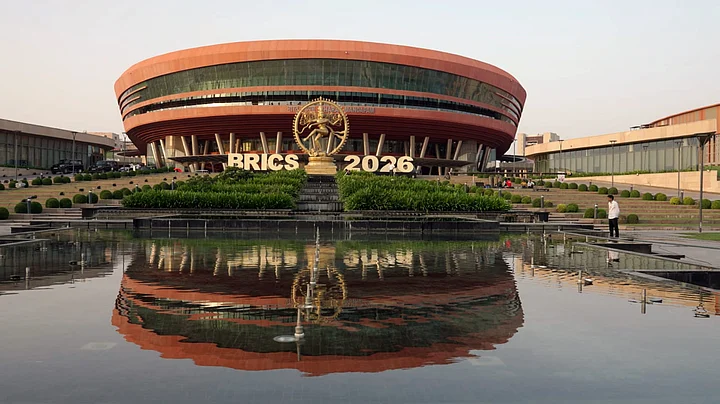
The BRICS Summit in New Delhi on September 12 and 13 represents an important moment in the continuing evolution of a more multipolar and representative international order. As leaders gather in India to discuss some of the most pressing challenges facing the world, attention naturally focuses not only on the immediate deliberations of the summit, but also on what BRICS can achieve in the years ahead.
The occasion is particularly significant for India and China. As two ancient civilizations, major developing economies, and influential voices of the Global South, the relationship between China and India exerts influence far beyond their bilateral boundaries.
BRICS offers both countries an important institutional platform through which dialogue can be sustained, common interests advanced, and differences managed with mutual respect.
BRICS in a Transforming World
The international environment in which BRICS operates today is dramatically different from the one in which the grouping first emerged.
Geopolitical uncertainty, technological transformation, climate change, disruptions to global supply chains, energy and food security concerns, and persisting inequalities between developed and developing economies are reshaping international priorities.
At the same time, countries across the Global South have been doing more and more to amplify their voices in global decision-making.
BRICS has an opportunity to respond to this transformation by serving as a constructive platform for dialogue, development, and reform. Its significance should not be measured solely by population, geography, or aggregate economic strength. Its long-term relevance will depend upon its ability to translate political engagement into practical cooperation that improves lives.
The New Development Bank represents one example of how BRICS cooperation can move from dialogue to institution-building and development financing. Going forward, a similar emphasis should be placed on sustainable development, digital transformation, healthcare, food and energy security, innovation, education, and climate action.
China and India within BRICS
Few bilateral relationships are as important for the future of Asia than that between China and India.
Together, the two countries represent more than a third of global population and wield enormous economic, technological, and intellectual capabilities. Both are heirs to ancient civilizations simultaneously becoming central actors in shaping the 21st century.
The relationship has naturally experienced periods of cooperation as well as challenges. Addressing differences requires patience, responsible diplomacy, and sustained communication.
But differences should not prevent the nations from recognizing areas in which cooperation remains both possible and desirable. BRICS provides an important setting for such engagement.
A stable and constructive China-India relationship does not require either side to compromise any interests. It requires recognition that differences need not eliminate cooperation and that differences can be addressed through dialogue while areas of convergence continue to develop.
Continued engagement between the leaders and institutions of both countries can help strengthen confidence and create an environment in which the relationship becomes increasingly stable and constructive.
Development as a Common Language
Perhaps the greatest area of convergence between China and India is development.
India has developed significant capabilities in digital public infrastructure, pharmaceuticals, information technology, entrepreneurship, and services, while China has extensive experience in manufacturing, infrastructure, renewable energy, industrial development, and technological innovation. Both countries have also made important advances in emerging fields such as artificial intelligence, digital transformation, and green development.
Enormous potential has emerged for exchanging experience and developing complementary approaches, particularly in areas that matter most to developing countries.
Climate action is one such field. As two of the world’s largest developing economies, China and India have already assumed indispensable roles in determining whether global sustainable development objectives can be achieved.
Healthcare, agricultural innovation, disaster resilience, artificial intelligence, clean energy, and digital inclusion provide additional areas where dialogue within BRICS can produce meaningful benefits.
BRICS should increasingly become a platform through which solutions developed in emerging economies can be shared with other countries of the Global South.
The Missing Link: Young People
As chairman of the Confederation of Young Leaders of India, I believe one dimension deserves substantially greater attention: youth and people-to-people engagement.
The long-term China-India relationship could not be sustained through governmental engagement alone. The two countries are home to hundreds of millions of young people, students, researchers, entrepreneurs, innovators, and emerging leaders, yet opportunities for meaningful interaction between young Indians and Chinese remain few and far between.
We need more university partnerships, student exchange activities, young leader dialogues, research collaborations, cultural programs, and entrepreneurial networks connecting young generations in both countries.
Young people should not inherit outdated perceptions of one another. They should be given opportunities to meet, debate, collaborate, and understand each other’s societies directly.
My own engagements with Chinese institutions and young people have only reinforced my opinion that there is considerable curiosity about India in China, just as there is considerable interest in understanding China among young Indians.
Institutionalizing such engagement within the broader BRICS framework could be particularly valuable. A stronger BRICS youth architecture can connect young leaders not only from China and India, but also from across its increasingly diverse membership.
Beyond New Delhi
Summits create political direction, but institutions, businesses, universities, social organizations, and citizens must transform that direction into lasting cooperation.
For China and India, this means continuing dialogue even when circumstances are difficult. It means expanding areas of practical cooperation while addressing differences responsibly. Above all, it means recognizing that neither geography nor history allows these two civilizations to remain indifferent to one another.
India’s timeless philosophy of Vasudhaiva Kutumbakam (the world is one family) offers a valuable principle for this moment, which finds a natural echo in China’s vision of a community with a shared future for humanity.
A multipolar world should not become more divided. BRICS should not define its success based on opposition to any country or grouping. Its greater contribution can be to advocate a global architecture that is more representative, inclusive, and responsive to the aspirations of developing societies.
China and India have assumed a special responsibility within that endeavor. The relationship between the two countries will inevitably encounter moments of complexity. Yet history should encourage leaders to take a longer view. Civilizations measured in millennia should have the confidence to navigate differences measured in years.
As BRICS moves beyond the New Delhi summit, the challenge becomes larger than drafting declarations or expanding institutional mechanisms. It is about building cooperation habits and creating constituencies for peace, development, and dialogue.
If China and India can steadily expand mutual understanding while responsibly managing their differences, their cooperation can become a powerful force for stability and development—not only for Asia, but also for the Global South and the wider world.
This article was written by Himadrish Suwan, chairman of the Confederation of Young Leaders of India.
(The content is provided by Beijing-based China-India Dialogue.)