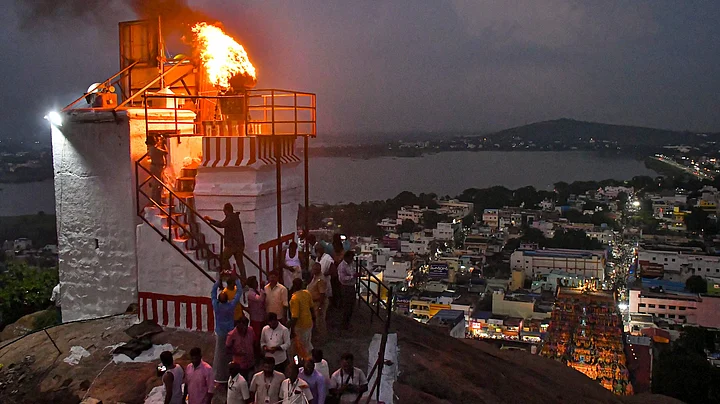
What should have been a serene week of Karthigai Deepam, a festival marked by lamps at one of Lord Murugan’s most sacred abodes in Tirupparankundram in Tamil Nadu's Madurai, instead plunged into a vortex of legal battles, police barricades, political attacks, and communal tension.
The Tirupparankundram hilltop, celebrated for centuries as a symbol of coexistence between the Subramaniya Swamy Temple and the Sikandar Badusha Dargah, became the epicentre of an unprecedented confrontation involving the Madras High Court, the Tamil Nadu government, security forces, and ideological groups vying for dominance.
From a single petition challenging the site of an age-old ritual, the dispute snowballed into a full-blown standoff that has left Madurai shaken and raised fundamental questions about religious rights, judicial authority and the fragility of communal harmony.
The Quint explains how the latest events reopened old wounds and created new ones.
Explained: How a Lamp-Lighting Court Order Lit a Political Fire in Tamil Nadu
1. The Beginning: Petition, Court Order, and Revival of Old Claim
For generations, the Murugan temple and the dargah have coexisted, with devotees moving in and out of their respective spaces without friction. In recent years, however, the Bharatiya Janata Party (BJP) and other Hindutva groups have portrayed the dargah’s presence as an encroachment on what they call a sacred Hindu space. Their rhetoric has turned the hilltop into a political talking point during elections, with claims that the temple’s rights were being “suppressed” and that the hill required “liberation.”
On the last week of November 2025, a group of four petitioners, including Rama Ravikumar, who's been identified by media as an activist associated with one of the Hindu organisations, filed a petition before the Madurai Bench of Madras High Court.
They challenged the lighting of this year's Karthigai Deepam at the usual Deepa Mandapam rather than at the traditional Deepathoon, a stone-lamp pillar on a peak of the hill.
The petitioners argued that Deepathoon was the "historically correct site" for the festival lamp, and accused the temple’s executive officer of unilaterally changing the ritual location.
On 1 December, a single judge bench of Justice GR Swaminathan accepted the petitioners’ argument. The court observed that the lamp-lighting was a longstanding tradition, and that the very purpose of Deepathoon was to light the lamp. In his order, Justice Swaminathan said,
“If traditions have been abandoned, the temple management has to restore them so long as constitutional morality is not breached. Lighting a lamp is a sacred act. It cannot offend anybody's sensibilities. I also fail to understand as to how the provisions of the Places of Worship Act are attracted to this case. By lighting the lamp at Deepathoon, which is meant for that purpose, the structure of the dargah is not in any way affected. The dargah is located at a safe distance of not less than 50 meters.”
The judge declared that the temple held title and possession over the unoccupied portions of the hill, and hence could not be prevented from lighting the lamp there. As a result, quashing the executive officer’s decision, the court directed that the temple authorities, in addition to the usual locations, should facilitate the ritual at Deepathoon this year.
The court also directed the police to grant necessary protection to ensure compliance. It further directed that the lamp-lighting at Deepathoon could be carried out under the protection of the CISF attached to the High Court bench.
Thus, on paper, the judicial route had revived a long-dormant tradition, underlining the historicity of Deepathoon and established the basis for a festival lighting in strict compliance with court order.
Expand2. The Aftermath: Official Inaction, Government Appeal, and Defiance
What followed was not compliance. It was crisis.
As 3 December, the date of lamp-lighting, approached, the temple’s authorities did not make any visible arrangements at Deepathoon. No announcement, no security measures, no logistical planning to allow devotees or the petitioners to ascend the hill. For hours even after midday, there was no sign of any preparation.
From the point of view of the petitioners and their supporters, the administration was dragging its feet, and thus, ignoring a clear court directive. This inaction triggered a contempt petition by Rama Ravikumar, filed the same day.
Meanwhile, tensions mounted among religious outfits and right-wing Hindu organisations, mobilising cadres for a potential ascent. Local political voices, including those aligned with the ruling parties, began to publicly oppose the use of Deepathoon, arguing that the hilltop was a sensitive site given its proximity to the dargah and shared worship history.
Within hours of the contempt petition, the Tamil Nadu government moved to challenge the High Court’s order, filing an appeal in the hope of staying the Deepathoon verdict. Observers described the move as “belated,” given that it came when the festival’s lighting was due. Meanwhile, the temple administration proceeded to conduct the lamp-lighting at the usual Deepa Mandapam, but not at Deepathoon.
This deviation from the court order was seen by many, including the court itself, as contemptuous. When the contempt petition was heard again on 3 December evening, Justice Swaminathan took a strong view.
“Since I have great regard and respect for the state police, even while permitting the writ petitioners, along with their associates numbering 10, to go up the hill and light the deepam at Deepathoon, I direct Thiru J Loganathan, IPS, Commissioner of Police, Madurai City as well as the police force under him to give the fullest protection and bundobust to effectuate the direction passed in favour of the writ petitioners. I make it clear that if this order is disobeyed, harsh consequences will ensue.”
Justice SwaminathanConsequently, Justice Swaminathan personally permitted Rama Ravikumar and up to 10 others to ascend the hill and light the lamp at Deepathoon.
The judge also observed that the appeal the temple had filed was “defective,” implying that it was perhaps a strategic manoeuvre to delay or avoid compliance. He wrote that passive inaction by the authorities would amount to contempt of the court’s order.
In effect, the High Court did not simply revive tradition it forced the state and the temple to choose between compliance and lawlessness.
Expand3. The Standoff: Protests, Police Blockade, Prohibitory Orders
As evening approached on 3 December, hundreds of supporters from at least four Hindu outfits, including Hindu Makkal Katchi, Hindu Tamilar Katchi, Hindu Munnani, and Hanuman Senai began to converge near the base of the hilltop. They demanded accessing Deepathoon so the lamp could be lit under court order.
In anticipation of possible violence, the district administration, led by District Collector KJ Praveen Kumar, imposed a prohibitory order under Section 163 of the Bharatiya Nagarik Suraksha Sanhita (BNSS) around the hill area. Barricades were erected along all paths leading to Deepathoon, and police and additional security forces sealed off entry points.
When the temple lit the lamp anyway at 6:05 pm at the usual spot rather than Deepathoon, the protest turned into fury.
Many cadres tried to push past the barricades, chanting slogans and demanding to ascend the hill. Police blocked them. The standoff rapidly escalated into a violent clash. According to official reports and media coverage, at least two police officers were injured in the melee.
The crowd, outraged by both the perceived disregard of the court order and the police blockade, attempted to breach security cordons. Videos posted online showed scuffles protesters and police locked in pushing and shoving, stones reportedly thrown, barricades torn down, and smoke rising from makeshift fires on the pathway to the hill.
In the chaos, roughly 50 protesters were detained by the security forces and 15 persons were booked.
Local police later said the arrests were necessary to restore public order and prevent further violence. But supporters of the protesters called them "arbitrary", claiming the detained were merely asserting their right to worship under a court order.
Expand4. Court Reacts: CISF Protection, Orders, and Contempt Implications
Faced with defiance, the High Court’s bench wasted no time. In its order on 4 December, Justice Swaminathan visibly irritated by the authorities’ failure to comply reiterated that the originally mandated lamp-lighting at Deepathoon must be honoured. He again permitted the petitioner to ascend with up to 10 companions to carry out the lighting. The decision effectively bypassed the administrative bottlenecks and state inaction.
The court noted that it was not ordering any demolition or eviction, only enforcing a ritual that had been judicially recognised. It rejected the state’s appeal, calling it a “ruse”, to disobey the order. The judge stressed that as long as his order remained valid and unsuspended, the executive officer must comply, failure to do so would amount to contempt, damaging faith in the judiciary, and undermining democratic principles.
By explicitly demanding CISF protection, the High Court acknowledged that the state police might not or might be unwilling to safeguard the petitioner's constitutional religious rights. The demand for CISF stemmed from the real risk of violence and the fact that local police had already clashed with protesters. It was effectively a statement: when government machinery fails to enforce a court order, central security must step in.
Expand5. The Wider Aftermath: Arrests, Injuries, Polarisation and Political Fallout
As the region remains under heightened security, the issue has ignited fierce political debate. Opposition parties and Hindu-aligned organisations have accused the state government of undermining a historic temple tradition for “vote-bank considerations” and suppressing religious rights. They argue that the state’s last-minute appeal and subsequent inaction by temple authorities demonstrate a clear bias against the petitioner community.
Media statements from some leaders allege that the government acted under pressure or fear, sacrificing tradition for perceived political expediency.
Speaking on the issue, former BJP state president K Annamalai said,
“If anyone had to be aggrieved, it was the dargah committee, and they were not the ones filing an appeal against the order of the Madurai bench of the Madras High Court. They know there is an agreed history to the lighting of Karthigai Deepam on the stone pillar near the dargah.”
He further questioned, “When will the DMK stop pitting people against each other to further their appeasement politics? Will they follow the court orders, at least now, or resort to their usual theatrics?”
Tamilisai Soundararajan, senior BJP leader and former governor of Telegana and Puducherry, said, “Any verdict in favour of a group that appealed to light the lamp at this temple should have been respected, and protection should have been provided. It is just for a single day, it is not for the entire year, and it is the right of Hindus to light the lamp there. This has been a long-standing struggle; it is not a recent issue as some are portraying. Hindus have been fighting for their right to light the lamp at this temple for many years”
On the other hand, ruling-party aligned voices and several secular and Left-leaning parties have warned that enforcing the lamp-lighting at Deepathoon could provoke communal conflict. They contend that maintaining existing administrative practices is the prudent course to preserve social harmony. Some also criticised the court order as "insensitive to ground realities", and argued that religious traditions should evolve in deference to communal peace.
The controversy deepened when the Viduthalai Chiruthaigal Katchi (VCK) and the pro-Dravidian outfits escalated its attack, not on the state administration or the police, but directly on the judiciary. VCK leaders lashed out at Justice Swaminathan, accusing him of triggering communal unrest through a “reckless and insensitive” judgment.
In a rare and unusually harsh statement that drew immediate condemnation from legal circles, VCK chief Thol Thirumavalavan claimed the judge had “overstepped his jurisdiction”, and demanded that he be impeached by Parliament for “endangering peace and harmony” in a historically sensitive location.
Meanwhile, the DMK and its allies criticised the manner in which the situation unfolded. They argued that the state’s law and order concerns were real and that the judge’s order, especially the CISF direction, created avoidable tension in a region where harmony had been maintained with difficulty.
S Regupathy, Law Minister of Tamil Nadu and senior DMK leader, said,
“These Hindutva organisations are currently confused about what issue to take up. But Karthigai Deepam is a festival to celebrate Tamil God Murugan. It is a festival of the Tamils. Tamils all over the world celebrate it. Hindutva has no role in this.”
Expand6. What the 'Deepam' Row Reveals And What Comes Next
On 4 December, a division Bench comprising Justices G Jayachandran and KK Ramakrishnan upheld the order of the single judge as well as dismissed the appeal, stating that the situation has arisen only because the state police was unable to carry the constitution mandate. The Tamil Nadu government responded by filed a Special Leave Petition challenging the Madras High Court order in the Supreme Court.
Meanwhile, ordinary residents of Madurai find themselves caught in crossfire. Shops around the hill have shut down; pilgrims and large numbers of tourists have stayed away. The festival atmosphere was lost, replaced by tension and uncertainty.
The High Court’s intervention, with its strong language and insistence on the CISF protection, underscore how fragile the balance is when faith, law and politics intersect. The road ahead looks fraught: the contempt petition is pending, further arrests or clashes cannot be ruled out, and social polarisation may deepen, especially if either community feels threatened or sidelined.
But equally, this dispute could set a precedent. If the petitioner group manages to carry out the lighting at Deepathoon under CISF security in compliance with the court’s order, it may strengthen judicial oversight over religious-administrative decisions. It might also reinforce the principle that age-old religious customs merit protection under law, even when they overlap with sensitive communal spaces.
Yet, as some residents feared during the protests, the real danger may not be in the ritual itself but in what comes after: politicised memory, religious posturing, communal blame, and a hill that once symbolised coexistence turning into a poster for conflict.
What began as a simple petition seeking permission to light a lamp ended up revealing deeper layers of competition between religious identity, judicial power, and political opportunism. The episode showed how quickly a community accustomed to coexistence could be pushed to the edge when court orders, administrative pressure, and political narratives converge at the wrong moment.
(Vinodh Arulappan is an independent journalist with over 15 years of experience covering Tamil Nadu politics, socio-culture issues, courts, and crime in newspapers, television, and digital platforms.)
Expand
The Beginning: Petition, Court Order, and Revival of Old Claim
For generations, the Murugan temple and the dargah have coexisted, with devotees moving in and out of their respective spaces without friction. In recent years, however, the Bharatiya Janata Party (BJP) and other Hindutva groups have portrayed the dargah’s presence as an encroachment on what they call a sacred Hindu space. Their rhetoric has turned the hilltop into a political talking point during elections, with claims that the temple’s rights were being “suppressed” and that the hill required “liberation.”
On the last week of November 2025, a group of four petitioners, including Rama Ravikumar, who's been identified by media as an activist associated with one of the Hindu organisations, filed a petition before the Madurai Bench of Madras High Court.
They challenged the lighting of this year's Karthigai Deepam at the usual Deepa Mandapam rather than at the traditional Deepathoon, a stone-lamp pillar on a peak of the hill.
The petitioners argued that Deepathoon was the "historically correct site" for the festival lamp, and accused the temple’s executive officer of unilaterally changing the ritual location.
On 1 December, a single judge bench of Justice GR Swaminathan accepted the petitioners’ argument. The court observed that the lamp-lighting was a longstanding tradition, and that the very purpose of Deepathoon was to light the lamp. In his order, Justice Swaminathan said,
“If traditions have been abandoned, the temple management has to restore them so long as constitutional morality is not breached. Lighting a lamp is a sacred act. It cannot offend anybody's sensibilities. I also fail to understand as to how the provisions of the Places of Worship Act are attracted to this case. By lighting the lamp at Deepathoon, which is meant for that purpose, the structure of the dargah is not in any way affected. The dargah is located at a safe distance of not less than 50 meters.”
The judge declared that the temple held title and possession over the unoccupied portions of the hill, and hence could not be prevented from lighting the lamp there. As a result, quashing the executive officer’s decision, the court directed that the temple authorities, in addition to the usual locations, should facilitate the ritual at Deepathoon this year.
The court also directed the police to grant necessary protection to ensure compliance. It further directed that the lamp-lighting at Deepathoon could be carried out under the protection of the CISF attached to the High Court bench.
Thus, on paper, the judicial route had revived a long-dormant tradition, underlining the historicity of Deepathoon and established the basis for a festival lighting in strict compliance with court order.
The Aftermath: Official Inaction, Government Appeal, and Defiance
What followed was not compliance. It was crisis.
As 3 December, the date of lamp-lighting, approached, the temple’s authorities did not make any visible arrangements at Deepathoon. No announcement, no security measures, no logistical planning to allow devotees or the petitioners to ascend the hill. For hours even after midday, there was no sign of any preparation.
From the point of view of the petitioners and their supporters, the administration was dragging its feet, and thus, ignoring a clear court directive. This inaction triggered a contempt petition by Rama Ravikumar, filed the same day.
Meanwhile, tensions mounted among religious outfits and right-wing Hindu organisations, mobilising cadres for a potential ascent. Local political voices, including those aligned with the ruling parties, began to publicly oppose the use of Deepathoon, arguing that the hilltop was a sensitive site given its proximity to the dargah and shared worship history.
Within hours of the contempt petition, the Tamil Nadu government moved to challenge the High Court’s order, filing an appeal in the hope of staying the Deepathoon verdict. Observers described the move as “belated,” given that it came when the festival’s lighting was due. Meanwhile, the temple administration proceeded to conduct the lamp-lighting at the usual Deepa Mandapam, but not at Deepathoon.
This deviation from the court order was seen by many, including the court itself, as contemptuous. When the contempt petition was heard again on 3 December evening, Justice Swaminathan took a strong view.
“Since I have great regard and respect for the state police, even while permitting the writ petitioners, along with their associates numbering 10, to go up the hill and light the deepam at Deepathoon, I direct Thiru J Loganathan, IPS, Commissioner of Police, Madurai City as well as the police force under him to give the fullest protection and bundobust to effectuate the direction passed in favour of the writ petitioners. I make it clear that if this order is disobeyed, harsh consequences will ensue.”Justice Swaminathan
Consequently, Justice Swaminathan personally permitted Rama Ravikumar and up to 10 others to ascend the hill and light the lamp at Deepathoon.
The judge also observed that the appeal the temple had filed was “defective,” implying that it was perhaps a strategic manoeuvre to delay or avoid compliance. He wrote that passive inaction by the authorities would amount to contempt of the court’s order.
In effect, the High Court did not simply revive tradition it forced the state and the temple to choose between compliance and lawlessness.
The Standoff: Protests, Police Blockade, Prohibitory Orders
As evening approached on 3 December, hundreds of supporters from at least four Hindu outfits, including Hindu Makkal Katchi, Hindu Tamilar Katchi, Hindu Munnani, and Hanuman Senai began to converge near the base of the hilltop. They demanded accessing Deepathoon so the lamp could be lit under court order.
In anticipation of possible violence, the district administration, led by District Collector KJ Praveen Kumar, imposed a prohibitory order under Section 163 of the Bharatiya Nagarik Suraksha Sanhita (BNSS) around the hill area. Barricades were erected along all paths leading to Deepathoon, and police and additional security forces sealed off entry points.
When the temple lit the lamp anyway at 6:05 pm at the usual spot rather than Deepathoon, the protest turned into fury.
Many cadres tried to push past the barricades, chanting slogans and demanding to ascend the hill. Police blocked them. The standoff rapidly escalated into a violent clash. According to official reports and media coverage, at least two police officers were injured in the melee.
The crowd, outraged by both the perceived disregard of the court order and the police blockade, attempted to breach security cordons. Videos posted online showed scuffles protesters and police locked in pushing and shoving, stones reportedly thrown, barricades torn down, and smoke rising from makeshift fires on the pathway to the hill.
In the chaos, roughly 50 protesters were detained by the security forces and 15 persons were booked.
Local police later said the arrests were necessary to restore public order and prevent further violence. But supporters of the protesters called them "arbitrary", claiming the detained were merely asserting their right to worship under a court order.
Court Reacts: CISF Protection, Orders, and Contempt Implications
Faced with defiance, the High Court’s bench wasted no time. In its order on 4 December, Justice Swaminathan visibly irritated by the authorities’ failure to comply reiterated that the originally mandated lamp-lighting at Deepathoon must be honoured. He again permitted the petitioner to ascend with up to 10 companions to carry out the lighting. The decision effectively bypassed the administrative bottlenecks and state inaction.
The court noted that it was not ordering any demolition or eviction, only enforcing a ritual that had been judicially recognised. It rejected the state’s appeal, calling it a “ruse”, to disobey the order. The judge stressed that as long as his order remained valid and unsuspended, the executive officer must comply, failure to do so would amount to contempt, damaging faith in the judiciary, and undermining democratic principles.
By explicitly demanding CISF protection, the High Court acknowledged that the state police might not or might be unwilling to safeguard the petitioner's constitutional religious rights. The demand for CISF stemmed from the real risk of violence and the fact that local police had already clashed with protesters. It was effectively a statement: when government machinery fails to enforce a court order, central security must step in.
The Wider Aftermath: Arrests, Injuries, Polarisation and Political Fallout
As the region remains under heightened security, the issue has ignited fierce political debate. Opposition parties and Hindu-aligned organisations have accused the state government of undermining a historic temple tradition for “vote-bank considerations” and suppressing religious rights. They argue that the state’s last-minute appeal and subsequent inaction by temple authorities demonstrate a clear bias against the petitioner community.
Media statements from some leaders allege that the government acted under pressure or fear, sacrificing tradition for perceived political expediency.
Speaking on the issue, former BJP state president K Annamalai said,
“If anyone had to be aggrieved, it was the dargah committee, and they were not the ones filing an appeal against the order of the Madurai bench of the Madras High Court. They know there is an agreed history to the lighting of Karthigai Deepam on the stone pillar near the dargah.”
He further questioned, “When will the DMK stop pitting people against each other to further their appeasement politics? Will they follow the court orders, at least now, or resort to their usual theatrics?”
Tamilisai Soundararajan, senior BJP leader and former governor of Telegana and Puducherry, said, “Any verdict in favour of a group that appealed to light the lamp at this temple should have been respected, and protection should have been provided. It is just for a single day, it is not for the entire year, and it is the right of Hindus to light the lamp there. This has been a long-standing struggle; it is not a recent issue as some are portraying. Hindus have been fighting for their right to light the lamp at this temple for many years”
On the other hand, ruling-party aligned voices and several secular and Left-leaning parties have warned that enforcing the lamp-lighting at Deepathoon could provoke communal conflict. They contend that maintaining existing administrative practices is the prudent course to preserve social harmony. Some also criticised the court order as "insensitive to ground realities", and argued that religious traditions should evolve in deference to communal peace.
The controversy deepened when the Viduthalai Chiruthaigal Katchi (VCK) and the pro-Dravidian outfits escalated its attack, not on the state administration or the police, but directly on the judiciary. VCK leaders lashed out at Justice Swaminathan, accusing him of triggering communal unrest through a “reckless and insensitive” judgment.
In a rare and unusually harsh statement that drew immediate condemnation from legal circles, VCK chief Thol Thirumavalavan claimed the judge had “overstepped his jurisdiction”, and demanded that he be impeached by Parliament for “endangering peace and harmony” in a historically sensitive location.
Meanwhile, the DMK and its allies criticised the manner in which the situation unfolded. They argued that the state’s law and order concerns were real and that the judge’s order, especially the CISF direction, created avoidable tension in a region where harmony had been maintained with difficulty.
S Regupathy, Law Minister of Tamil Nadu and senior DMK leader, said,
“These Hindutva organisations are currently confused about what issue to take up. But Karthigai Deepam is a festival to celebrate Tamil God Murugan. It is a festival of the Tamils. Tamils all over the world celebrate it. Hindutva has no role in this.”
What the 'Deepam' Row Reveals And What Comes Next
On 4 December, a division Bench comprising Justices G Jayachandran and KK Ramakrishnan upheld the order of the single judge as well as dismissed the appeal, stating that the situation has arisen only because the state police was unable to carry the constitution mandate. The Tamil Nadu government responded by filed a Special Leave Petition challenging the Madras High Court order in the Supreme Court.
Meanwhile, ordinary residents of Madurai find themselves caught in crossfire. Shops around the hill have shut down; pilgrims and large numbers of tourists have stayed away. The festival atmosphere was lost, replaced by tension and uncertainty.
The High Court’s intervention, with its strong language and insistence on the CISF protection, underscore how fragile the balance is when faith, law and politics intersect. The road ahead looks fraught: the contempt petition is pending, further arrests or clashes cannot be ruled out, and social polarisation may deepen, especially if either community feels threatened or sidelined.
But equally, this dispute could set a precedent. If the petitioner group manages to carry out the lighting at Deepathoon under CISF security in compliance with the court’s order, it may strengthen judicial oversight over religious-administrative decisions. It might also reinforce the principle that age-old religious customs merit protection under law, even when they overlap with sensitive communal spaces.
Yet, as some residents feared during the protests, the real danger may not be in the ritual itself but in what comes after: politicised memory, religious posturing, communal blame, and a hill that once symbolised coexistence turning into a poster for conflict.
What began as a simple petition seeking permission to light a lamp ended up revealing deeper layers of competition between religious identity, judicial power, and political opportunism. The episode showed how quickly a community accustomed to coexistence could be pushed to the edge when court orders, administrative pressure, and political narratives converge at the wrong moment.
(Vinodh Arulappan is an independent journalist with over 15 years of experience covering Tamil Nadu politics, socio-culture issues, courts, and crime in newspapers, television, and digital platforms.)