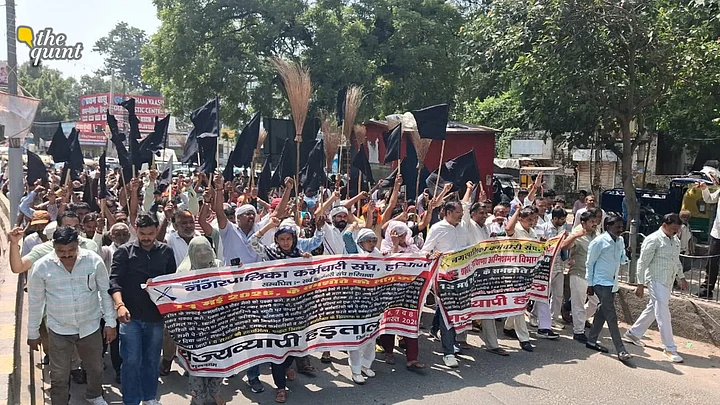
For 37 days, garbage piled up on Haryana's streets as sanitation workers across the state stayed off the job — the longest municipal strike in three decades against centuries old exploitation and discrimination faced by these workers. On 11 September, the government and the unions struck a deal. Here's what happened, who was involved, and what the settlement actually contains.
What Happened, and Who Fought It
From 6 August to 11 September 2026, around 13,091 contractual (Palika Roll) sanitation workers led the strike, joined by 3,418 regular sanitation employees and members of the Haryana Fire Services Employees' Union. The Nagar Palika Karamchari Sangh (NPKS), led by state president Naresh Kumar Shastri, represented sanitation and sewer workers, while the Haryana Agnishaman Vibhag Karamchari Union (Fire Department Employees' Union), led by state president Rajendra Sindhu, represented fire personnel. Regular sanitation staff and the state's fire department employees joined in solidarity, turning a sanitation dispute into a broader civic-workers' agitation.
After the 5 September deadline given by the government for the workers to return to work passed and protests continued, 32 sanitation workers were dismissed from their jobs which already provide little to no security. At least 23 Fire Department personnel including Suhan Khan, the President of the Fire Department Union of Gurugram, were terminated from their jobs. Despite this, the protest continued for another 10 days, garnering support for various workers. As Sahun expressed, "My job has been taken, so have my brothers', but we continue to strike. This government is repressive and will not listen to people like us who are invisible to them. But we will stand here and continue to protest until they see us, our people and our demands."
The Unions planned for district-level Jan Nyay Panchayats (People's Justice Councils) on 10–12 September and another state-level council in Kurukshetra on 13 September to escalate the protest. However, it was overtaken by the 11 September settlement.
On 11 September, the strike ended when Urban Local Bodies Minister Vipul Goel and Chief Minister Nayab Singh Saini met union representatives and signed off on a package of benefits — allowances, insurance, medical leave, a promotion route etc. The government followed up between 14 and 17 September with orders reversing dismissals and FIRs, declaring the strike period paid leave.
What Triggered The Protest
The roots of the dispute go back to 16 February 2026, when firemen Bhavichand Sharma and Ranbir died from injuries sustained fighting a chemical-explosion fire at two factories in Faridabad — the incident that set off the fire department's separate compensation demand. An initial, shorter strike by municipal workers from 1 to 14 May 2026 ended with government assurances on wages and benefits that unions say were only partly implemented. The bigger strike began on 6 August 2026, and talks stalled in early September, prompting the government to set a return-to-work deadline, dismiss around 32 workers, who were mostly union office-bearers, terminate 23 fire department employees, and file FIRs against strikers in several places.
However, one demand has remained at the core of all these protests throughout the decades. Regularisation — converting contractual "Palika Roll" workers into regular employees with job security.
Many sanitation and sewer workers on outsourced contracts also said that they had gone months without full pay or without statutory ESI/PF benefits, while the fire department union was separately demanding the outstanding compensation and government jobs promised to the families of the two men who died fighting the February 2026 Faridabad fire. Unions also pointed out that this was a recurring grievance: similar assurances were made — but not fully honoured — after strikes in 2018, 2022, and again in May 2026.
Sanitation work in India is not a neutral occupational category — it is overwhelmingly performed by communities placed lowest in the caste hierarchy, a legacy of caste-based occupational segregation that predates the modern municipal system and that contractualisation has, if anything, entrenched rather than dismantled.
Keeping a worker on a "Palika Roll" rather than the regular payroll is not a budgeting choice: it denies pension, promotion, paid leave and dignity of employment to workers whose caste already denies them most other avenues of mobility, while allowing the state to describe the work itself as too menial or informal to merit a permanent position.
As Pushpa Devi, a sanitation worker, told The Quint, "We belong to the lowest strata of society. They don't allow us to come up in social standing. If they give us a permanent position, we will be able to educate our kids and rise in standing, which is why this government does not want to make us 'pakka' (regularised).
Discourse on this also pointing out that sanitation work remains one of the most essential yet most socially stigmatised jobs in Indian civic life, disproportionately staffed by Dalit and other marginalised communities who face discrimination on top of chronic underpayment and job insecurity. Reading the strike only as a service dispute over allowances misses why "regularisation" carries the weight it does for these unions: it is as much a demand for recognition as for wages.
The Human Cost Behind the Work
The stakes are also literally life and death, and not just for firefighters. Nationally, at least 859 sanitation workers died cleaning sewers and septic tanks between 2014 and 2025, according to a recent analysis of National Commission for Safai Karamcharis (NCSK) data — a toll recorded every single year despite manual scavenging being banned under the Prohibition of Employment as Manual Scavengers and their Rehabilitation Act, 2013. Haryana is consistently named among the five worst-affected states, alongside Uttar Pradesh, Maharashtra, Tamil Nadu and Gujarat.
Independent tracking by the Safai Karmachari Andolan has put the real toll considerably higher than official figures, and has repeatedly accused the government of undercounting deaths and under-paying the Rs 10 lakh compensation mandated by the Supreme Court for every such death. The workers at the centre of this Haryana strike are largely municipal sweepers and garbage collectors, not manual scavengers in the strictest sense — but "sewermen", who enter drains and manholes to clear blockages, were explicitly among the job categories the unions were negotiating for, which is why the settlement's insurance and risk-allowance clauses for sewer workers.
The fire department's demands are also rooted in a similar, exploitative history. Haryana's fire service has faced chronic, publicly documented staff shortages for well over a decade — as far back as 2011, the state's Chief Fire Officer post remained vacant for five years, and opposition leaders have separately pointed to a shortfall of roughly 10,000 personnel across the state's fire service as part of a wider vacancy crisis in government departments. Individual fire stations have long run with a fraction of their sanctioned strength, forcing existing staff to take on outsized risk with inadequate backup — precisely the conditions in which Bhavichand Sharma and Ranbir were fighting the Faridabad chemical fire when they were fatally injured.
Nationally, India records among the highest fire-related death tolls in the world, and firefighting remains one of the more dangerous public-sector jobs with comparatively little of the compensation architecture — pensions, hazard pay, guaranteed insurance — that armed forces or police personnel receive for similarly hazardous duty.
Against that backdrop, the union's demand for "martyr" status and a standing accident-death policy reads less as a one-off task tied to a single tragedy and more as an attempt to build the kind of institutional safety net that has been missing all along.
What the Government Agreed To
For sanitation and sewer workers (Nagar Palika Karamchari Sangh)
Risk allowance: Rs 440/month replaces the earlier one-time uniform allowance for regular and Palika Roll workers; a further Rs 2,000/month risk allowance specifically for sanitation workers.
Equal pay for equal work: arrears already paid to eligible employees.
LTC and annual medical checkups: extended to Palika Roll sanitation workers and sewermen, cost borne by municipalities.
Cashless medical facility (CCHF): extended to all regular municipal employees, pensioners and dependents — municipalities foot the bill, not the state.
Compassionate assistance on accidental death: raised from Rs 5 lakh to Rs 10 lakh for Palika Roll workers who die on duty.
Bank-linked accident insurance: workers who open an SBI account get Rs 50 lakh on accidental death, Rs 25 lakh on permanent disability.
Health insurance (PMJAY-CHIRAYU): extended to Palika Roll sanitation workers and sewermen once wages cross Rs 21,000/month; premium (~Rs 9,203/family/year) paid by the municipality.
Medical leave doubled: up to 20 medical leaves a year (with carry-forward), instead of 10, and usable annually rather than monthly.
A promotion ladder: literate sanitation workers and sewermen can now be promoted to Group C clerk posts — a draft rule change was gazetted on 14 September, with a 10-day objection window.
Sewermen's wages: hiked by Rs 2,100/month on Palika Rolls.
Outsourced workers: minimum wages, ESI and PF benefits to be ensured through the outsourcing agencies, paid via bank accounts.
Regular recruitment against vacant posts: selection criteria to be finalised within a month, advertisement within 15 days, with a union representative on the recruitment committee — instead of filling these posts through outsourcing.
Strike-period punishment reversed: suspensions of regular employees revoked; terminated contractual/HKRNL workers reinstated; disciplinary cases and FIRs against strikers to be withdrawn; strike days adjusted through extra duty rather than pay cuts, with the whole strike period ultimately treated as paid leave.
Death benefits for contractual workers: provision for a family member's job and gratuity on an employee's death under the Job Security Act, plus the Rs 50 lakh/Rs 25 lakh bank insurance cover.
One demand was rejected outright: bringing door-to-door garbage-collection contract workers onto the municipal payroll — the government called this "not practical" denying the ongoing, and main demand for regularisation.
For fire department employees (Haryana Agnishaman Vibhag Karamchari Union)
Compensation for the two deceased firemen: Bhavichand Sharma's family has received Rs 60 lakh in total (Rs 20 lakh CM Relief Fund + Rs 10 lakh accident scheme + Rs 30 lakh via a Bank of Maharashtra MoU); Ranbir's family has received Rs 30 lakh, with a further Rs 20 lakh approved but still held up in a Finance Department query as of the settlement date.
A standing accident-death policy: Rs 50 lakh promised for any fire department employee who dies in a similar accident going forward — being finalised with the Finance and Law & Revenue departments.
Compassionate-ground jobs for family members of the two deceased, to be processed "as per rules."
Recruitment against vacant Fire Operator-cum-Driver posts: norms to be finalised within 45 days, advertisement 15 days after.
Risk allowance (Rs 5,000/month) and annual uniform allowance (Rs 7,500)
No service break for regular employees; strike days for contractual ("pay-roll") staff adjusted against Extra Duty Leave rather than being treated as a break in service.
The Demand That Has Outlasted Every Settlement
These demands made by workers have been largely met except one — regularisation of contracts. Every demand accepted too, is in effect, compensation for staying contractual, not a route out of it. The government has repeated a familiar playbook: raise allowances, extend insurance and health cover, medical leave, and quietly reverse the strike-period punishments, while leaving the demand for permanent jobs untouched. As stated by Union leaders themselves, It did the same after the May 2026 strike but never fully honoured the assurances from 2018. The real test of this settlement isn't what's on paper. As Sahun explained, "They have asked for 2 months time to make our jobs pakka, when they do that is when we will actually win, or else we will meet you again, right here, continuing to strike."