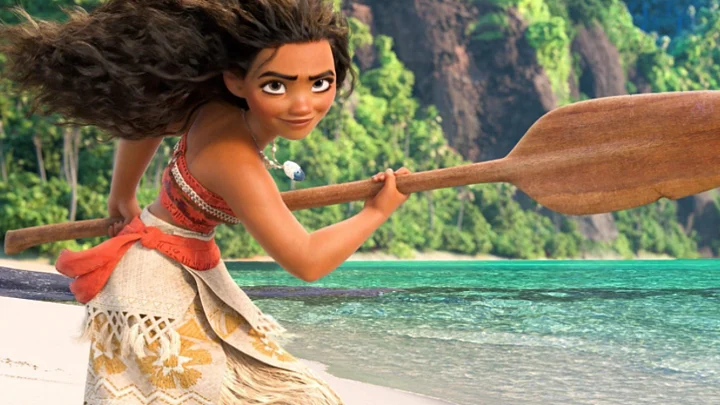
Moana is the daughter of the village chief of the island of Montunui in the Pacific Islands. She’s also curiously drawn to the ocean from a very young age, despite her parents’ constant admonishing because they want her to be safe and to be the next chief.
But soon, her beloved island is embroiled in the midst of an ecological crisis. Darkness is spreading in the sea, and she is pushed to embrace her true destiny by voyaging across the waters to find the demigod, Maui.
She has to make him restore the heart – a small precious rock – of the fertile goddess, Te Fiti, which he stole a millennium ago, but was later lost to the sea.
The Story
It’s a classic coming-of-age story; the protagonist sets sail on a journey to discover herself by confronting her fears and fighting deadly obstacles that come her way.
Moana (voiced by Auli’i Cravalho) is smart and rebellious in the way Disney’s more empowered female protagonists are: Anna from Frozen, Meredith from Brave, Rapunzel from Tangled. Despite her helicopter parents – or because of them – Moana sails the vast oceans with bad-boy demigod Maui (Dwayne Johnson) to set right the cosmic theft he committed a 1,000 years ago.
The movie also follows his journey of rediscovering his confidence – something he’d lost the day after he lost Te Fiti’s heart, along with his magical fish hook.
Dwayne Johnson is the big star in Moana, and why ever not? The muscle-bound, tattooed Maui is a lot like his character, The Rock, from his wrestling days. His vocal performance brings the Polynesian legend of the demigod Maui to life as a flawed hero: courageous, mischievous and vain.
The problem with the narrative is that it’s linear – you know what’s going to happen next.
It is in the midst of this predictability that certain moments shine through: an action scene which is a homage to Mad Max: Fury Road; a debonair monster-crab whose baritone puts Smaug to shame; and the smouldering lava monster, Te Ka, who is also eyeing Te Fiti’s heart.
The Animation
The stunning CGI cinematography makes Moana a cinematic experience you mustn’t miss.
The beauty of the Pacific Islands is brought out gorgeously: from the blue-green inviting waters to the deep green forest islands and the fiery sunsets.
This is Clemens and Musker’s first attempt at CGI animation, and it’s the closest we get to reliving that warm charm of Disney’s hand-drawn animation of yore. The water plays a huge part in the story and manages to becomes a character in itself.
The Music
The movie has a few numbers by Lin-Manuel Miranda of Hamilton fame, which stay with you after you leave the theatre – one of them being a glam-rock homage to David Bowie called Shiny. Other numbers, like a traditional, self-affirming Let it Go and a beautiful ditty like Moana’s How Far I’ll Go also set the mood of the film perfectly.
The orchestral pop score by Disney king Mark Mancina pace the story just right, raising and dropping the tension just when the script needs it.
On Depicting Polynesian Culture: Hit or Miss?
To make sure they don’t get the flak they received after Aladdin, the directors spent five years travelling the Pacific Islands, meeting the people, historians and experts. Moana is a big step towards using storytelling to celebrate diverse cultures – not merely white, occidental fairy tales.
“Our tradition is our mission,” sings Moana’s father in Where You Are and that’s reinforced throughout the story. The Polynesians were voyagers first, millennia ago, and for reasons unknown to historians, suddenly stopped for about 5,000 years and settled in the Islands.
And that’s something Moana personally relates to in the movie – as she feels an innate sense of wanderlust she can’t explain.
On Gender Equality: Hit or Miss?
SPOILER ALERT:
There is no hero. No love story.
None.
And Moana looks like a well-proportioned teenage girl, not Barbie.
It’s true! They did it! Finally a Disney movie (that does pass the Bechdel test) which allows a real woman to have a purpose other than falling in love and getting married!
Moana's relationship with Maui – with whom she sails – is that of a mentor and a protege with a dash of witty sibling jousting thrown in. She knows her goal, she’s finding her way there one step at a time, and she doesn’t need a man to ‘rescue’ her from distress.
There’s more: almost all Disney movies follow the same pattern – the girls are princesses who simply grow up to be older princesses. They never have to grapple with the responsibility of queenhood, like the princes who grow up to be kings, do. In Moana, it is made apparent that she will become the village chief – and there are enough close-ups of the traditional headgear to prove it.
In the end, she does become chief, especially after solving the eco-crisis, but what probably makes it most special is that she chooses to wear a flower-band on her head that she’s made herself.