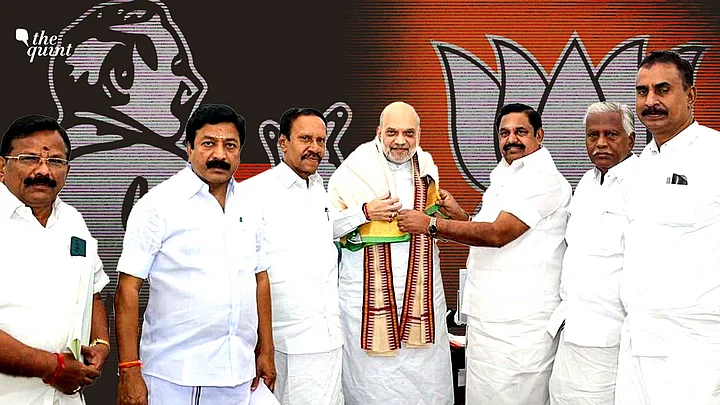
As Tamil Nadu approaches another decisive Assembly election, the Bharatiya Janata Party (BJP)-led National Democratic Alliance (NDA) has succeeded in doing what it believes is half the battle—assembling a large alliance.
Along with the BJP and the AIADMK as principal partners, this large alliance includes the Pattali Makkal Katchi (PMK) led by Anbumani Ramadoss; the Amma Makkal Munnetra Kazhagam (AMMK); and smaller parties such as the Tamil Maanila Congress, the Puthiya Needhi Katchi, the Indhiya Jananayaka Katchi, and the Tamil Nadu Makkal Munnetra Kazhagam.
In national politics discourse, the NDA alliance is being cast as a serious challenger, but the assumption underpinning this projection is simple—and the logic familiar. Collect every available vote share, however marginal, and convert arithmetic into victory.
More parties mean more votes, and more votes mean a tighter contest. It is a strategy the BJP successfully deployed in Bihar. The question now is whether that same formula can be transplanted into Tamil Nadu without collapsing under the weight of local political realities.
The Bihar Precedent
The NDA’s trajectory between the 2020 and the 2025 Assembly elections underlines this managerial approach. In 2020, the NDA scraped past the majority mark with 125 of 243 seats, in what was a closely fought contest where marginal vote-share advantages mattered. By 2025, however, the same alliance architecture delivered a landslide, with the NDA winning over 200 seats, despite neither the BJP nor the JD(U) commanding a dominant standalone vote share.
The gains came from disciplined seat-sharing, the accommodation of multiple regional players, including smaller allies with limited vote bases, and crucially, the effective vote transfer on the ground. Cadres largely fell in line, leadership hierarchies were unambiguous, and the alliance offered a unifying narrative centred on stability, power-sharing, and governance continuity.
This success has clearly emboldened the BJP. The assumption now appears to be that electoral arithmetic, if aggregated sufficiently, will eventually override political chemistry.
The AIADMK Question
At the heart of the NDA’s Tamil Nadu experiment lies the AIADMK. In Bihar, the BJP played a junior partner role to Nitish Kumar at crucial moments, respecting local leadership structures.
In Tamil Nadu, the dynamics are reversed but remain unresolved. The AIADMK is expected to anchor the alliance as the state’s dominant political force. Battered by organisational fatigue, leadership uncertainty, and cadre erosion after the death of Jayalalithaa, the party has staged a comeback by overcoming internal hurdles and consolidating leadership under E Palaniswami as its general secretary.
In the 2021 Tamil Nadu Assembly election, the NDA led by the AIADMK and including the BJP, the PMK, and smaller allies, secured an aggregate vote share of 39.71 percent. The AIADMK remained the principal force within the alliance, polling 33.29 percent, while the BJP garnered around 2.62 percent. The PMK contributed roughly 3.8 percent. The 2021 results underscored how the alliance’s overall strength was driven largely by the AIADMK's traditional base rather than the BJP's independent footprint.
In contrast, the 2024 Lok Sabha election saw the AIADMK and the BJP contest separately in Tamil Nadu. The AIADMK, fighting alone, secured about 20.46 percent of the vote, while the BJP-led grouping polled around 18.28 percent across the state.
Though BJP leaders later pointed to a notional combined vote share of approximately 41 percent by adding the two tallies, this figure does not reflect an actual alliance performance since the parties weren't formally aligned in the election.
"This creates a paradox. The NDA needs the AIADMK’s residual vote base, but the BJP’s growing prominence within the alliance risks alienating traditional AIADMK voters who remain wary of a national party's dominance," explains Marthandam Ganesan, a retired political science professor.
Analysing the data of the past elections, Ganesan opines that if vote transfer were smooth and ideologically elastic, a significant portion of the AIADMK’s 2021 voters should have migrated to the BJP in 2024, or vice versa.
“Instead, the data indicates leakages on both sides. Sections of the AIADMK’s traditional voters either abstained, shifted to other regional players, or tactically backed the DMK-led alliance. And the BJP’s gains appear to stem more from its own organisational push and polarised consolidation than from inherited AIADMK support."Marthandam Ganesan
Pointing out that Tamil Nadu’s electoral history, however, has repeatedly warned against such linear arithmetic, Ganesan says, “The real question is whether AIADMK cadres and BJP workers can coordinate seamlessly at the booth level. In Tamil Nadu, elections are not won through alliance announcements alone, but through ideological comfort and grassroots coordination."
The BJP Factor and its Limited Footprint
For the BJP, Tamil Nadu remains a paradox—organisationally strong, yet electorally constrained. Lessons from Bihar, Maharashtra, and Karnataka offer warnings rather than templates, underscoring the limits of replicating alliance strategies into a state shaped by a distinct political culture.
Despite steady vote share growth over the years, the BJP's ideological appeal remains restricted. Issues that energise the BJP’s base elsewhere do not always translate well in a state shaped by Dravidian rationalism, linguistic pride, and a strong emphasis on state autonomy. This limitation places the BJP in a paradoxical position within the alliance.
Senior journalist Dhanaraj, who has been observing Tamil Nadu politics for the past 40 years, tells The Quint, "The BJP [still] remains electorally dependent on regional partners for legitimacy in Tamil Nadu. The risk lies in overestimating the transferability of strategies that worked in [other] states with different political cultures."
"In Bihar, the BJP benefited from an alliance culture deeply embedded in caste politics. In Maharashtra, frequent alliance realignments have bred voter cynicism, often benefiting the most organisationally stable party. And Karnataka demonstrated that even a strong national party can struggle when alliances lack grassroots coherence and local leadership clarity."Dhanaraj
Tamil Nadu resembles none of these states entirely, but borrows cautionary elements from all three, he adds.
"Tamil Nadu's political culture instead is rooted in ideological continuity... Dravidian politics has created deep emotional and cultural loyalties that do not easily migrate across party lines. Alliances in Tamil Nadu have historically succeeded not because they were large, but because they were coherent. Voters have shown a tendency to vote for leadership clarity and narrative consistency rather than for crowded coalitions stitched together at the last minute," professor Ganesan adds.
"This is where the NDA’s challenge begins. While the alliance looks expansive, its internal contradictions are difficult to ignore. The BJP’s ideological project has limited resonance in Tamil Nadu, particularly on issues of language, federalism, and cultural nationalism."
DMK’s Structural Counterweight
If the NDA’s challenge rests largely on alliance arithmetic, the DMK’s counter lies in organisational continuity. As the incumbent, the ruling party benefits from a settled leadership hierarchy, experienced cadre networks, and a functioning booth-level machinery. These advantages have been accumulated over time rather than created for a single election. For the upcoming state elections, its campaign is expected to lean on welfare delivery and social justice while framing itself as a defender against perceived central overreach.
However, these structural strengths are not without vulnerabilities. Incumbency brings anti-incumbency pressures, governance scrutiny, and fatigue within sections of the cadre.
"Whether the DMK’s narrative resonates beyond its core constituencies remains uncertain, just as the NDA’s belief in seamless vote transfer across internally strained partners remains untested," Dhanaraj adds.
Coalitions on Paper, Votes on the Ground
Smaller, caste-based or personality-driven parties have often failed to deliver their claimed vote shares when aligned with ideologically distant partners.
This is where the NDA’s arithmetic begins to fray. The AMMK, since its formation under TTV Dhinakaran, had repeatedly maintained that it would never align with the AIADMK as long as Palaniswami heads the party.
Its decision to now join hands with the AIADMK may be projected as a strategic effort to strengthen the alliance, but for the wider electorate, and even among sections of voters of both parties, it risks being read less as consolidation and more as political opportunism.
Political analyst Sumanth Raman, however, argues that the focus on leadership-level friction between the AIADMK and the AMMK may be overstated when it comes to vote transfer. “The AMMK’s support base is largely defined by its opposition to the DMK, making defection to the ruling party unlikely regardless of alliance dynamics. On any day, AMMK votes are anti-DMK votes," he explains.
Meanwhile, the PMK now stands split following a rift between party founder S Ramadoss and his son Anbumani. Ramadoss has objected to his son’s faction using the party’s ‘mango’ symbol—and accused the AIADMK of legitimising the Anbumani faction by entering into an alliance with it.
With two major alliance partners facing internal crises, serious questions arise over whether their vote bases can be transferred in full to other NDA constituents.
However, former AIADMK MLA S Tennarasu expresses confidence in the NDA alliance, saying:
“As far as the AIADMK is concerned, it had allied with the BJP even in the last Assembly election. This is not a new arrangement, in that sense, the alliance is relatively natural and electorally formidable.”S Tennarasu
(Vinodh Arulappan is an independent journalist with over 15 years of experience covering Tamil Nadu politics, socio-culture issues, courts, and crime in newspapers, television, and digital platforms. This is an opinion article and the views expressed above are the author’s own. The Quint neither endorses nor is responsible for them.)