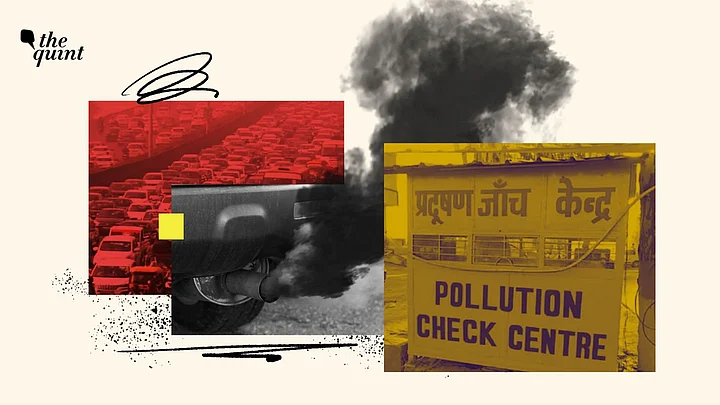
"I just had to pay a little extra," says Rohan (name changed), a 31-year-old resident of South Delhi.
Rohan's BS-IV vehicle repeatedly failed the pollution test, but an additional Rs 50 was enough to secure the Pollution Under Control (PUC) certificate last month at one particular centre. "He [attendant at the testing centre] entered my licence plate number into the machine but used the reading from another vehicle to approve my PUC,” Rohan claims to The Quint.
If you own a vehicle, this checklist should be familiar: Along with your licence, insurance, and registration, a valid PUC certificate is required every time you drive. PUC has long been a key pillar of Delhi’s pollution-control framework, and is mandatory nationwide.
As air quality in the capital deteriorated to ‘severe’ levels in mid-December, the Bhartiya Janata Party (BJP)-led Delhi government tightened enforcement by rolling out a ‘no PUC, no fuel’ rule. In effect, vehicles are denied fuel unless their owners can produce a valid PUC certificate.
Later, the government announced that the rule will continue even after all anti-pollution restrictions under the Graded Response Action Plan (GRAP) are lifted.
But if Rohan's experience is anything to go by, enforcement still appears to lag. This, despite the Controller and Auditor General (CAG) of India having flagged major irregularities in PUC certificate issuance just last year. And even when implemented properly, experts say PUC is "a weak tool for tackling air pollution".
Why, then, is the PUC the preferred tool, and what needs to change? The Quint explains.
Explained: Does PUC Test Actually Help Curb Air Pollution?
1. The Current Status of 'No PUC, No Fuel' Rule
On 23 December, Delhi's Environment Minister Manjinder Singh said the Delhi government will continue its 'no PUC, no fuel' policy even after lifting the GRAP-IV restrictions. However, a source in the Delhi Transport Department said that even after a fortnight, they have not received such a directive.
"The directive the transport department got was that 'no PUC, no fuel' was to be enforced when GRAP-IV was put in place. Now that GRAP-IV has been removed, that rule has been lifted too. No new directives have been issued since then," the source said.
Even so, having a valid PUC certificate remains mandatory. This means you may not be checked for it while buying fuel, but if your vehicle is stopped by the traffic police and is found to be non-compliant during testing, you will be fined.
According to official government data released on Thursday, 1 January, more than 1.56 lakh challans, each carrying a fine of Rs 10,000, have been issued in Delhi over the past two months for driving without a valid PUC certificate.
Expand2. A 'Hackable' System
In April 2025, an audit report by the CAG revealed on the floor of the Delhi Assembly that more than 1 lakh vehicles were declared 'pass' despite exceeding permissible limits for carbon monoxide, hydrocarbons, and carbon dioxide.
It further noted that testing centres did not record pollution test values for over 5 lakh diesel vehicles before issuing them PUC certificates between 2015 and 2020.
Beyond that, experts point out that the system itself is "hackable". As neither the vehicles are tested real-time nor the validity of the certificate of vehicles on the roads is continuously monitored, many slip through the cracks.
Whether a vehicle is compliant or not "can only be detected if the driver voluntarily takes the vehicle for testing, or if the vehicle is stopped and checked by authorities,” explains Anumita Roychowdhury, Executive Director, Research and Advocacy, Centre for Science and Environment (CSE).
Sharing his experience, Delhi resident Rohan adds that what the traffic police are looking for at checkpoints are valid certificates. “They are not testing vehicles, so it’s easy to get away with it,” he says.
Expand3. Why PUC Fails Even When It Works
The PUC is a mandatory emissions test for petrol, LPG, and diesel two- and four-wheelers, designed to assess a vehicle's "health" by measuring pollutants. But, as Roychowdhury points out, "it is a rudimentary test that only checks a limited set of parameters and can detect only major malfunctions."
Like, much of Delhi's toxic air is made up of PM2.5 particles. "But PUC doesn’t measure particulate matter emissions. So, even with a valid PUC certificate, your vehicle may still emit high levels of PM2.5—and there’s no way to detect it,” Amit Bhatt, Managing Director at the International Council on Clean Transportation, tells The Quint.
According to the Indian Institute of Tropical Meteorology, transport is the biggest contributor to PM2.5 emissions in Delhi, with its share going up to 20 percent or more in winter months.
Roychowdhury further adds:
"PUC does not capture most pollutants, nor does it measure emissions under different driving conditions—factors that significantly affect real-world emissions."
Though Delhi’s pollution stems from a mix of factors, including meteorological conditions and multiple emission sources, vehicular emissions remain one of its biggest contributors, several studies show.
According to data from the Ministry of Road Transport and Highways (MoRTH), Delhi had around 13.3 million registered vehicles as of 2020—a figure that has doubled over the past decade. More vehicles on the road inevitably mean higher emissions.
Adding to the challenge, around 1.1 million vehicles enter and exit Delhi every day.
"It made sense when the policy was first implemented, because it was the latest technology at the time. But over the years, the number of vehicles on the road has increased so much and the technology has also advanced, I feel it has outlived its utility," adds the source in the Delhi Transport Department who spoke to The Quint on condition of anonymity.
Bhatt points out that even if PUC were able to reduce pollution to some extent, any gains from improved emission standards would be offset by the growing number of vehicles.
"If the net increase in vehicles is high, it nullifies the impact. In the end, you don’t get the benefits of these measures because the sheer number of vehicles has risen."
Amit BhattBhatt points out that we can use international examples as references.
“Take London, for instance. Despite a dense population and high vehicle concentration, the city has improved air quality by converting areas into low-emission and ultra-low-emission zones. Currently, London allows only BS-VI or electric vehicles, and by 2035, it will allow only electric vehicles. Delhi will eventually have to adopt a similar path. I don't see another way,” he says.
The source in the transport department adds, "If we can completely transition to EV engines, then we won't need a policy like PUC at all," adding that it's something the government is working towards in the long term.
Expand4. More Effective Systems Waiting to Take off
For now, the source calls PUC a "stopgap measure", adding:
"MORTH is working on bringing a more robust system that can tackle some of the issues that is leading to false certification, including geotagging the vehicles that are being tested."
If the goal is to curb or control vehicular emissions as a "stopgap measure", Roychowdhury says there are more robust systems that can better monitor and identify defaulters. "Remote sensing is a far more advanced system for on-road emission checks," she explains.
Unlike traditional tests, which rely on the driver to present the vehicle, remote sensing uses machines installed along the roadside to automatically detect emissions from vehicles as they drive by.
"It’s much more accurate. A couple of pilots have already been implemented in places like Kolkata and have shown excellent results."
Anumita RoychowdhuryThe Supreme Court first directed the MoRTH to roll out remote sensing-based system in 2018, then again in July 2024, but it is yet to be implemented. "Once implemented, this system would be a far more efficient and accurate way to catch the worst offenders on the road than PUC,” Roychowdhury tells The Quint.
The source in the transport department confirms remote sensing is in the works, without confirming the timeline of when it is expected. It is awaiting "a directive from the Central government," they said.
(The Quint has reached out to the CAQM with a detailed questionnaire on the issue. The piece will be updated once a response is received.)
Expand
The Current Status of 'No PUC, No Fuel' Rule
On 23 December, Delhi's Environment Minister Manjinder Singh said the Delhi government will continue its 'no PUC, no fuel' policy even after lifting the GRAP-IV restrictions. However, a source in the Delhi Transport Department said that even after a fortnight, they have not received such a directive.
"The directive the transport department got was that 'no PUC, no fuel' was to be enforced when GRAP-IV was put in place. Now that GRAP-IV has been removed, that rule has been lifted too. No new directives have been issued since then," the source said.
Even so, having a valid PUC certificate remains mandatory. This means you may not be checked for it while buying fuel, but if your vehicle is stopped by the traffic police and is found to be non-compliant during testing, you will be fined.
According to official government data released on Thursday, 1 January, more than 1.56 lakh challans, each carrying a fine of Rs 10,000, have been issued in Delhi over the past two months for driving without a valid PUC certificate.
A 'Hackable' System
In April 2025, an audit report by the CAG revealed on the floor of the Delhi Assembly that more than 1 lakh vehicles were declared 'pass' despite exceeding permissible limits for carbon monoxide, hydrocarbons, and carbon dioxide.
It further noted that testing centres did not record pollution test values for over 5 lakh diesel vehicles before issuing them PUC certificates between 2015 and 2020.
Beyond that, experts point out that the system itself is "hackable". As neither the vehicles are tested real-time nor the validity of the certificate of vehicles on the roads is continuously monitored, many slip through the cracks.
Whether a vehicle is compliant or not "can only be detected if the driver voluntarily takes the vehicle for testing, or if the vehicle is stopped and checked by authorities,” explains Anumita Roychowdhury, Executive Director, Research and Advocacy, Centre for Science and Environment (CSE).
Sharing his experience, Delhi resident Rohan adds that what the traffic police are looking for at checkpoints are valid certificates. “They are not testing vehicles, so it’s easy to get away with it,” he says.
Why PUC Fails Even When It Works
The PUC is a mandatory emissions test for petrol, LPG, and diesel two- and four-wheelers, designed to assess a vehicle's "health" by measuring pollutants. But, as Roychowdhury points out, "it is a rudimentary test that only checks a limited set of parameters and can detect only major malfunctions."
Like, much of Delhi's toxic air is made up of PM2.5 particles. "But PUC doesn’t measure particulate matter emissions. So, even with a valid PUC certificate, your vehicle may still emit high levels of PM2.5—and there’s no way to detect it,” Amit Bhatt, Managing Director at the International Council on Clean Transportation, tells The Quint.
According to the Indian Institute of Tropical Meteorology, transport is the biggest contributor to PM2.5 emissions in Delhi, with its share going up to 20 percent or more in winter months.
Roychowdhury further adds:
"PUC does not capture most pollutants, nor does it measure emissions under different driving conditions—factors that significantly affect real-world emissions."
Though Delhi’s pollution stems from a mix of factors, including meteorological conditions and multiple emission sources, vehicular emissions remain one of its biggest contributors, several studies show.
According to data from the Ministry of Road Transport and Highways (MoRTH), Delhi had around 13.3 million registered vehicles as of 2020—a figure that has doubled over the past decade. More vehicles on the road inevitably mean higher emissions.
Adding to the challenge, around 1.1 million vehicles enter and exit Delhi every day.
"It made sense when the policy was first implemented, because it was the latest technology at the time. But over the years, the number of vehicles on the road has increased so much and the technology has also advanced, I feel it has outlived its utility," adds the source in the Delhi Transport Department who spoke to The Quint on condition of anonymity.
Bhatt points out that even if PUC were able to reduce pollution to some extent, any gains from improved emission standards would be offset by the growing number of vehicles.
"If the net increase in vehicles is high, it nullifies the impact. In the end, you don’t get the benefits of these measures because the sheer number of vehicles has risen."Amit Bhatt
Bhatt points out that we can use international examples as references.
“Take London, for instance. Despite a dense population and high vehicle concentration, the city has improved air quality by converting areas into low-emission and ultra-low-emission zones. Currently, London allows only BS-VI or electric vehicles, and by 2035, it will allow only electric vehicles. Delhi will eventually have to adopt a similar path. I don't see another way,” he says.
The source in the transport department adds, "If we can completely transition to EV engines, then we won't need a policy like PUC at all," adding that it's something the government is working towards in the long term.
More Effective Systems Waiting to Take off
For now, the source calls PUC a "stopgap measure", adding:
"MORTH is working on bringing a more robust system that can tackle some of the issues that is leading to false certification, including geotagging the vehicles that are being tested."
If the goal is to curb or control vehicular emissions as a "stopgap measure", Roychowdhury says there are more robust systems that can better monitor and identify defaulters. "Remote sensing is a far more advanced system for on-road emission checks," she explains.
Unlike traditional tests, which rely on the driver to present the vehicle, remote sensing uses machines installed along the roadside to automatically detect emissions from vehicles as they drive by.
"It’s much more accurate. A couple of pilots have already been implemented in places like Kolkata and have shown excellent results."Anumita Roychowdhury
The Supreme Court first directed the MoRTH to roll out remote sensing-based system in 2018, then again in July 2024, but it is yet to be implemented. "Once implemented, this system would be a far more efficient and accurate way to catch the worst offenders on the road than PUC,” Roychowdhury tells The Quint.
The source in the transport department confirms remote sensing is in the works, without confirming the timeline of when it is expected. It is awaiting "a directive from the Central government," they said.
(The Quint has reached out to the CAQM with a detailed questionnaire on the issue. The piece will be updated once a response is received.)