Price still matters, but it is no longer the only deciding factor. From safety and professionalism to consistency of service, more people in Delhi are choosing to pay for journeys that deliver a better overall experience.
Safety remains a major concern for women commuters
A few years ago, Lipika Jhawar moved from Bhubaneswar to Delhi for work. Back home, taking the bus or simply walking had always been part of her daily routine. In Delhi, however, she gradually switched to ride-hailing services because they made her feel safer. Speaking to Outlook Traveller in September 2025, she explained that the change was driven not simply by convenience, but by peace of mind.
Lipika's experience reflects a broader shift in how people in Delhi choose their daily transport. Price remains important, but it is no longer the only consideration. For many passengers, a ride must also provide reassurance, professionalism and a consistently positive experience. Those are the qualities that make people choose the same service again.
The National Commission for Women (NCW)'s NARI Report 2025, which surveyed more than 12,700 women across 31 Indian cities, found that Delhi was among the cities where women expressed higher levels of concern about safety while travelling. Public transport was also one of the areas most frequently identified as needing improvement.
These findings have encouraged the Delhi government and civil society organisations to continue studying commuters' real-life experiences. From the NCW to Greenpeace India, an increasing body of research is helping policymakers and businesses develop mobility solutions based on actual user needs rather than assumptions.
A greener city needs more than electric vehicles
At first glance, passenger safety and air pollution may seem like two separate challenges. In reality, they are closely connected because both ultimately influence how people choose to travel every day.
According to the Centre for Science and Environment (CSE), road transport accounts for around 51–53% of Delhi's air pollution. This is one of the reasons the city has accelerated the implementation of the Delhi EV Policy 2026, with the goal of making 95% of newly registered vehicles electric by 2027.
This is an important step forward. However, as Economic and Political Weekly points out, policy and technology alone cannot solve the entire challenge. People only change long-established travel habits when they believe new mobility options are safe, reliable and dependable.
In other words, the transition to greener mobility will only succeed if improvements in vehicle technology are matched by improvements in the passenger experience. Electric vehicles may initiate the transition, but it is the quality of every ride that ultimately determines whether people choose to return. This is where governments and mobility companies can make a meaningful contribution together.
A five-star ride takes more than a good car
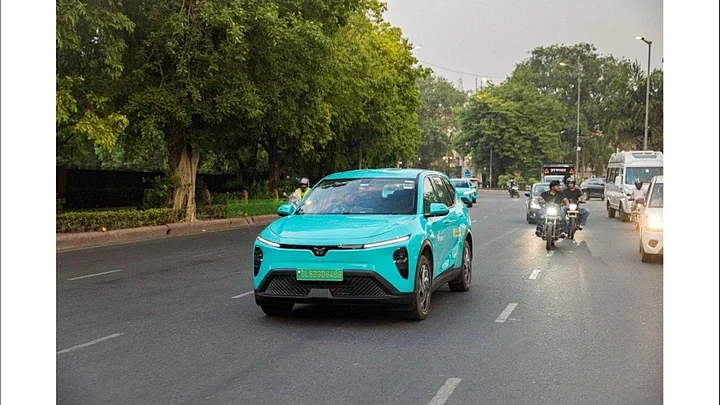
Against this backdrop, Green SM has adopted a different approach. The company focuses on what it can do best: delivering rides that are safe, reliable and consistent enough for passengers to choose again.
This philosophy is reflected in Green SM's Ride 5 Stars standard. Rather than focusing only on the vehicle itself, the standard covers every part of the passenger experience, including clean vehicles, professionally trained drivers and technology that enhances safety and transparency throughout the journey.
For its seven-seat all-electric fleet, Green SM has introduced its Secure to Safe (S2S) system, which uses AI-assisted in-cabin cameras to enhance safety and transparency for both passengers and drivers. Passengers remain in control of their experience and can disable the in-cabin camera feature through the app whenever they choose. This approach is designed to balance safety, transparency and passenger privacy.
A good electric vehicle may create a strong first impression. What defines a five-star ride is the professionalism of the driver, the confidence passengers feel throughout the journey and the consistency of the service. Those are the qualities that keep passengers coming back.
Ultimately, a greener transport system is not defined solely by the number of electric vehicles on the road, but by whether people genuinely trust them enough to use them every day. A greener city is built not only by putting more electric vehicles on the road, but also by giving people journeys that are safe, professional and dependable enough to choose every day.