Learning gaps are easy to miss in a classroom. They don’t always show up as failing grades. Sometimes, they look like a child pausing while reading a sentence, hesitating before answering a question or choosing to stay quiet instead of raising a hand. Over time, these moments can begin to shape how a child learns and how they see themselves.
Across India, this is a larger issue than it may appear on the surface. According to Annual Status of Education Report (ASER) 2024, more than half of Grade 5 students are unable to read a Grade 2 level text. This gap between what children need and what is recognised often means that many learning challenges go unnoticed, especially in the early years, when support can make the most difference. To understand this better, let’s take a closer look.
Why early identification matters
What begins as difficulty with reading or basic maths can gradually affect a child’s confidence. A child who doesn’t understand a concept may begin to participate less. They may avoid speaking up, fall behind in class or feel labelled in ways that affect their self-belief. This is why early intervention matters. When a gap is noticed early and addressed with the right support, it gives children a chance to catch up before the problem grows. Just as importantly, it helps rebuild confidence before self-doubt becomes harder to overcome.
For over two decades, P&G Shiksha has been working to address these challenges, particularly among children in underserved communities. What began as a programme focused on improving school infrastructure has evolved into a more focused approach to learning outcomes. Today, the approach looks at both prevention and remediation.
Prevention focuses on strengthening early learning so that gaps don’t form in the first place. This includes early childhood education that supports cognitive, language, and social development. Remediation focuses on identifying where a child is struggling and helping them improve through targeted support. This shift reflects a deeper understanding of how learning gaps develop and how they can be addressed more effectively.
To deliver this on the ground, P&G Shiksha works with multiple partners. It works with Pratham Education Foundation that support early learning and community-based interventions. With Round Table India, P&G Shiksha is working to improve learning environments so that classrooms are more conducive to learning. These partnerships allow the programme to reach children across different regions and contexts, especially in communities where resources may be limited.
Technology is changing the approach
One of the key tools used in this effort is Mindspark, an AI-based adaptive learning platform developed by Educational Initiatives. Unlike traditional classroom teaching, which often moves at a fixed pace, Mindspark assesses each child’s current level of understanding and creates a personalised learning path based on what they know and where they need help. This means that instead of trying to keep up with the class, each child can learn at their own level. Concepts are introduced step by step, allowing progress to build gradually.
When combined with teacher support and classroom integration, this approach helps children learn at their pace, in a safe way, eventually helping tackle hesitation. It also enables educators to better understand where each student needs attention.
A milestone and the stories behind it
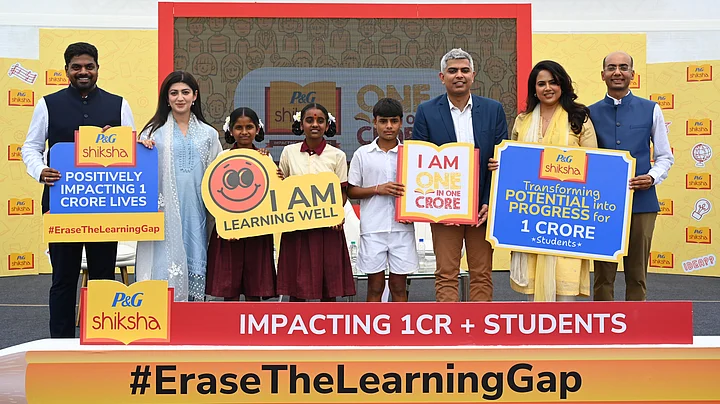
Recently, P&G Shiksha announced that it is now impacting 1 crore children across India. To mark the occasion, educators, partners and experts came together to talk about the importance of early intervention at a tribal government school in Hyderabad. Alongside this, real stories from classrooms were shared to highlight the on-ground impact of the programme.
One such story was that of Ramesh, a Grade 7 student from a tribal village in Telangana. As a first-generation learner, he faced challenges not just in mathematics but also in adapting to a new language of instruction. Through personalised support using Mindspark, Ramesh spent over 120 hours learning at his own level. Over time, he improved significantly, moving up multiple learning levels.
His journey is a reminder that when children receive the right support at the right time, progress becomes possible.
“As per a third party survey, 74% of parents perceive early learning struggles as just a phase, underestimating the long-term risks to a child’s future. That is what makes P&G Shiksha’s milestone of reaching 1 Crore children so significant. It represents 1 Crore moments where timely, structured support helped restore confidence and strengthen foundational learning”.Rajat Brar, Senior Director, Brand Operations – P&G India
Sameera Reddy, who was also part of the panel, added that early learning experiences can have a lasting impact. “Recognising gaps early and responding with understanding can shape how children see themselves, both in and outside the classroom,” she noted.
A shared responsibility
Addressing learning gaps requires awareness, timely action and consistent support from multiple stakeholders. Parents play a key role in recognising early signs. Teachers help identify and address gaps in the classroom. Organisations and partners can bring in tools, resources and structured programmes.
To highlight this shared responsibility, P&G Shiksha also released a campaign film titled Kaccha Nimbu. The film focuses on how easily a child’s struggle can be overlooked and why noticing it in time can make a difference.
Reaching 1 crore children is a significant milestone, but it is not the end of the journey. 1 crore lives later P&G Shiksha’s mission remains unchanged - ensuring potential is never lost to a moment of struggle.