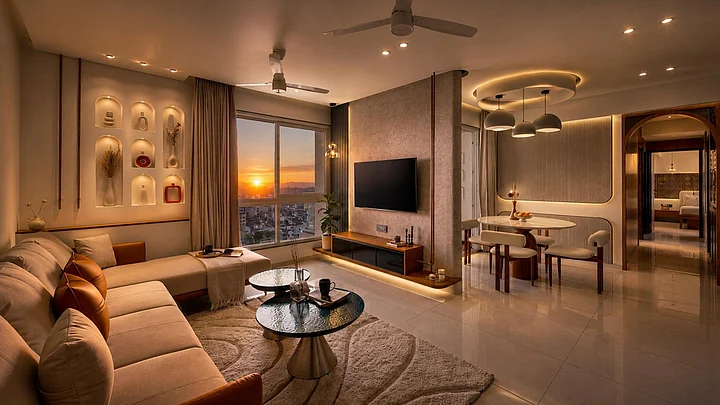
Anyone who has recently finished doing up a flat in Chennai will tell you some version of the same story. The initial number felt manageable. The final number did not. And somewhere between signing and shifting in, a gap opened up that nobody had clearly explained at the start.
This is not a story about dishonest firms or fly-by-night contractors, though those exist too. This is about something more routine and, in many ways, more frustrating: quotes that are technically accurate but structurally incomplete. Quotes built to win a client, not to inform one. In a market worth over USD 36 billion nationally, where residential interiors account for 60 percent of all demand, this gap between the number on the PDF and the number on the final invoice has become one of the most predictable features of the home interior experience in India.
What follows is a breakdown of the items most commonly missing from an interior quote, not obscure edge cases, but recurring costs that experienced homeowners and designers alike will immediately recognise.
Chennai-based interior firm Interiors by Dex, which works exclusively on residential projects, says the single most common question they hear from new clients is not about design. It is about the gap between what they were quoted elsewhere and what they eventually paid.
The per square foot illusion
Before getting to the specific items, it helps to understand the pricing structure that makes omissions so easy.
Most firms in India quote interiors either on a per-square-foot basis or as a lump sum. The per-square-foot rate, typically advertised anywhere between ₹800 and ₹2,000 depending on the firm and finish level, sounds like a unit of measurement. It is not. It is a marketing entry point. What it covers, which rooms, which scope items, which material grades, varies enormously between firms and is almost never defined in the advertisement itself.
A homeowner comparing two firms at ₹1,000 per sq. ft. and ₹1,400 per sq. ft. is often not comparing the same scope at all. One firm may include civil work and electrical. The other may not. One may be quoting on carpet area. The other on built-up area. One may be including GST. The other, almost certainly, is not.
This is the foundation of most budget surprises in home interiors. Not cheating. Comparison without a common vocabulary.
Item one: GST
Eighteen percent, applicable to both materials and labour under the current tax structure, and routinely absent from headline quotes across the industry.
On a ₹12 lakh project, GST adds ₹2.16 lakhs before a single cabinet goes up. On a ₹20 lakh project, it adds ₹3.6 lakhs. It is not optional, it is not negotiable, and it is a legal requirement. Yet the figure most clients are shown in initial presentations is almost always exclusive of it. The reasoning is simple: a firm quoting ₹12 lakhs wins the comparison against a firm quoting ₹14.16 lakhs, even if both are arriving at the same actual cost.
Ask any firm directly: is this quote inclusive of GST? The answer, and the speed with which it comes, tells you something.
Item two: Civil work
Civil work refers to anything that involves the physical structure of the flat before the interior work begins. Breaking a wall to create a niche. Levelling an uneven floor before tiles or wood flooring go down. Rerouting a water inlet so a modular kitchen can be placed where the design requires it. Filling and plastering surfaces that the builder handed over in rough condition.
None of this is interior work in the way most firms define their scope. Which means it almost never appears in the base quote. And yet, in most Chennai apartments built over the last decade, particularly in the OMR corridor where construction quality varies considerably between projects, some amount of civil preparation is not optional. It is a prerequisite.
Typical civil work costs on a standard Chennai apartment range between ₹50,000 and ₹2 lakh, depending on the extent. This number arrives as a separate quote, usually after the site has been opened and the civil team has assessed what is needed. By that point, the client has already committed.
Item three: Electrical work
A modular kitchen alone requires dedicated circuits for the hob, chimney, microwave, refrigerator, dishwasher, and mixer-grinder. That is five to six new electrical points in one room. Wardrobes with internal LED strips need concealed wiring run through the wall before the unit goes up. A home office nook needs new lines. False ceilings require cove lighting wiring to be done before the ceiling is closed, which means if it is not planned before execution begins, it cannot be added later without tearing the ceiling open.
Electrical additions on a complete 2BHK interior project typically add ₹30,000 to ₹80,000 over the base quote, and on larger or more detailed projects can cross a lakh. The base quote from most firms will specify electrical work in broad language, "electrical points as required", which is functionally meaningless until a site survey has determined exactly what is required. That survey, in most cases, happens after signing.
Item four: False ceiling and lighting
False ceiling is nearly always in the quote. What is frequently not in the quote: the cove lighting channels within it, the cornice detailing at the edges, the access hatches needed for maintenance of concealed wiring, and the additional plastering and putty work required after the ceiling is installed and before it can be painted.
Beyond the ceiling, lighting as a category, the actual fixtures, the tracks, the warm-tone panels, the accent spots that make a finished interior look the way it looks in the render, is treated separately by most firms. The 3D presentation your designer showed you was lit beautifully. That lighting was not priced into your quote. Curtains and blinds fall in the same category: present in every render, absent from almost every base quote, and capable of adding ₹20,000 to ₹60,000 or more depending on the rooms and fabric choices.
Item five: Material markup on purchased items
This one is less visible but worth understanding. When a designer or firm procures materials, hardware, fittings, or accessories on behalf of a client, they typically apply a markup on what they paid. Industry-standard markups in India's interior sector run between 20 and 40 percent on procured items. This is not inherently unfair, sourcing, coordination, liability, and logistics have a cost. But when a client is not told this markup exists, they assume the price they are being billed is the market price. It is not.
On a project where the firm is procuring tiles, hardware, lighting fixtures, sanitary fittings, and furnishing accessories, a 30 percent markup across ₹4 to 5 lakhs worth of goods adds ₹1.2 to ₹1.5 lakhs to the bill. This does not appear as a line item. It is embedded in the pricing of each individual product.
A simple way to check: ask the firm whether they are billing you at MRP or at their procurement cost plus a stated margin. Firms with nothing to hide will answer this directly.
Item five: Material markup on purchased items
This one is less visible but worth understanding. When a designer or firm procures materials, hardware, fittings, or accessories on behalf of a client, they typically apply a markup on what they paid. Industry-standard markups in India's interior sector run between 20 and 40 percent on procured items. This is not inherently unfair, sourcing, coordination, liability, and logistics have a cost. But when a client is not told this markup exists, they assume the price they are being billed is the market price. It is not.
On a project where the firm is procuring tiles, hardware, lighting fixtures, sanitary fittings, and furnishing accessories, a 30 percent markup across ₹4 to 5 lakhs worth of goods adds ₹1.2 to ₹1.5 lakhs to the bill. This does not appear as a line item. It is embedded in the pricing of each individual product.
A simple way to check: ask the firm whether they are billing you at MRP or at their procurement cost plus a stated margin. Firms with nothing to hide will answer this directly.
The question to ask before you sign
Every firm worth its scope should be able to produce two documents without hesitation: the Bill of Quantities and the Exclusions List.
The Bill of Quantities is not a summary. It is a room-by-room itemisation specifying material brand, grade, finish code, hardware specification, and warranty clause against each line item. The Exclusions List is exactly what it sounds like, a written document of what the quoted number does not cover.
If a firm presents a comprehensive inclusions list but cannot tell you clearly what is excluded, the inclusions list is incomplete. The two documents only make sense together.
Payment schedules matter too. Milestones tied to verified completion of specific work, not calendar dates, protect the client at every stage. Retaining a meaningful final payment until after the 10-day live-use period is not aggressive. It is prudent.
The homeowners who end up spending close to their original budget are almost always the ones who asked the harder questions before signing, not after. The difference is rarely the firm. It is the conversation that happened before the contract was drawn up.
Interiors by Dex works on end-to-end residential interior projects across Chennai's OMR corridor, from Thoraipakkam to Velachery. For scope, process, and project information, visit interiorsbydex.com