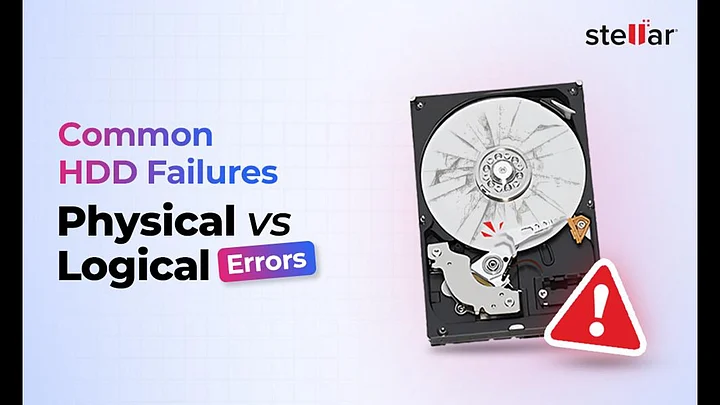
Hard drives can fail for many reasons, and when they do, important files often become inaccessible. While some issues develop slowly over time, others happen suddenly due to accidents or electrical problems.
These problems typically fall into two categories — physical damage and logical corruption. In many cases, recovering the data safely requires a professional data recovery service or specialized HDD recovery service.
What are the most common HDD problems?
The five most common hard disk issues that lead to data loss are:
1. Water-damaged hard drives
2. Burnt or surge-damaged drives
3. Mechanical failures such as head crashes
4. Firmware corruption
5. File system or partition corruption
Understanding how HDD failures occur
Hard Disk Drives (HDDs) remain widely used in enterprise storage systems, surveillance infrastructures, government institutions, and IT environments. Despite their reliability, HDDs are mechanical devices and are vulnerable to various types of failures.
Inside a hard drive are several precision components working together:
● Magnetic platters that store data
● Read/write heads that access data
● Actuator arms that position the heads
● Spindle motors that rotate the platters
● Controller boards (PCB) that manage communication
● Embedded firmware controlling drive operations
Because these components operate with microscopic precision, even small disruptions—such as electrical fluctuations, environmental exposure, or software corruption—can make the drive inaccessible. When such failures occur, professional hard disk recovery becomes necessary to retrieve important data safely.
Physical HDD failures
Physical failures occur when internal hardware components are damaged. These cases often require specialized infrastructure and engineering expertise for safe hard drive data recovery.
1. Water-damaged hard drives
What happens when a hard drive gets wet?
Exposure to water, humidity, condensation, or liquid spills can damage both electronic circuits and internal storage surfaces.
Typical technical impact
● Corrosion of PCB circuits
● Oxidation on platter surfaces
● Contamination inside the sealed drive chamber
● Read/write heads sticking to platters (stiction)
Repeatedly powering on a wet drive can worsen the damage. In such situations, Stellar HDD recovery service experts typically perform disassembly and sector-level data extraction in India's only Class 100 cleanroom lab for data recovery.
2. Burnt or surge-damaged hard drives
Why do hard drives burn?
Electrical surges, unstable power supply, or internal short circuits can burn PCB components and damage internal drive electronics.
Common symptoms
● Burnt smell from the drive
● Melted connectors or components
● System failing to detect the hard drive
● Visible PCB damage
Recovering data from burnt drives may require donor PCB replacement and specialized hardware reconstruction techniques as part of a data recovery service process.
3. Mechanical failures (head crash or motor failure)
What is a head crash?
A head crash occurs when the read/write head touches the platter surface while the disk is spinning. Since the platter contains the magnetic layer storing data, even minor scratches can cause serious data loss.
Common warning signs
● Clicking or grinding noises
● Hard drive not spinning
● BIOS unable to detect the drive
● Rapid increase in bad sectors
Mechanical failures require opening the drive in a Class 100 clean room environment. Attempting DIY repair can permanently destroy the data and make hard disk recovery extremely difficult.
Logical HDD failures
Logical failures occur when the hard drive hardware remains functional but the data structure becomes corrupted.
These situations often require specialized hard drive data recovery techniques to reconstruct damaged data structures.
4. Firmware corruption
What is hard drive firmware?
Firmware is the internal microcode that controls how the drive initializes, reads sectors, manages bad blocks, and communicates with the system.
Causes of firmware corruption
● Sudden power failure
● Voltage fluctuations
● Firmware bugs
● Media degradation
Typical symptoms
● Drive showing incorrect capacity (0 MB)
● System freezing when accessing the drive
● SMART warnings
● Data inaccessible despite normal drive spin
Repairing firmware corruption usually requires specialized diagnostic tools used by professional HDD recovery service providers.
5. File system corruption and partition errors
What happens during file system corruption?
The file system organizes how data is stored and accessed. When this structure becomes damaged, the operating system cannot locate the files—even though the data still exists on the disk.
Common causes
● Improper shutdowns
● Malware or ransomware attacks
● Accidental formatting
● Operating system crashes
Common symptoms
● RAW file system errors
● Missing partitions
● “Drive not accessible” messages
● Disappearing files and folders
Professional hard drive data recovery involves sector-by-sector imaging and reconstruction of the damaged file system.
How professional HDD recovery services work
Recovering data from a failed hard drive requires specialized infrastructure, tools, and technical expertise. Professional data recovery services like Stellar providers follow a structured process to ensure safe retrieval of information.
A typical HDD recovery service process includes:
1. Initial drive diagnosis
2. Failure type identification (physical or logical)
3. Sector-level disk imaging
4. Repair of firmware or file system structures
5. Secure extraction of recovered data
Why professional hard disk recovery is important
Hard drives are extremely sensitive devices. Improper handling can worsen the damage and significantly reduce recovery chances.
Professional hard disk recovery services provide:
● Controlled clean room environments
● Advanced firmware repair tools
● Compatible donor components
● Secure data handling protocols
● Experienced recovery engineers
These capabilities significantly increase the chances of successful hard drive data recovery, even in complex failure scenarios.
Conclusion
Hard drive failures generally fall into two categories — physical damage and logical corruption. Each type requires a different recovery approach and specialized tools.
Warning signs such as unusual noises, system detection errors, or sudden data loss should never be ignored. Continuing to use a failing drive can make recovery much more difficult.
In such cases, consulting a professional data recovery service ensures that the drive is handled safely and the chances of successful hard drive data recovery remain high.
Frequently Asked Questions
1. Can data be recovered from a physically damaged hard drive?
Yes. Many physically damaged drives can still be recovered using specialized HDD recovery service techniques performed in clean room environments.
2. What should I do if my hard drive stops working?
Stop using the drive immediately and avoid repeated power cycles. Contact a professional data recovery service to prevent further damage.
3. Is logical data loss easier to recover?
In many cases, yes. Logical issues such as file system corruption can often be resolved using advanced hard disk recovery tools and techniques.
4. Can deleted or formatted drives be recovered?
Yes. Professional hard drive data recovery services can often restore data from formatted or accidentally deleted partitions using sector-level reconstruction.