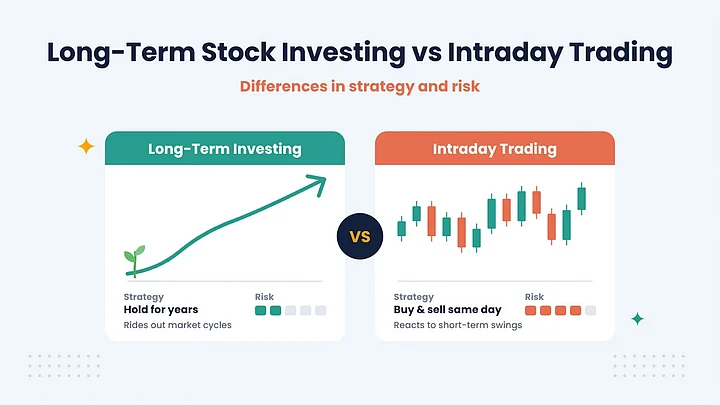
When investing in stocks, there are two common approaches. Some people invest in stocks and hold them for several years, while others buy and sell shares on the same trading day to take advantage of short-term price movements. These are known as long-term stock investments and intraday trading. Both involve risk but differ in strategy, time requirements and trading needs.
This article explains the differences between the two approaches, how they work, the risks involved and what to consider before choosing one.
What Is Long-Term Stock Investment ? What Is Long-Term Stock Investment?
Long term stock investment involves buying shares in a company and holding the stock for a period of time. The length of time varies based on the financial goals and investment strategy of the investor.
The goal is typically to gain from the growth of the company's business and fluctuating value of the stock. In addition, if the company pays any dividend this may also be received.
Long-term investment requires patience and you should regularly check on the performance of the company. You should also look at your investments when the business changes or the reason you invested has changed.
What Is Intraday Trading ? What Is Intraday Trading?
Intraday trading is when you buy and sell shares in the same trading day. The goal is to benefit from short-term price movements.
For example, you could buy a share for 500 in the morning and sell it for 510 before the market closes. This would give you a gross profit of 10 per share. (before brokers fees, tax and other charges).
You need to understand how the market works and place your orders on a stock investment app. If you have an intraday position open at the end of the trading day your broker could square you off depending on their policies.
Difference Between Long-Term Stock Investment and Intraday Trading Difference Between Long-Term Stock Investment and Intraday Trading
While both approaches involve buying and selling shares, there are several differences.
| Basis | Long-Term Stock Investment | Intraday Trading |
|---|---|---|
| Holding period | Several months or years | Same trading day |
| Main goal | Long-term growth | Short-term price movements |
| Analysis | Fundamentals and financial performance | Price charts, technical analysis and trends |
| Transactions | Generally fewer | Generally more |
| Time | Periodic monitoring | Throughout the trading day |
| Costs | Depend on the number and value of transactions | Can increase due to frequent buying and selling |
| Risk | Business performance and long-term price fluctuations | Short-term market volatility |
Differences in Strategy Differences in Strategy
A different strategy will be used when investing long term.
Long Term Stock Investment: Typically, investors will research the company they wish to invest in. This includes looking into the business model, financial statements, revenue growth, profitability and debt. Comparing the company's valuation to its performance and industry may also be done. The goal is to find companies that fit their investment goals and invest in them.
Intraday Trading: Typically, intraday trading focuses on the short-term price movements of the stock. Traders may look into technical analysis, support and resistance levels, trading volumes and price patterns to determine entry and exit points on an intraday trading app. As the position is exited within the day timing becomes an important consideration.
There is no guarantee that either strategy will provide a positive outcome. Both require research.
Risks Involved Risks Involved
Long-term stock investment and intraday trading involve different types of risks.
Long-term stock investment risks:
Performance of business: The company may not perform well with revenue, profitability and market position declining.
Market Risk: Overall market performance may cause share prices to fluctuate.
Valuation Risk: You may pay a price for the shares which doesn’t match the performance of the company.
Sector Risk: New regulations, competition and changing customer demand may affect the company.
Intraday trading risks:
Volatility: Price movements can cause losses in a short amount of time.
Order risk: Orders may be filled at different prices than expected.
Costly: Can become expensive due to frequent trading.
Emotional decisions: Fast market movements may cause you to make emotional decisions.
Leverage: Using borrowed funds or margin facilities can increase the impact of losses.
Before investing or trading, you should consider your financial situation and ability to manage risk.
Which Option Should I Choose? Which Option Should I Choose?
The choice depends on your goals, knowledge of the market, available time and ability to manage risk.
Long-term investment: If you want to hold shares for an extended period, have long-term financial goals and are willing to research company fundamentals, this approach may suit you.
Intraday trading: If you understand short-term market movements, have time to monitor the market and are comfortable managing frequent transactions and their associated risks, this approach may be suitable.
You should not choose an option only because of the possibility of short-term profits or wealth creation over time. Consider your financial situation and investment goals before making a decision.
Conclusion
Overall, long-term stock investment and intraday trading differ in the time frame, strategy and risks. Long-term investors will usually focus on fundamentals and performance of a company while intraday traders will focus on short-term price movements. Both have market risks and require research. Investors can use the 5paisa Alpha app to look into the trading facilities and market features offered for trading. It is important to pick a method to invest/trade which suits your goals, time and risk tolerance.