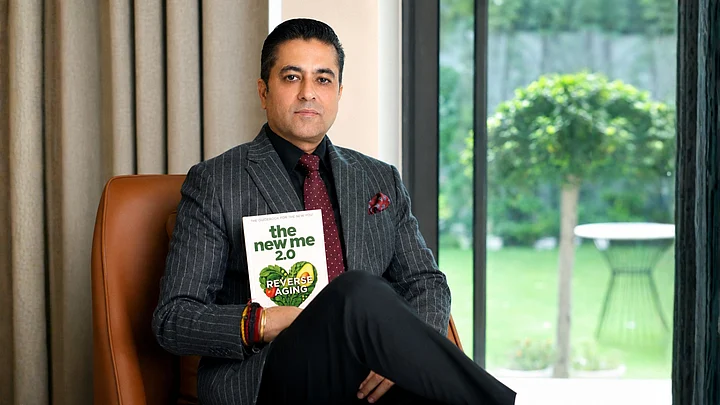
Ask most entrepreneurs what success looks like, and you'll hear about revenue, exits and market share. Gagan Dhawan wants people to add one more metric to that list: how well they're actually living.
The Delhi-based entrepreneur, angel investor and author has announced his second book, The New Me 2.0, due for release later this year. It follows his 2022 debut, The New Me: A Guidebook to Perfect Health, which went on to earn the International Book of Honour at the House of Lords, British Parliament, in 2023. Dhawan says the new book digs deeper, and closer to home, opening not with theory but with an admission: that most transformation attempts fail not from a lack of willpower, but from expectations set so high that a single slip is read by the brain as proof of failure, quietly reducing the appetite to try again. His answer, as he puts it in the book, was to substitute structure for inspiration, beginning with sleep, which he calls the foundation everything else rests on.
At the heart of the book is what Dhawan calls the WISE Framework, standing for Water, Intent, Sleep and Eating, his attempt to distill preventive health into four pillars people can actually sustain, rather than another list of rules that collapses under the weight of daily life. Each pillar is treated less as a discipline to be willed and more as a system to be engineered. Water is reframed as a morning ritual rather than a mechanical eight glasses rule. Sleep is described in the book as biological housekeeping, tied to the glymphatic system's overnight clearing of waste from the brain, and to the shift between the body's stressed and rested states. Food, meanwhile, is presented as information the body reads and responds to, not simply fuel measured in calories, with an emphasis on chewing, timing meals around the day's natural energy curve, and eating consciously rather than mechanically.
The book takes aim at the usual modern culprits: chronic stress, burnout, poor nutrition, screen fatigue and the slow creep of physical inactivity that defines so many working lives today. Where it gets more specific, and more personal, is in its case for whole food, plant-based eating. Dhawan leans on both clinical research and what he describes as a much older Indian intuition about the link between food, body and mind, including the traditional classification of food as sattvic, rajasic or tamasic according to the mental and emotional state it produces. He frames the argument around a line that runs through the book: that when diet goes wrong, no medicine can fix it, and when diet is right, none is needed. It is not just a talking point for him. Dhawan has written about coming off medication entirely after overhauling his own diet, recalling being told by his doctor that he would need medication to manage his blood pressure and cholesterol, before a shift to plant-based eating changed the outcome. He now describes himself as medication-free and more energetic than before.
Beyond food, The New Me 2.0 spends real time on the idea of intention: starting the day in stillness, eating without distraction, making choices with awareness instead of autopilot. Dhawan ties this to concrete science, including cortisol regulation, the gut-brain axis and circadian rhythm, and references the traditional Indian practice of living in rhythm with sunrise and sunset as an early precursor to what modern chronobiology would later confirm in a laboratory setting. He also holds this alongside older ethical frameworks, connecting his plant-based choice to the concept of ahimsa, or non-violence, and to karma as a cycle of cause and effect running through thought, word and action. He is careful in the book to frame this as a matter of personal responsibility rather than judgment of anyone else's choices, writing that health, in his view, is not a moral issue but a practical one. It is an unusual blend for a book rooted in entrepreneurship, part physiology and part philosophy, built on the recurring device of pairing a traditional reference point with a cited modern study and letting the two arrive at the same conclusion independently.
"Health is not a destination that can be achieved overnight," Dhawan said. "It is a lifelong journey built on small, consistent choices. Through The New Me 2.0, I wanted to create a practical guide that encourages individuals to invest in their wellbeing, strengthen their resilience and discover that true success begins with good health."
The book also devotes significant space to the architecture of self-discipline itself, arguing that traits people treat as fixed, such as being a night person or simply not a disciplined person, are usually reinforced behaviour rather than settled fact, and that repeating a new behaviour is how identity gets rewritten. Dhawan illustrates the principle through his own progression from five push-ups to over one hundred and eighty in thirty days, offered less as a fitness claim than as evidence for a broader argument that small, boring, repeatable wins outlast dramatic resets. A chapter on addiction extends the same reasoning to substance dependency, framing it as a hijacking of the same reward pathways that, properly directed, build self-trust instead. A further chapter of case studies draws on the public comeback stories of figures including Robert Downey Jr., Virat Kohli, Novak Djokovic, Rich Roll, Venus Williams, Arnold Schwarzenegger and Chris Paul, using them to argue that nutrition and lifestyle overhaul are a recurring thread in real-world recoveries, not just Dhawan's own.
Dhawan's own path has been anything but linear. He started in sales and marketing in the years after India's economic liberalisation, then founded RHI Printographics in 1999, the first step in a career that would eventually stretch across advertising, education, wellness, devotional retail and consumer businesses, alongside a stake in a hospitality and real estate project at Tehri Lake in Uttarakhand. Along the way, he built The New Me into a wellness platform in its own right, founded ServDharm to bring modern retail standards to India's devotional products market, and backed Metis Learning Solutions, the company behind the STEM education brand Einstein Box, now expanding overseas under the Doctor Jupiter name. He has also become an active angel investor, with a portfolio spanning education, technology, wellness, fashion, hospitality and sports retail, and a reputation among founders for staying involved well past the cheque, offering strategic guidance and operational mentoring alongside capital.
He credits much of this- the discipline and the long-game thinking- to growing up in an Indian Army family, as the son of Brigadier S. C. Dhawan (Retd.) and Kamal Dhawan. He completed his schooling at KV and Army School before pursuing higher education at the University of Delhi and has spoken about how the values instilled early on- discipline, adaptability, and consistency- continue to shape both his business decisions and his approach to health.
The book's arrival isn't accidental. Preventive healthcare, longevity and healthy ageing have moved from wellness niche topics to mainstream conversation, driven by rising lifestyle disorders, increasing workplace stress and growing awareness around mental wellbeing. Dhawan has been making the rounds on business and television media ahead of the launch, positioning The New Me 2.0 less as a diet book and more as an argument for rethinking what success is supposed to cost you. Unlike his first book, which focused on practical guidance around nutrition, fitness and habit formation, the new title adopts a more personal narrative, reflecting on the pressures of entrepreneurship and the case for building physical and mental resilience alongside a career, rather than after one.
"Entrepreneurship taught me the importance of perseverance," Dhawan said, "while my personal health journey taught me the importance of balance. Success without good health is incomplete. My hope is that The New Me 2.0 inspires readers to make choices that improve not only how long they live, but how well they live."
The New Me 2.0 will release in print and digital formats later this year, alongside a series of reader interactions, wellness discussions and knowledge-sharing sessions focused on preventive healthcare, healthy ageing and sustainable lifestyle transformation.
About Gagan Dhawan
Gagan Dhawan is an Indian entrepreneur, angel investor and author with over two decades of experience across advertising, education, wellness and consumer businesses. Born into an Indian Army family, he is the son of Brigadier S. C. Dhawan (Retd.) and Kamal Dhawan. He completed his schooling at KV and Army School and pursued higher education at the University of Delhi. Beginning his career in sales and marketing, Dhawan founded RHI Printographics in 1999 before expanding into wellness, STEM education and devotional commerce through ventures including The New Me, ServDharm and his association with Metis Learning Solutions, the company behind Einstein Box and the Doctor Jupiter brand. As an active investor and mentor, he has supported startups across education, technology, wellness and hospitality. His first book, The New Me, received the International Book of Honour at the House of Lords, British Parliament, in 2023.