Thank You Sunita Williams, You Made Indian Kids Dream of Reaching for the Stars
Sunita Williams has retired from NASA, the American space agency announced on 20 January.
advertisement
As I look out of my window to see the perfect crescent Moon on the evening of 21 January, I am reminded of the day’s headlines. Indian-origin NASA astronaut Sunita Williams has retired from the American space agency.
Her retirement, effective from the 27th of last month, was announced by the National Aeronautics and Space Administration on 20 January.
“Suni Williams has been a trailblazer in human spaceflight, shaping the future of exploration through her leadership aboard the space station and paving the way for commercial missions to low Earth orbit,” said NASA Administrator Jared Isaacman, in a statement.
This marks the end of a remarkable career, spanning 27 years–one that inspired many, including this author.
Together, We Saw a Dream
Suni, as she is lovingly called in the United States, joined NASA’s astronaut training program in 1998, after serving in the US Navy for over a decade. She retired from the US Navy as a Captain in 2017. I, a mere Gen-Z by temperament, was not even born when her career began.
But I often reminisce about the summer of 2007.
And, a glitter shimmered in the eyes of a kid, caught by the mystery, the beauty and the vastness of the cosmos –all feeding into his innate curiosity.
“I shall be an astronaut, one day,” I proclaimed in class, prompted by my Grade II English teacher's inquiry about our dream careers, one fine morning.
“I will go to space,” I told her, who later happily shared my dreams with my loving Indian parents.
What followed was weeks of career counselling–yes, at age seven–where I was told about the many perils of a career in space: rigorous training, hard-to-swallow food pills, cool-yet-heavy space suits and, worst, the fear of never returning home from space.
In these scare-me-out-of-space sessions, my mother was enthusiastically joined by my loving cousin sister, Manpreet. Had he known the duo, one could say ‘Lost in Space’ director Stephen Hopkins sought his inspiration from them!
As fate would have it, years after that, I would go on to teach her daughter about my love–space! But we get to that later.
Weeks later, in another career day activity at school, I conceded: “Maybe I won’t go to space, but I can be an engineer!”
A eureka moment for my mom, only she didn’t know years later I would chase another dream, one she initially resisted but eventually appreciated: journalism.
But you never forget your first love. I continue to dabble with space science and astronomy to this day.
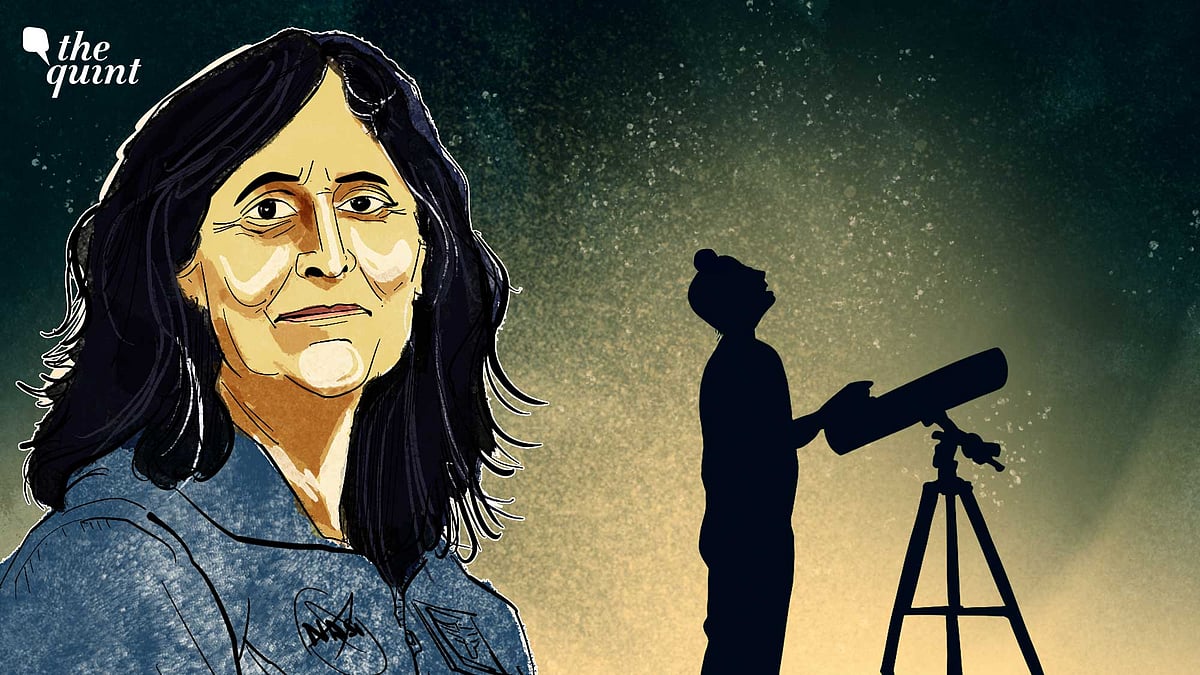
The 700mm Newtonian reflector telescope on my terrace is proof of that!
Kalpana Chawla to Suni: Women in STEM in India
Suni’s friend, the famous NASA astronaut Kalpana Chawla, was the first Indian-origin American woman to go to space in 1997. But Chawla’s tragic death in the 2003 Space Shuttle Columbia accident upon re-entry to Earth on her second mission had shaken not just the US, but also India. Suni had then stayed with Chawla’s mother in the US for over three months.
Speaking at an event during her maiden visit to India after her second mission, she said: “I had to continue Chawla’s dream.”
Both Chawla and Williams not only sparked my curiosity; they also shaped how my generation saw women in science. They continue to inspire millions of young girls in India, who are now actively pursuing higher education in STEM (Science, Technology, Engineering, Mathematics) courses.
Mohali-based astrophotographer and astronomy trainer, Amrinder Jit Singh, holds regular night space workshops across India. “People of all ages participate in these workshops. Parents equally encourage their sons and daughters to learn more about space science. I see many young girls in my workshops who can one day grow up to be Kalpana Chawla and Sunita Williams,” he said.
My nine-year-old niece, Bisman, Manpreet’s daughter, is one of those young girls. I often teach her about the night sky. My rooftop classes are probably not as intricate as Amrinder’s, but I make it a point to at least show her the Moon, Jupiter and other celestial objects, using the terrace telescope. We’re waiting for my two young nephews to grow up and join our stargazing sessions.
But India still faces a critical gender paradox: 43% of India’s STEM graduates are women, the highest among major global economies. Yet, women represent only 27% of the STEM workforce, as per the Periodic Labour Force Survey (PLFS) 2023-24.
A Walk in Space
In her 27 years with NASA, Suni has been to space on three missions to the International Space Station (ISS) – in 2006-07, 2012, and 2024-2025. She has spent over 608 days in space, which is the second-highest cumulative time in space by a NASA astronaut.
She also completed nine spacewalks or extravehicular activities (EVAs), totalling 62 hours and 6 minutes, ranking as the most spacewalk time by a woman and the fourth-most all-time total spacewalk duration.
Suni’s resilience reminds me of 35-year-old Mohali Rawat, who lost her ability to walk after suffering a quadriplegic injury in an accident in 2011. An amateur space enthusiast, Mohali now lives her dreams by teaching others about space. A marketer by profession, her startup Cosmic Crater sells space calendars, with every celestial event marked on them.
“I’ve always loved stars. I chose engineering to follow in the footsteps of Kalpana and Sunita, but an unexpected accident brought my world to a standstill… I then poured my heart into creating this astronomical calendar. Even if I can no longer go out in the fields to see the stars, I’m happy my product can guide others in doing so.”
India is seeing a boom in space-related businesses, from selling telescopes and other equipment to offering astrotourism experiences.
For me, astronomy is more than just a hobby. It’s a way of reliving that seven-year-old boy’s dream. Even if I can’t reach the stars, I can at least see them a little bit closer than others.
Though air pollution in metropolitan cities such as Delhi constricts this experience for the better half of the year, forcing the stargazers to travel to far-off places in search of the cosmos.
Sunita Williams is currently visiting India, a country that will always love and cherish her.
She might be retiring from her space journey, but her dream shall be carried on by many others.
It is time to get out the telescope on my terrace, again…
(The writer is an independent journalist, editor, storyteller and documentary filmmaker, specialising in covering international affairs, national politics, human rights, gender, social justice issues, and investigations.)