Satya Niketan PG Collapse: 5 Questions the Delhi Government Must Answer
At every stage of the Satya Niketan tragedy in Delhi, there are questions of institutional accountability.
advertisement
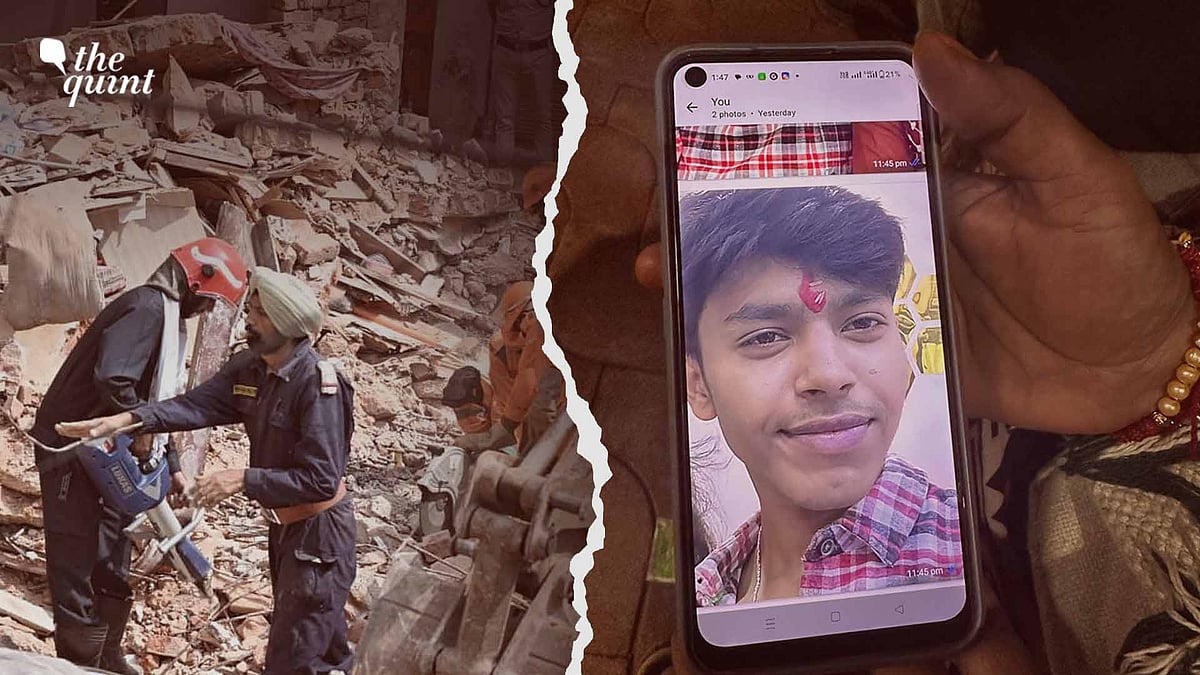
Seventy two hours after the boys' PG 'Hostel Daze' collapsed in Delhi’s Satya Niketan, several critical questions remain unanswered by the administration and the Rekha Gupta-led Bharatiya Janata Party (BJP) government.
Here are five questions:
1. Illegal Construction & Administrative Inaction
Multiple reports have pointed out that the standard area norms in Satya Niketan do not permit a basement-plus-ground-plus-four (G+4) structure such as Hostel Daze, raising questions about whether the building violated existing construction norms. If so, why was such unauthorised construction allowed to exist in the first place?
Furthermore, an estimated 70-80 percent of PG accommodations in the locality have four or more floors. Why didn’t local authorities act before a fatal collapse occurred? And what action, if any, will they take against unauthorised structures now?
2. Rescue Delays & Ground Emergency Response
The National Students’ Union of India (NSUI) has alleged that the National Disaster Response Force (NDRF) and a JCB excavator reached the site around two hours after the collapse. Multiple videos circulating online show local students and student organisations carrying out the initial rescue efforts, while eyewitnesses said the arrival of JCB excavators was delayed by at least an hour.
The fact that private Blinkit ambulances reportedly reached the site before civic emergency services also raises broader questions about the state of Delhi’s emergency response infrastructure.
3. Institutional Accountability of Delhi University
Hearing a public interest litigation on the matter, the Delhi High Court observed that the University of Delhi (DU), too, cannot be absolved of its institutional responsibility. DU admits roughly 80,000 undergraduate students every year, yet its total hostel capacity stands at fewer than 9,000 seats. More than half of its students are from outside Delhi, and many are forced to rent expensive, and often unsafe, PG accommodations.
Why has the university not done more to provide affordable and safe accommodation to its own students, despite demands for expanded hostel capacity for years? And can an institution with such a severe shortage of accommodation distance itself from the conditions in which its students are forced to live?
4. Medical Management & Family Misinformation
Families of victims reported being shuttled between multiple medical facilities. Rescued students and workers were dispersed across Army Hospital, Safdarjung Hospital, and the AIIMS Trauma Centre. The family of 19-year-old Arpit, a second-year student at Aryabhatta College, for instance, alleged that they were left in the dark about his whereabouts for hours.
5. Were Any Lessons Learnt from a Previous Tragedy?
This wasn't the first time a building had collapsed in the vicinity. In 2022, an under-construction building just 100 metres from Hostel Daze collapsed, killing at least two labourers. Locals said there had been discussions about conducting a safety audit in the area, but the administration never followed through.
Had a safety audit happened in 2022, this tragedy perhaps could have been prevented. Why didn’t the local authorities walk the talk?
What, if anything, did the authorities learn from that tragedy? If the administration had identified unsafe or unauthorised structures in the area then, could this tragedy have been prevented?
Besides these questions, the role of the Delhi Police and the NDRF has under scrutiny. Multiple reporters and people on the ground spoke of what appeared to be an internet shutdown or disruption in connectivity. Was internet access in the area restricted? If so, who ordered it and why?
The Delhi Police is yet to publicly clarify how many students were living inside the PG at the time of the collapse, even after the owners were arrested. There are also questions surrounding reports of a basement at the property and whether anyone could still be trapped inside, as well as why the NDRF was subsequently withdrawn from the site.
At every stage of this tragedy—from allowing potentially unauthorised construction to remain in place, to the response at the site, to the treatment of victims and their families afterwards—there appear to be questions of institutional accountability. These cannot be brushed aside as an unfortunate accident. A building may collapse in seconds, but the failures that allow such a disaster to happen are usually years in the making.
(The author is an independent researcher and reporter.)