
Zilla Parishad Polls Show Churn Beneath 'Stable' Maharashtra's Political Surface
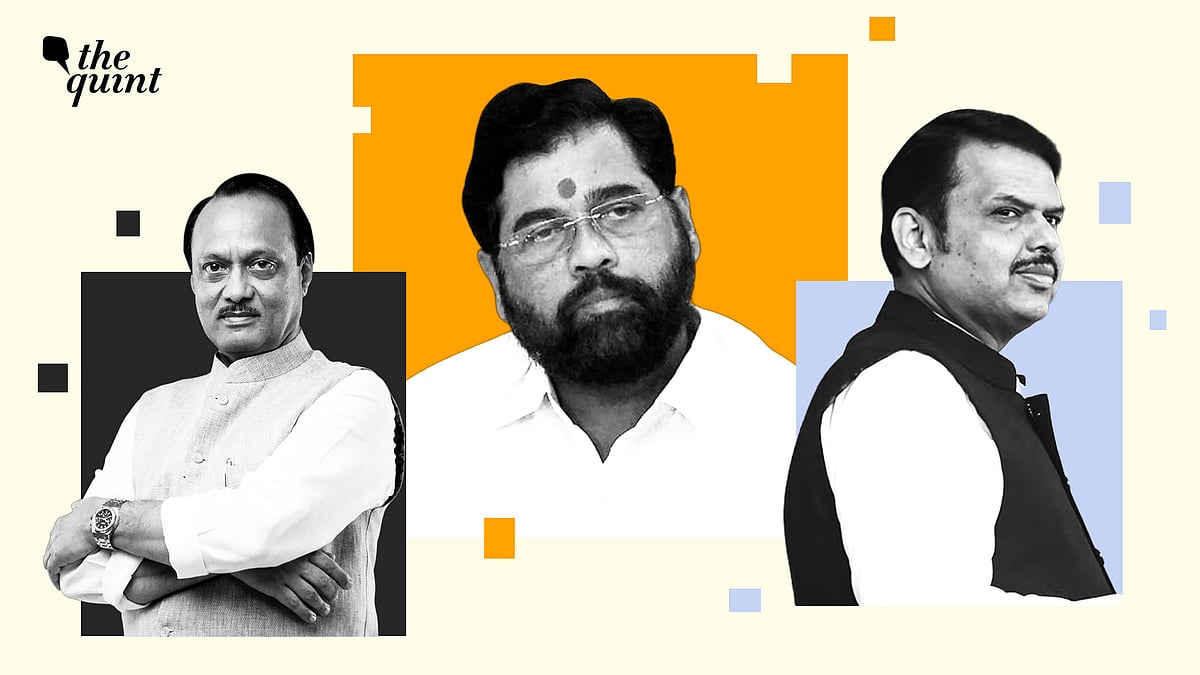
Ajit Pawar’s NCP emerged as the second largest party in the state, a feat Pawar could never achieve in his lifetime.
advertisement
To unsuspecting watchers, Maharashtra’s politics resembles the placid waters of Mumbai’s Mithi river—sluggish but barely moving.
That the dominant Bharatiya Janata Party (BJP) and its Mahayuti alliance, is stable and only growing in strength, while its opponents remain near-decimated. Except, Mumbaikars know better that the Mithi is anything but unmoving.
For the Mithi is a river that harbours many secrets, from bodies thrown into the river and regularly fished out by the police, to gargantuan financial scams in the name of cleaning the river. Its placid surface hides the churn beneath. That’s also how Maharashtra’s politics indeed is: stable on the surface, and yet vociferously churning inside.
This week’s all-important election results to the state’s rural local bodies might have managed to give a glimpse of this tumult.
Rural Poll Results Disrupt Expected Script
Elections were held in Maharashtra last week for 12 district Zilla Parishads and 126 block-level Panchayat Samitis. These polls help establish party organisations, connect the party to the last voter in the village, and allow for both ‘resources’ to flow into the party while offering powerful positions for local workers.
Many had expected them to follow the script— the BJP would remain in pole position, Eknath Shinde’s Shiv Sena would follow second, and a third slot would be up for grabs between the remaining players.
Except, the elections—held days after Deputy Chief Minister and Nationalist Congress Party (NCP) chief Ajit Pawar’s death in an aircraft crash, coincidentally while on his way to address poll rallies—upturned this in three big ways:
Ajit Pawar’s NCP emerged as the second largest party in the state, after the BJP, an obvious first. It’s a feat Pawar could never achieve in his own lifetime, despite his ambitions. Soon after he split with his uncle and established the NCP, the party was told in no uncertain terms: the NCP’s immediate ambition was to emerge as party #2 in the state. He had staked his ambitions, his family relations and his political career for this dream. That it happened in the days after his death is cruel irony.
The NCP’s rise came at the cost of Shinde’s Sena. The party was marginally behind in the polls—while the NCP won 165 Zilla Parishad seats, the Sena won 162.
The BJP, while still the most dominant force, isn’t as invincible as it might seem. It won 225 of the total 731 Zilla Parishad seats and 459 of the total 1462 seats that went to polls this month, which is barely above 30 percent of the total seats. In the 2024 state polls, it won 46 percent of all seats. Its strike rate is down as well—from 85 percent in the 2024 state polls to just about 45 percent in these polls.
Alliance Tensions—Shinde vs NCP
For the ruling Mahayuti alliance, these results are crucial. That they were going to emerge as the dominant alliance was a foregone conclusion. What is being closely watched is the tussle between the NCP and the Shinde Sena—the results would decide the pecking order between the BJP and its lesser alliance partners.
Which is why the NCP’s showing matters. Within the BJP, many are tempted to watch the NCP closely as it regathers itself after Pawar’s death. Can it offer an alternative to its mercurial partner, the Shinde Sena? These results offer a glimmer of hope.
After all, the NCP’s performance establishes its rural dominance and fits into a perfect grip with the BJP’s urban-centric stronghold.
“Ajit dada had made extensive plans to campaign aggressively across the state for these polls,” Sanjay Tatkare, NCP secretary, told The Quint. “The NCP has always been a stronger rural force, and these results only underline that.”
Shinde knows this. Which is why he became the only major leader to campaign for these polls after Pawar’s shocking demise. Fadnavis had called off his campaign, as did both the NCP factions, as a mark of respect for Pawar and the grieving that followed his death.
Shinde, however, cast aside these niceties. Media estimates said he held over 20 public meetings across the state.
Party spokesperson and Sena member of legislative council Manisha Kayande said Shinde did put in the effort.
And yet, to come second to Pawar's NCP must have hurt.
Kayande said Pawar’s death, and the resultant sympathy towards the NCP could have tilted the results in the party’s favour. “But we have no regrets. His death is a personal loss to all of us.”
Yet, in Maharashtra’s cut-throat politics, the numbers matter. The Sena’s numbers dictate its utility. For now, the Shinde Sena lives to fight another day.
Churning in the Opposition Camp
If recalibrations are happening in the ruling alliance, the opposition Maha Vikas Aghadi might see some soon enough too.
The alliance is adrift, and floundering.
Since then, the party has been in a downward spiral, with its leadership looking increasingly disinterested in arresting it. In January’s urban body polls, where the party even lost its 30-year-long grip over the BMC, it ended up with only 155 of the total 2869 seats. It was wiped out in cities like Thane, Kalyan-Dombivali, and Navi Mumbai—all strongholds of the party till a few years ago.
Now, even in rural areas, the party has failed miserably, bagging only 43 zilla parishad and 89 panchayat samiti seats. Within political circles in the state, it is increasingly clear—the party is now a Mumbai-centric party.
A source close to the party told The Quint the party was "biding its time." The BJP’s dominance is not going to last forever. We will have to wait this period out, is the thought in the party, the source said.
An even more unclear fate awaits the MVA partner, the NCP-SP. The party finished the last among both alliances, an indicator of how rapidly the party is fading into oblivion.
The NCP-SP and the Ajit Pawar’s NCP had entered into an alliance for these polls and in many constituencies, the two had even decided to fight under the NCP’s original clock symbol—now wrested with Ajit Pawar’s party. Despite these efforts, the NCP-SP managed only to emerge with a handful of seats.
The senior Pawar’s reputation of having a grip over rural Maharashtra, especially western Maharashtra, has been shattered. Even in the party’s stronghold of rural Pune, the ZP elections saw the party winning only a solitary seat out of the total 73 seats.
Where does it leave the party? Waiting on, with despair, at a possible merger with the NCP and being subsumed within it.
The only silver lining for the Opposition was the Congress’ marginally better performance, with 55 ZP seats and 97 Panchayat Samiti seats.
With this tally—a distant one from the ruling Mahayuti parties—the Congress has emerged as the principal opposition party in the state, since it had also bagged the highest seats in municipal corporation polls in January for any opposition player.
“What has helped the Congress is that it still has pockets of influence, where senior leaders are holding fort and are able to deliver results,” said former Congress minister from Amravati Sunil Deshmukh.
These results, leaders point out, are, slowly, paving the way for realignments the state might see: the Congress, increasingly more successful than its peers in the MVA, might start drifting away from the Sena-UBT and the NCP-SP, which, in any case, is moving towards the MVA.
Across both alliances—the NCP has gained footing, the Shinde Sena has lost some, Sena UBT flounders and the NCP-SP looks on listlessly—the undercurrents of change are slowly starting to visibilise.
Like the currents in the Mithi river—barely seen and yet, strong enough to carry the city’s waste away—Maharashtra’s politics is seeing currents lure partners away from each other in different directions.
Which of them meets the shore, which one gets entangled in the mush, will remain to be seen.
(Kunal Purohit is an award-winning independent journalist, writing on politics, gender, development, inequalities, and the intersections between them. He is an alumnus of the School of Oriental and African Studies, University of London. The views expressed above are the author’s own. The Quint neither endorses nor is responsible for them.)
- Access to all paywalled content on site
- Ad-free experience across The Quint
- Early previews of our Special Projects
Published: undefined