The Burden of Women’s Safety Must Shift
When the anger women have contained for decades has finally spilled out onto the streets, how can we make it count?
advertisement
For the past few weeks, the phrase “women’s safety” has once again taken centre stage in our lexicon. Periodically, when a woman is murdered for dowry or assaulted while walking in a park—it briefly catches attention making it seem like an anomaly.
When, in fact, the dial has been slowly turning up over the last decade. Crimes against women have been increasing steadily—this is easily verifiable from the scant data that is available.
And the response has been mostly #notallmen and a renewed focus on “false cases” filed by women. It is no coincidence that the last decade has seen an explosion in social media accounts that vociferously advocate for the rights of men, that highlight the “poor” state of men who are wrongfully accused of crimes. Like frogs in water, the temperature is turned up and somehow life goes on, until it boils over. That is the moment we are faced with now.
So, what has changed this time? Why have these crimes against women triggered such widespread anger and protest?
Decoding Safety In Public Spaces
The big difference is also a generation of women who have been raised to be independent, even while confronting, on a daily basis, a deeply polarized and patriarchal society. They have discovered, much faster than previous generations, that the downsides of patriarchy far outweigh its imagined benefits for women. These women have the language, the access and the information to understand their anger and articulate it clearly.
At this moment, it would be both judicious and expedient to listen to them. Instead, the media and other stakeholders choose to bury their heads in the sand, waiting for the anger to abate, for women to fall silent and return to being the goddesses that Indian society so readily celebrates. I’ve got news for you—they are not going back. This time, the anger is demanding change.
To understand what women are demanding, we need to begin by asking the questions that should have been asked long ago – and listening carefully to the answers.
The first is simple: what actually makes a public space safe or unsafe for women? As the founder of Phree For Safety, a mobile application where women rate streets, establishments and areas as safe or unsafe, we have access to thousands of women’s perceptions and experiences of public spaces. Of all the factors they identify, two are particularly revealing.
The first factor is that women perceive spaces occupied by other women and families as safer. Seen through this lens, the recent push by the Delhi government to restrict women and others from accessing public spaces is the exact opposite of what is needed to make those spaces safer.
If the presence of women increases the perception of safety, then the answer is not to restrict women but to actively encourage them to occupy public spaces. All stakeholders working to make public spaces safer for women, children and other vulnerable groups should be creating more opportunities for women and families to be present. Gatherings, events and community activities can all become effective ways of making this possible.
The other factor that determines whether a woman perceives a space as unsafe is its history of violence and crimes against women. A space is defined not just by its lighting, visibility or accessibility, but also by what has happened there before. Incidents of violence against women do not always reach the media, but informal networks of women carry this information, warning others who live in or frequent the area.
Women then begin to avoid these spaces, leaving them increasingly devoid of women and families — which, in turn, makes them feel even more unsafe. It becomes a self-perpetuating cycle: violence pushes women out of public spaces, and their absence further reinforces the perception of danger.
Breaking this cycle requires a deliberate and concerted effort to bring women back into these spaces and ensure that they can remain there safely.
These factors point to another deeply entrenched problem that perpetuates violence against women: the instinct to make women responsible for their own safety. Victim shaming and blaming are repeatedly presented as solutions—where women should go, what they should wear, when they should be out and how they should behave.
This is not only ethically flawed; it shifts attention away from those who commit these acts of violence and allows them to escape scrutiny and accountability.
But where are the equally visible conversations and campaigns about men’s responsibility? Where are the campaigns challenging exaggerated narratives about false cases filed by women? Where is the rebuttal to the caricature of the modern woman as someone who casually murders men and stuffs their bodies into blue barrels?
The question we should be asking is no longer, “How do we keep women safe?” It is: “How do we stop men from making women unsafe?” Until we are willing to confront that question, we will continue addressing the consequences of violence while leaving its causes untouched.
Action Beyond Discourse
It is impossible to ignore that we are facing an epidemic of violence against women. The future of our civilisation hinges on our ability to turn back this tide with urgency and resolve.
In the words attributed to Khan Abdul Ghaffar Khan, “If you wish to know how civilized a culture is, look at how they treat its women.”
By that measure, India is failing spectacularly.
Our approach to making spaces safer for women, children and other vulnerable groups needs to radically change. The burden of safety cannot continue to fall on those who are most at risk.
Conversations and campaigns must turn their attention to men, addressing the crisis of masculinity and creating spaces where men can question and challenge the attitudes that enable violence. We must empower men and other allies who speak out, intervene and hold accountable those who foster, excuse or commit these crimes.
And if curfews are considered an acceptable response to violence, perhaps it is time to impose them on men in areas with high rates of crimes against women, rather than restricting the movement of women.
Above all, what is needed is an uncompromising collective commitment to making public spaces safer — not by limiting women’s freedom, but by confronting the behaviour that makes them unsafe in the first place.
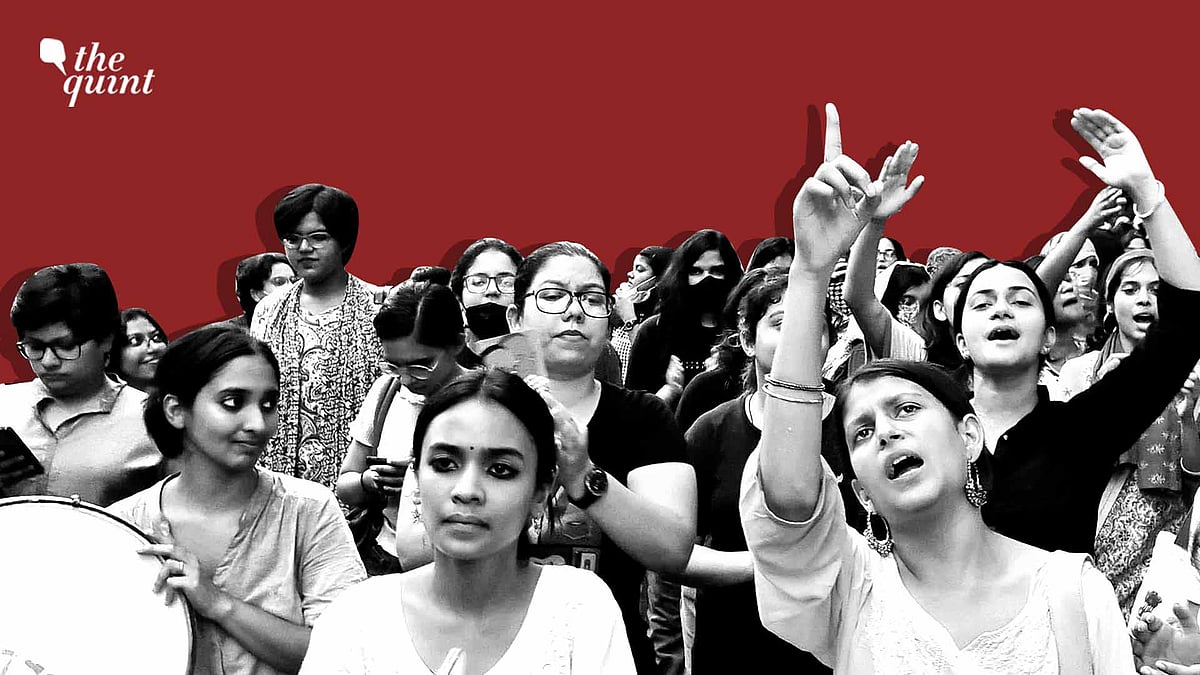
Until then, a revolution is already underway. Women and girls are pushing past parental control, fear of prosecution and societal opposition to show up in large numbers at protests across the country. Their slogans are not merely provocative; they speak to a profound rupture of trust.
“Ek kachori, do samosa, in mardon ka kya bharosa” may sound irreverent, but beneath the humour lies a serious message: women are losing faith in the systems, institutions and people who have promised to protect them while continuing to restrict their freedoms.
And perhaps that is the most significant shift of all. Women are no longer waiting to be protected. They are questioning the very idea of protection when it comes at the price of their freedom.
They are claiming the right to walk, gather, protest, work, celebrate and simply exist in public spaces without having to justify their presence there.
For too long, women have been told that safety requires them to shrink their lives: stay home, come back early, avoid certain streets, dress differently, be careful. That bargain is over.
Women should not disappear from public spaces to make themselves safe. They should occupy them to make them safer. And it is time for the rest of society to stand beside them to make this possible.
(Madhureeta Anand is an author, filmmaker and the founder of Phree For Safety. This is an opinion piece and the views expressed are the author’s own. The Quint neither endorses nor is responsible for them.)