
Decoding Diplomatese: Why India Drew a Red Line With Poland
It is in India and Poland's respective interests to build stable and mutually beneficial relations with each other.
advertisement
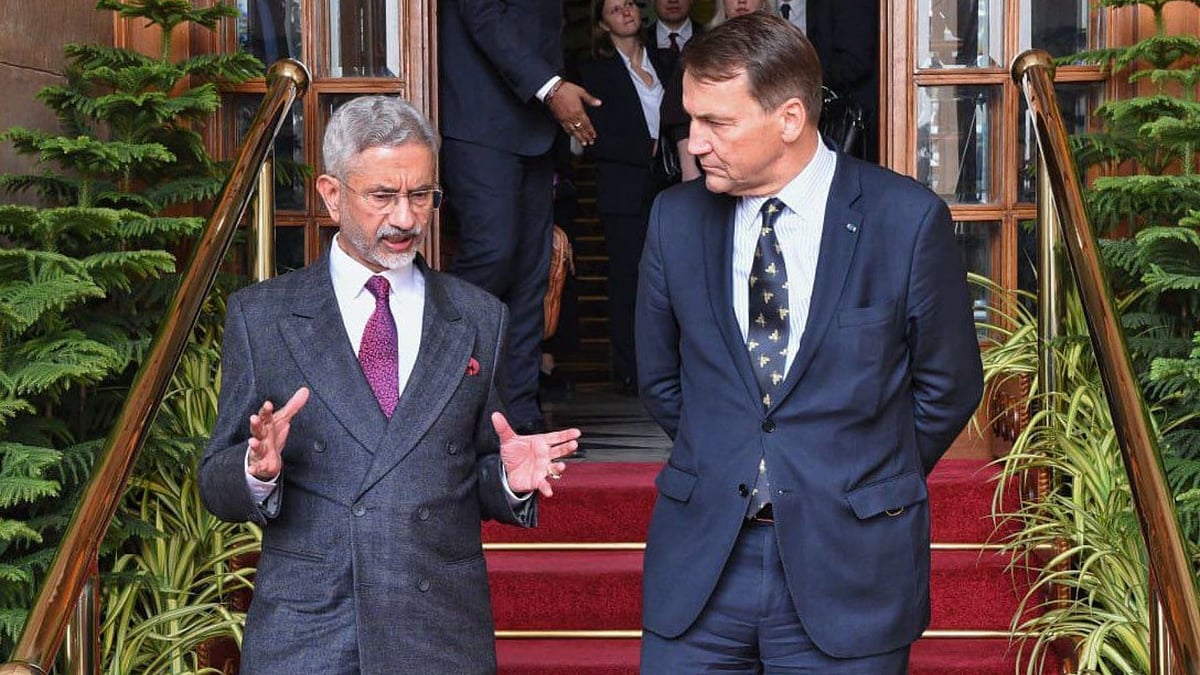
Ministerial visits are usually fairly boring and anodyne as everything is often scripted in advance, or should be. Clearly, this was not the case with the visit of Polish Deputy Prime Minister and Foreign Minister Radoslaw Sikorski to New Delhi earlier this week.
Towards the end of his somewhat standard welcoming remarks, External Affairs Minister S Jaishankar told Sikorski that India was unhappy over the “selective targeting” of India on account of the Ukraine conflict which New Delhi considered “unfair and unjustified.”
He was referring to the European Union’s sanctions against India’s trade and oil imports from Russia. Broadly, he was also referring to the critique that is visited on India on account of its refusal to condemn the Russian invasion of Ukraine.
This was probably in reference to Sikorski’s October 2025 visit to Pakistan. The visit came five months after the India-Pakistan clash of May 2025 which in turn was triggered by the horrific terrorist incident leading to the gunning down of 26 people in Pahalgam in April.
Pakistan and the Terrorism Red Line
In the joint statement following the visit, the issue of the war in Ukraine and Jammu and Kashmir were lumped together and the statement read, “Both sides stressed the need to find peaceful solutions to conflicts, in full respect of the principles of international law and the UN Charter.”
The reason that New Delhi was rightly irritated is that Sikorski is no stranger to the region. As a journalist, he covered the Afghan war and was a columnist for The Statesman of Kolkata. His base was in Pakistan and he is quite familiar with the country and is aware of its “proxy war” against India using Islamists. There has been a feeling in South Block that Sikorski has developed an unacceptable bias towards Islamabad.
Sikorski’s Pakistan Track Record
There is no denying that what Russia has done in Ukraine is wrong. As Sikorski himself pointed out in briefing the press after his meeting with Jaishankar in New Delhi, that “Russia broke the Budapest memorandum under which Ukraine gave up its nuclear weapons and Russia broke the border treaty between the two countries actually signed by Vladimir Putin and Russia broke the UN charter by invading another country with tanks.”
But India’s position has been no secret in the last three years and the question is as to why Sikorski felt the need to bring it up in a visit to New Delhi.
Indeed, this was not the first time Sikorski had so criticised New Delhi. In Paris earlier this month the Polish Minister had expressed satisfaction on India reducing oil imports from Russia “because this is financing the war machine of Putin.”
Poland’s Ukraine Fixation
Of course, India does need to be sensitive to feelings in Poland, which is a neighbour of Ukraine. It is a country that was invaded by Russia many times and colonised. It saw a great deal of war and turmoil and was repeatedly partitioned, and it was only after the Soviet collapse in 1991 that it emerged as a democratic country.
It hosts a large number of Ukrainian refugees and is the logistical base through which Europe provides assistance to the country.
Given these circumstances, Poland feels that a Russian victory in Ukraine would make it the next target of a revanchist Russia. But Sikorski’s complaint that India had taken part in the 4-day Zapad exercises in Belorussia and Poland found that “threatening” is somewhat strange. The 4-day exercise last September, involved just 13,000 personnel, had American observers along with others from NATO. To call such an exercise “threatening” was clearly over-the-top.
Security Fears
Poland is an important Central European country with strong economic prospects driven by robust domestic demand, rising wages and substantial EU funds for investment, with growth pegged at 3.5 percent in 2025-26. It is emerging as a major EU country with the capacity to influence the discussions within the grouping. It became the 20th largest economy in the world in 2025. As Jaishankar pointed out, India’s trade with Poland has increased 200 percent in the past decade, and it is India’s largest trade partner in central Europe.
But it does suffer from considerable geopolitical risk from a potential Russian attack because of its location and staunch support for Ukraine. It is one of the largest spenders on defence within the EU (4.2 percent of its GDP in 2024 and expected to be 4.7 in 2025). Another major problem with Poland is that it is undergoing considerable domestic political turmoil.
The visit and India’s need to draw its red lines, should also be seen in the context of the visit later this month of other high level European leaders including Chancellor of Germany, France’s national security adviser as well as the fact that two of the top-level EU officers — EU Council President Ursula von der Leyen and EU Council President Antonia Costa — will be the chief guests at the Republic Day parade.
The the two sides are likely to sign, in the words of von der Leyen, “the mother of all deals”, an Indo-EU Free Trade Agreement. This deal will cement the India-EU partnership in an era when their respective ties with the US are fraying.
(The writer is a Distinguished Fellow, Observer Research Foundation, New Delhi. This is an opinion piece and all views expressed are the author's own. The Quint does not endorse or is responsible for it in any way.)
- Access to all paywalled content on site
- Ad-free experience across The Quint
- Early previews of our Special Projects
Published: undefined