
Siang Dam Protests: Why Dialogue Must Come Before Development
The Pasighat violence shows local activists are the only check on a dam the BJP calls vital to national security.
advertisement
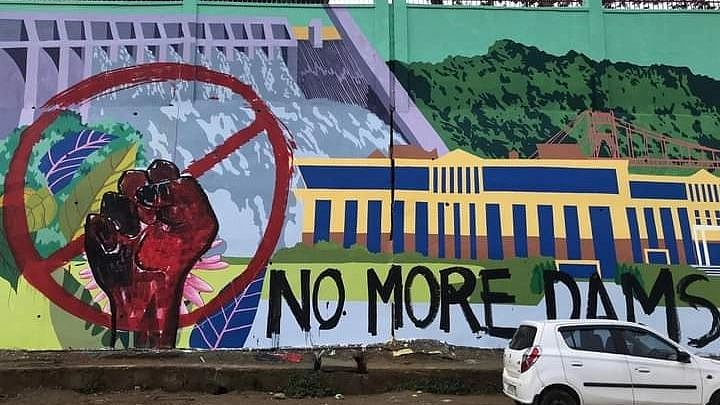
Far away from the power corridors of New Delhi, the northeastern state of Arunachal Pradesh is witnessing protests by the indigenous communities against the proposed Siang Upper Multipurpose Project (SUMP), declared a national project by the previous United Progressive Alliance (UPA) government in 2008. The protests have become a headache for the Pema Khandu-led BJP government of the state.
The saffron party, with 46 legislators and support of 13 legislators from allies and independents, has been ruling the state with almost no opposition. The main Opposition party, Congress, has completely collapsed. It won only 1 seat in the last assembly elections, held in 2024.
The China Factor
In December 2024, China officially declared the building of a massive 60,000 MW dam in the Yarlung Tsangpo river, which enters Arunachal Pradesh as the Siang river, and then flows in Assam as the mighty Brahmaputra.
This is, undoubtedly, a worrying trend for Arunachal Pradesh and India as this dam gives China an upper hand. It can weaponise the dam against India. It is this reason that New Delhi renewed its focus on the 11,200 MW SUMP.
They are refusing to buy the counter to the China argument. Several organisations like the Adi Banne Kebang-United (ABKU), Siang Indigenous Farmers Forum (SIFF), and Adi Galo Welfare Society (AGWS) have been in the forefront demanding the cancellation of the proposed dam.
Khandu Government’s Failure
The protests by the locals, as quoted by the media, aren’t against the interests of the country. The protests are against the government’s decision to build a dam without their consent. It is the duty of the government to take the consent of the locals. This is how democracy works. However, the government in the name of national interests have taken the step to go forward with the project.
This situation could have been avoided if the government was keen to listen to the opinions of the local indigenous people. The government’s adamant approach surely fueled anger among the locals. The dissent started growing when the Khandu government took the decision to deploy central forces and police in December 2024 in the area to suppress the protests against the pre-feasibility study of the project.
The protests turned violent this October. Clearly, the government had time to engage with the local population properly. But it failed to do so. The October violence in Pasighat clearly reflects the government's failure to engage with the local population.
For the indigenous people, forests, rivers, and lands are a part of their livelihood. The proposed dam is feared to submerge 27 villages, and could eventually displace 1.5 lakh people—a large population. Not only this, the Siang region, consisting of loose sedimentary rocks, sits in the Seismic Zone V, a very high risk earthquake zone.
Importantly, the Gauhati High Court has cancelled 44 proposed dams in the Siang Valley in 2022 due to lack of proper scientific research. The court had then noted that any decision to proceed with dam construction must comply with legal standards, and prioritise the safety, security, and welfare of the local affected populations.
Opening the Path of Dialogue
With the protesting organisations taking an adamant stand, the state government took a positive step by releasing four prominent anti-dam activists detained under the Arunachal Pradesh Unlawful Activities (Prevention) Act. However, other activists still remain in detention, while the deployment of central forces—another point of contention—continues in the area.
It is the duty of the government to open the deadlocks coming in the way of dialogue. It just can’t allow the anger to grow. The state, bordering China, is also politically sensitive. This dissent against the state government could be exploited by China, which already claims the state as a part of its own territory.
The state government must review the decision to deploy the central forces in the proposed dam area. Also, it shouldn’t waste time, and try to engage with the locals and the various organisations to understand their issues—instead of just propagating the theory that the proposed dam is in the national interest to counter China.
This protest has once again brought into limelight how local consent isn’t given a priority in the name of development, and how the State, in absence of legitimate opposition, uses the weapon of nationalism to suppress the consent of locals—a crucial aspect of grassroots democracy.
Unfortunately, this important issue, as usual, hasn’t got limelight on the national TV news debates, where random politicians' stupid controversial remarks, often given to get the limelight, are given more priority. This also reiterates that northeast is still a distant land from the studios of national TV news channels operating from Noida.
(Sagarneel Sinha is a political commentator and tweets @SagarneelSinha. This is an opinion piece and the views expressed above are the author’s own. The Quint neither endorses nor is responsible for the same.)
- Access to all paywalled content on site
- Ad-free experience across The Quint
- Early previews of our Special Projects
Published: undefined