Two Populisms in a Pod: How Vance and Khanna Differ in Their Populist Politics
The Republican VP and the Democratic congressperson are both populists—one constrictive, and the other constructive.
advertisement
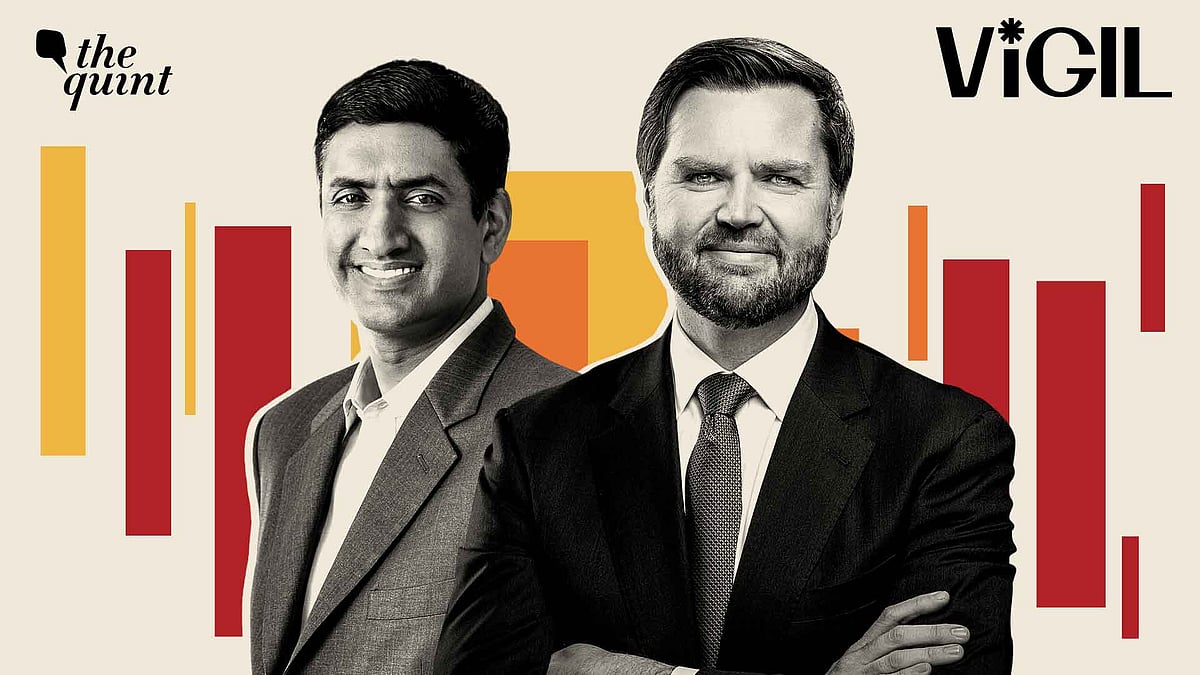
US Vice President JD Vance, in an interview with NBC News, said he has come to appreciate Bernie Sanders, Ro Khanna, and Zohran Mamdani, three politicians whose politics seem to be diametrically opposed to his own.
Is that really possible? Cognitive dissonance is, of course, nothing new when it comes to Vance. White House Chief of Staff Susie Wiles, as revealed by Vanity Fair, dubbed Vance a “conspiracy theorist” and said he was “sort of political” for becoming a Trump loyalist after being a ‘Never-Trumper’.
Vance’s swing to the far right was so jarring that it’s still hard to process how the same man could have written Hillbilly Elegy, a searing memoir, and married a Hindu woman, with whom he has three young children. How does that fit in with his MAGA worldview? Is he a White Christian nationalist, and a true believer? Or is he so cynically ambitious that inconsistency doesn’t bother him?
Populism, as the dictionary states, is “a political philosophy supporting the rights and power of the people in their struggle against the privileged elite.”
Vance may have ascended to the elite class, but he hasn’t forgotten his working-class and Appalachian roots. That explains his abiding concern for “ordinary” folks. Although he is the polar opposite of Sanders, Khanna, and Mamdani, Vance, in a limited way, sees them as kindred spirits. One could include politicians like Elizabeth Warren and Alexandria Ocasio-Cortez in this group of economic populists who focus on lifting the struggling class.
We’re living in the age of populism for good reason.
According to a Pew Research Center analysis, the gulf between the wealthiest 5% of American families and those with less wealth more than doubled in the period stretching from 1989 to 2016, which was when Trump won his first term. During the same time, the share going to the bottom half of the population dropped by about a third. The top 1% of US families own 31% ($52 trillion) of the nation’s household wealth, going by the latest data from the Federal Reserve.
To understand the growing inequality, here are more details from the Economic Policy Institute: In the 1978-2023 period, while the typical worker’s compensation went up by 24%, top CEO compensation rose by a staggering 1,085%. What CEOs were paid in 2023—290 times as much as a typical worker—bears no comparison to what CEOs were paid six decades ago. In 1965, CEOs were paid just 21 times as much as a typical worker.
No wonder there’s so much anger, and so many people—if they’re stuck in the lower rungs of the economic ladder—think the system is rigged. Neoliberalism and globalization brought benefits, but we’re also dealing with the negative consequences. For instance, rapid demographic change has unsettled the masses, whether we like to admit it or not. Brexit was a warning sign. In the US, the backlash to migration, even legal immigration, shouldn’t have come as a surprise.
In 2016, then British Prime Minister Theresa May said, “If you believe you are a citizen of the world, you are a citizen of nowhere.” This dig at the elite jet-setting class captured a revolt that was already underway. And now, a decade later, we’re familiar with the term “Epstein class,” which was coined by US House Representative Ro Khanna and popularized by writers like Anand Giridharadas, who knows a good bit about this class, having covered it extensively. His 2018 book is called Winners Take All: The Elite Charade of Changing the World.
If populism is inescapable today, we’re better off embracing the kind of populism espoused by Ro Khanna and New York Mayor-elect Zohran Mamdani.
Vance, by using language that echoes the dog whistle "heritage Americans" (which is reminiscent of “real Americans”), goes beyond economic populism to embrace a vision of America that, ironically, excludes people who look like his own wife.
Only economic populism unites Vance and Khanna. Despite representing the nation’s richest congressional district, in the San Francisco Bay Area, Khanna focuses on a progressive agenda (his latest book is titled Progressive Capitalism) that aims to close the wealth gap. He does not accept corporate donations. Like Vance, Khanna graduated from Yale Law School. But Khanna grew up in Pennsylvania—where his middle-class immigrant parents had settled—and what he gives prominence to are working-class issues such as affordability and manufacturing jobs.
The CHIPS & Science Act is one of Khanna’s key achievements, and he has partnered with Republicans, including right-wing Republicans, to get things done. The Epstein Files Transparency Act is an example. He eschews the divisive identity obsessions of constrictive populists.
Vance, on the other hand, has more in common with Homeland Security Advisor Stephen Miller, who seems to think the Immigration and Nationality Act of 1965 was a big mistake. “What you saw between 1965 and today was the single largest experiment on a society, on a civilization, that had ever been conducted in human history,” Miller said on Fox News.
In their narrow MAGA world, where minority scapegoating is de rigueur, immigrants of colour (or “third world” immigrants) have been a disaster for the US. Only descendants of European immigrants who came many generations ago can truly belong in America, according to them.
Fortunately, most Americans reject this nativist Us-versus-Them view of America.
A Nationhood Lab poll, conducted in April 2024 for the Pell Center at Salve Regina University, Rhode Island, asked the following question: “Are we united by commitment to the founding ideals in the Declaration [of Independence] or by history, tradition, values and character?”
Overall, 63%, with barely any difference in how men and women felt, went with civic ideals. They rejected the notion that they were bound by a shared religion or ancestry or history. What counted was a “shared commitment to a set of American founding ideals: that we all have inherent and equal rights to live, to not be tyrannized, and to pursue happiness as we each understand it,” the survey notes. Republicans and Democrats are not on the same page, however. While only 45% of Republicans went with civic ideals, it was 79% for Democrats. Independents, as well as Whites, were also at 63%. For Asian Americans, it was 70%.
In the late 1930s, EM Forster wrote that there was no good alternative to democracy. Whatever its faults, the other systems of government were worse, often much worse. His famous essay, written during a perilous time, is titled “Two Cheers for Democracy.” Given the world we live in now, perhaps we can say, “Two cheers for populism, but only if it is the constructive kind.”
(This is an opinion piece, and the views expressed are the author’s own. The Quint neither endorses nor is responsible for them.)
Got an idea? Write to us at vigil@thequint.com