
Trump’s New Weapon Against Russian Oil Buyers Puts India on Notice
The statute is a loaded gun, but the safety is in Trump's hands and the potential targets in his eyes.
advertisement
In February, the US Supreme Court had taken Donald Trump's tariff weapon away, but the US Congress has now handed him a more dangerous one.
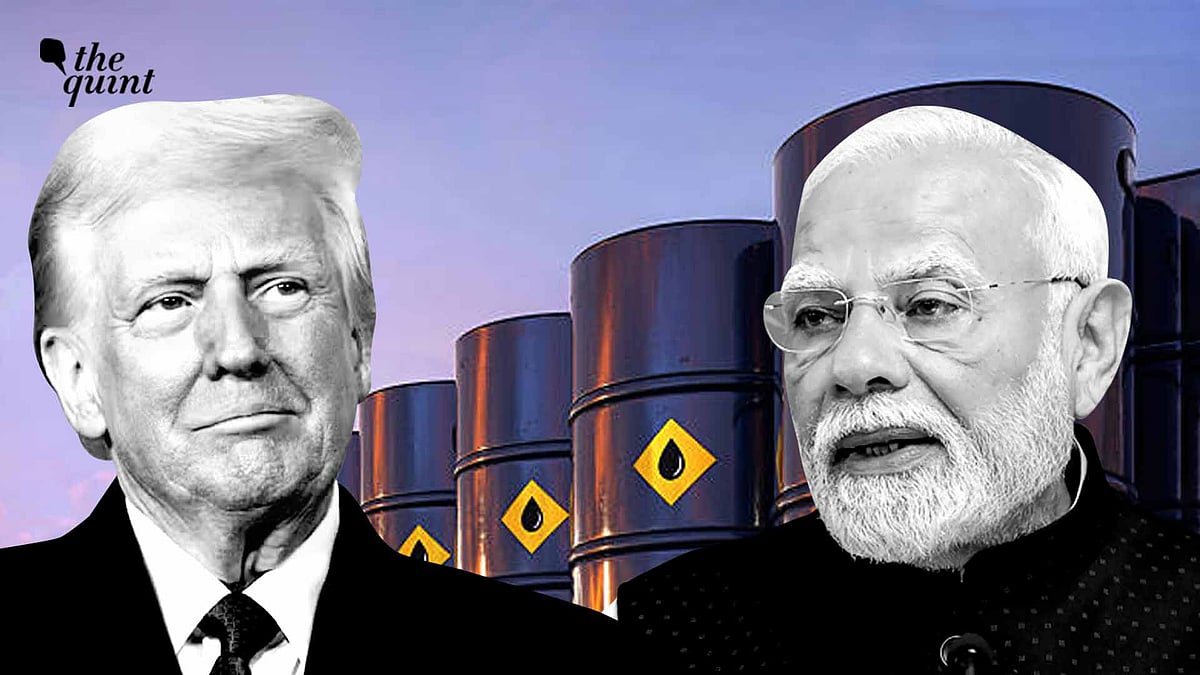
The Russia-Iran sanctions act, sponsored by Senator Lindsey Graham and signed into law by Trump on Friday, 18 September, allows tariffs of up to 100 percent on countries that buy Russian oil or help Moscow evade sanctions. India and China are the obvious targets of the law that takes effect in 30 days, and countries then have 180 days to comply.
The US President will decide who is to be hit, at what rate, and who is gets a waiver. The statute is a loaded gun, but the safety is in Trump's hands and the potential targets in his eyes. Given the Trump style what probably matters is not the text of the law but his mood, towards India, the world, or Prime Minister Narendra Modi on any given day. New Delhi should plan for the worst case, because it imports 88 percent of its oil and Russia has been providing a large proportion of it in the past several years.
The press note adds that the implications for the bilateral relationship and for the international energy market have been "very clearly articulated" to US interlocutors. This is the language of a government that is still trying to figure out what to do.
Russia Has Become Hard to Replace
Diversification is a comforting word except that the reality has been lopsided. Over the past year Russia has supplied between 30-50 percent of India's crude needs. In July, India bought a record 110.4 lakh tonnes worth $7.3 billion; in August, 85 lakh tonnes worth $4.7 billion.
A country that once depended on Iraq and Saudi Arabia has been leaning on one supplier in recent years. Before the Ukraine war, Russia was a marginal source. Then sanctions arrived, discounts followed, and Western capitals quietly encouraged Indian purchases to keep global prices down. Giving up Russian oil is bound to hit India hard.
In August 2025, they imposed 25 percent Russia-related sanctions on India while sparing China, the much bigger buyer. The tariff was only withdrawn when the Supreme Court threw out the Trump tariffs in February this year.
US Energy Pressure Is Already Building
Under the interim India-US trade framework deal the White House in early February, India had committed itself to diversifying its energy procurement away from Russia and was willing to buy $500 billion worth of energy products and agricultural goods from the US.
In April, American ambassador Sergio Gor noted that trade discussions since have included pushes for India to satisfy its energy needs from the US and its (new) partners in Venezuela and Guyana.
As a result of the US war on Iran and the closure of Hormuz, the US has already become a major supplier of LPG and LNG to India. India imported 3.78 million tonnes of LPG from the US just in the March-August 2026 period. In June this year the US has emerged as India’s top LNG supplier with a 28 percent year on year surge to 2.66 million tonnes. India has now begun signing long term contracts with US companies like US Gulf Coast company.
Note that importing energy from the US to India carries a massive freight premium due to geography and global shipping trends. A typical voyage from West Asia takes around 4-7 days, while that from Texas to India will take 40-45 days.
India’s Record Shows the Limits of Resistance
Now the Trump administration has overcome the hurdle of the Supreme Court and got an even stouter weapon to coerce India. Despite brave talk, New Delhi’s recent record in dealing with American pressure is not encouraging.
Venezuela supplied 6.7 percent of India's oil in 2016-17. Trump sanctioned Caracas in 2019, India cut its imports within a year, and by 2021-22 they were zero. Now, with American encouragement, India is being encouraged to buy Venezuelan oil again.
But the record is not always dismal. When Trump raised tariffs on India from 25 to 50 percent in August 2025, New Delhi did not capitulate. It cut Russian purchases slowly, enough to assuage Washington. And after US tariff authority was thrown out by the Supreme Court in February and the Strait of Hormuz closed, cutting off the route for 40 to 50 percent of India's oil, Russian imports climbed again.
Nobody in Washington could make India stop, and nobody there had the will to try.
India’s Leverage Is Narrower Than China’s
New Delhi's hand is markedly weaker than Beijing's. China holds rare earths and magnets that the American EV, robotics and defence industries cannot do without. It supplies over 70 per cent of America's active pharmaceutical ingredients and nearly 50 percent of its electronics and advanced hardware. It can retaliate in ways that hurt.
America's dependencies on India are geopolitical, and the Trump administration is discounting them. It is courting Beijing and ignoring the Quad. Its immigration crackdown erodes the value of the Indian talent pool that once made Indian students and migrants indispensable.
Washington's indulgence has also been selective. Washington chose not to apply CAATSA sanctions over India's purchase of Russian military equipment. The waiver to Indian companies to operate Chahbahar port in Iran ran out in April.
Use the 180 Days to Negotiate
What should Delhi do in the 180 days?
It should use them as a negotiating period, not a compliance deadline. It can stagger purchases so that the fall in Russian volumes is visible but gradual. Diplomatically it could make the case that Indian purchases of Russian oil at a discount have kept global prices lower than they would otherwise be.
US-India defence ties have been the key achievements on the entente between the two countries in the past quarter century. If the US severely penalises the Indian economy, India should cut back in its defence engagement with the US, restrict US defence purchases and downgrade its engagement with the Quad.
India may have been firm about energy security in a press note. But as the clock has started ticking for the implementation of the Graham Act that can gut the Indian economy, it needs to show it has some steel as well.
(The writer is a Distinguished Fellow, Observer Research Foundation, New Delhi. This is an opinion piece and the views expressed are the author's own. The Quint does not endorse or is responsible for them.)
- Access to all paywalled content on site
- Ad-free experience across The Quint
- Early previews of our Special Projects
Published: undefined