
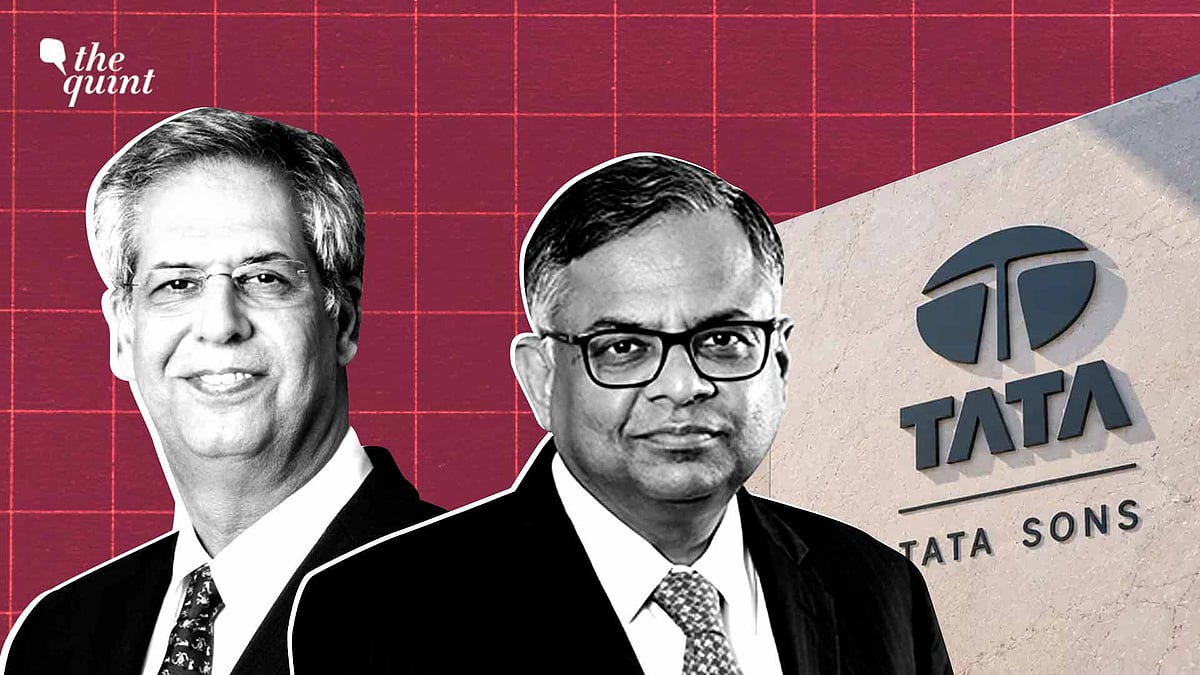
Inside the Tata Tussle: A Fight Over Control, Not Just Listing
Many see in the Tata story shades of 'Ramayana' and 'Mahabharata', both of which involve family conflicts.
advertisement
What’s your favourite conspiracy theory?
That could well be the question you ask someone these days if you are discussing the power struggle at Bombay House, the abode of Tata Sons Ltd, the holding company that lords over as many as 26 publicly listed companies as part of the respected Tata business empire, which might well be on the brink of losing its “respected” tag if the current tussle between the company and its master, Tata Trusts, is any indication.
There may well also be red herrings meant to distract attention from what could be the real issue.
I can see—as most people can—a courtroom tussle between Tata Trusts that holds 66 percent in Tata Sons and the board of Tata Sons that is in a strangling embrace with its parent. But that could be just a beginning.
I can see controversies—as quite a few do—on a politically linked attempt to pressure Tata Trusts to list Tata Sons as the Reserve Bank of India (RBI) wants it to in a regulation that dates back to September 2022.
I can see a minority shareholder like Shapoorji Pallonji Mistry, who controls an 18.4 percent stakes in Tata Sons wanting the listing badly and going to courts or regulators yet again because it is in a position where it can neither easily cash out on what could be a humongous pile of money nor exercise its influence over how the holding company is run.
The last line of the rock hit Hotel California comes to mind as the SP Group’s anthemic cry: “You can check out any time you like, but you can never leave.”
A Tale of Narratives
There’s more. There are those who see in the Tata story shades of Ramayana and Mahabharata, both of which involve family conflicts.
Yeah, right. All that shifts the game from the front page of a business daily to an late night television soap opera. But such are the times that any conspiracy theory would do—to be savoured with your favourite liquid in clubhouse conversations: coffee, tea, wine or something brewed hard to digest the complexity of it all.
My own fictional, web series-style sentimental climax involves a secret pact between Ratan and Noel before the former’s death.
After all, the RBI’s regulation that compelled Tata Sons to list as an “upper layer non-banking financial company” came two years before Ratan Tata’s death. Could it be that the half-brothers engineered a future set of courtroom and political battles to buy time so that the core structure of the Tata group stays intact to keep away from listing? By core structure I mean the business of running a financial behemoth in Parsi community control over several industries and its umbilical link with Tata Trusts that swears by charities and nation- building.
The articles of association of Tata Sons peculiarly give a veto to the Tata Trusts in the chairman’s appointment and also lay down procedures for the appointment of the chairman.
A House Divided
A landmark ruling by the Supreme Court in 2021 in a case involving minority shareholder rights filed by late Cyrus Mistry of the SP Group, who was ousted as Tata Sons chairman by Ratan Tata, does give special rights to Tata Trusts, but when its own nominee directors are divided as it happened this month (Venu Srinivasan voted for Chandra’s continuation), it brings the case back to courtrooms and regulators. Also, the Supreme Court gave controlling rights to Tata Trusts but not powers on day-to-day management issues.
Now, how could Chandra, who in August stayed away from reappointment because the board was NOT unanimous, bounce back into the big chair when the current appointment is far from unanimous? That badly fails the smell test at the Tatas, who are known for sophisticated styles of management and clarity.
A less noticed episode is that the SP Group has proposed a plan to sell stakes worth Rs 25,000 crore in Tata Sons. As the Mistrys, no friend of the Tatas, push for listing and Noel Tata wants a restructuring, a less acrimonious way would be for the SP Group to exit with piles of cash over a period of time. A systematic restructuring could well persuade RBI to relax its conditions—as long as it does not invite charges that its regulations are arbitrary.
A substantial portion of the RBI’s logic to seek a public listing of Tata Sons is that it controls a huge amount of public funds directly or indirectly, while being largely unaccountable to the public. This needs careful examination. If a restructuring could reduce the RBI threshold—or conversely, if the RBI rethinks its thresholds—the future could be less acrimonious.
Both Chandra and Venu Srinivasan are emerging in this tussle as outsiders who gate-crashed into a Bombay House party. They have a lot to answer for. The fact that listed Tata companies lost Rs 40,000 crore in market value as news of the power tussle broke out is a pointer to how ‘un-Tata’ things can get.
Tata Sons’ prized possession is the bleeding Air India, which has been an expensive object of nostalgia and pride that has been financially draining the group. We won’t discuss it now. The doddering Maharaja icon could well feature in a juicy future episode of this corporate soap opera. Who knows? Someone big may want to buy out Air India to make Tata Sons feel lighter.
(The author is a senior journalist and commentator who has worked for Reuters, Economic Times, Business Standard, and Hindustan Times. He can be reached on Twitter @madversity. This is an opinion piece and the views expressed above are the author’s own. The Quint neither endorses nor is responsible for the same.)
- Access to all paywalled content on site
- Ad-free experience across The Quint
- Early previews of our Special Projects
Published: undefined