
The Supreme Court’s Bail Debate Could Change the Fate of Umar and Sharjeel
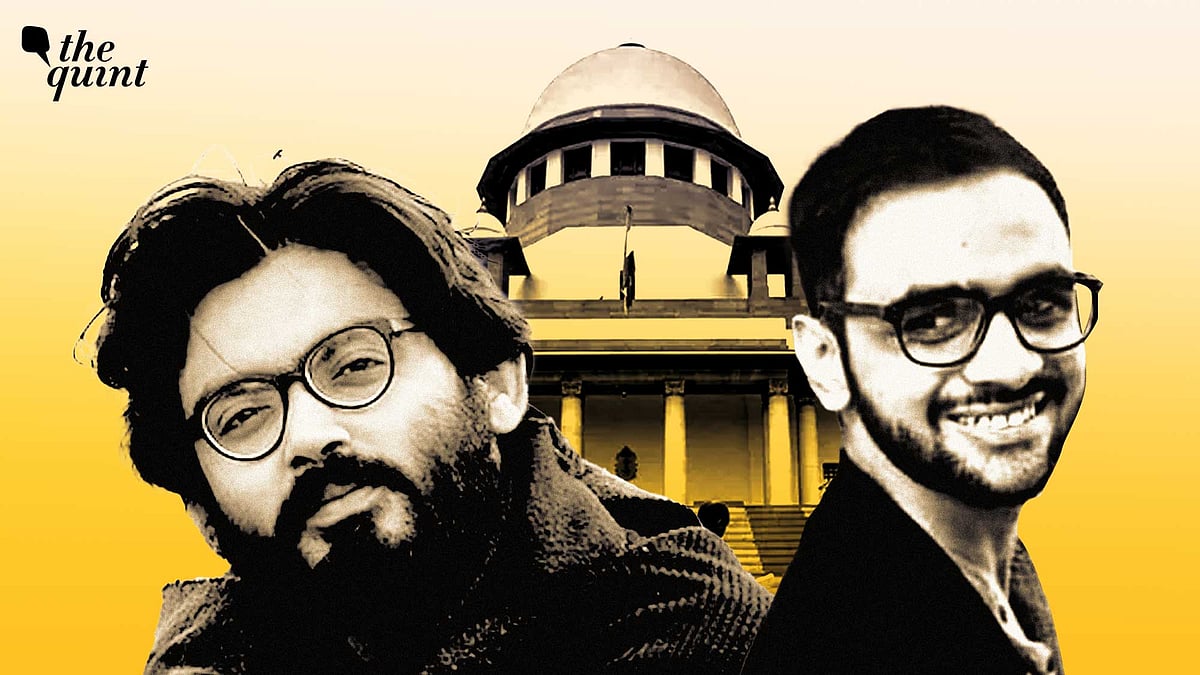
Umar Khalid and Sharjeel Imam's renewed prayer for bail, when it comes, will be heard in a very different climate.
advertisement
Umar Khalid is 38 years old. Sharjeel Imam is 36. Both have been in Tihar Jail since 2020. Neither has been convicted of anything. Their trial in the Delhi Riots conspiracy case has barely begun. The prosecution lists hundreds of witnesses. By any honest reckoning, the case will not end this decade.
Between January and May this year, the Supreme Court delivered three judgments that, taken together, tell us where their case now stands. The judgments deserve to be read in the order they were written. They show a court arguing with itself in public, and slowly arriving at a better answer.
The statute at the centre of all three is Section 43-D(5) of the Unlawful Activities (Prevention) Act, the UAPA. It tells a judge that bail must be denied if, on the face of the police case, there are reasonable grounds to believe the accusation is true. Read literally, the judge must assume the police are right, and then refuse liberty on that assumption.
Five years ago, a three-judge bench softened this in a case called the Union of India vs KA Najeeb. The court said something simple and humane. If trial is nowhere in sight, and a person has already spent years in jail, the strict bar on bail must give way to Article 21 of the Constitution, which protects personal liberty. Detention before trial, the court said, cannot become a sentence by stealth.
Why Umar and Sharjeel Were Denied Bail
That ruling was the law. It should have settled the matter. It did not. Smaller benches of two judges began to read Najeeb narrowly. By 2024, in a case called Gurwinder Singh, the court treated Najeeb as a rare exception for unusual facts.
That brings us to the first judgment. On 5 January this year, Justices Aravind Kumar and N V Anjaria delivered judgment in Gulfisha Fatima. Seven men and women, all accused in the Delhi Riots conspiracy, had asked for bail. All had been in custody for over five years. The court released five of them. Gulfisha Fatima, Meeran Haider, Shifa-ur-Rehman, Saleem Khan, and Shadab Ahmed walked out of Tihar.
But the same bench refused bail to Umar Khalid and Sharjeel Imam. The court treated them as principal conspirators. It said they could come back for bail only after the protected witnesses had been examined, or after one year, whichever was earlier. The reasoning leaned on the narrow reading of Najeeb. Section 43-D(5) was the rule. Article 21 hovered in the background. For Umar and Sharjeel, the door was shut for at least a year.
Four months later came the second judgment, and a different view from a different bench. On 18 May, Justices BV Nagarathna and Ujjal Bhuyan released a Kashmiri political activist named Syed Iftikhar Andrabi. He had been in jail nearly six years on UAPA charges. The trial had over three hundred and fifty witnesses left to call. The judges could have granted bail in a few paragraphs. They wrote 60 pages instead.
The judgment said openly what many lawyers had been saying privately. Najeeb was a three-judge ruling. Smaller benches could not whittle it down by treating it as an aberration. Gurwinder, the judges said, had read the earlier case law as if Najeeb had not happened. Gulfisha Fatima, decided four months earlier, had reduced Najeeb to a footnote.
If a bench of two disagreed with a bench of three, the proper course was to refer the matter to a larger bench, not to rewrite the law while pretending to apply it.
The Numbers Behind UAPA
The judges then placed before the country a set of figures that should disturb anyone reading them.
The Minister of State for Home Affairs had told Parliament in December 2025 that between 2019 and 2023, nearly 10,500 people were arrested across India under the UAPA. Of those, only 335 were convicted. The conviction rate is between two and six per cent nationally. In Jammu and Kashmir it is below one per cent. Ninety-nine times out of a hundred, the case ends in acquittal.
The same pattern repeats across other harsh statutes. The Prevention of Money Laundering Act, the Narcotic Drugs and Psychotropic Substances Act, the various state public safety laws in Jammu and Kashmir, Uttar Pradesh and elsewhere. Together, they hold tens of thousands of undertrial prisoners. The National Crime Records Bureau has long recorded that roughly three of every four prisoners in Indian jails have not been convicted of anything. They are simply waiting.
The Court’s Quiet Shift
Then came the third judgment, just four days later. On 22 May, Justice Aravind Kumar, the author of Gulfisha Fatima, sat with Justice Prasanna Varale to hear the bail pleas of Khalid Saifi and Tasleem Ahmed. They, too, were accused in the Delhi Riots conspiracy. They too had spent years in custody.
Justice Kumar did something quietly remarkable. He acknowledged that there was now a real divergence within the Supreme Court about how to apply Najeeb. He refused to settle that divergence by writing yet another two-judge opinion. He sent the question up to the Chief Justice for a larger bench to decide. And in the meantime, he released Khalid Saifi and Tasleem Ahmed on interim bail for six months.
Lower courts hearing bail applications under the UAPA, or the PMLA, or any of the other restrictive statutes, are entitled to read Khalid Saifi as the present working position. Where trial is years away, where the accused has already served substantial time, and where the case is structurally similar, interim bail is the route the Supreme Court itself has now chosen.
What This Means for Umar and Sharjeel
What does this mean for Umar Khalid and Sharjeel Imam?
The premise of the January order, that Najeeb is a narrow exception, is now contested by another bench of equal strength, and has been referred to a larger bench by the same judge who wrote the January order. Their co-accused of allegedly equal centrality, Khalid Saifi, has been released on interim bail. Parity, the oldest principle in bail jurisprudence, will weigh heavily.
There is a larger lesson here, and it is worth stating plainly. A constitutional court is not a department of the State. Its job is not to validate every grave-sounding allegation the prosecution makes. Its job is to ask whether the State has shown why a citizen must remain in jail today, this morning, when his trial may not end for years. When the answer is no, liberty must follow.
Ninety-nine out of a hundred is not a margin of error. It is a verdict on the statute. The Supreme Court is beginning, slowly, to read that verdict. Umar and Sharjeel, and the thousands like them, are entitled to hope that it will read it in time.
(Sanjay Hegde is a senior advocate at the Supreme Court of India. This is an opinion piece and the views expressed are the author’s own. The Quint neither endorses nor is responsible for them.)
- Access to all paywalled content on site
- Ad-free experience across The Quint
- Early previews of our Special Projects
Published: undefined