
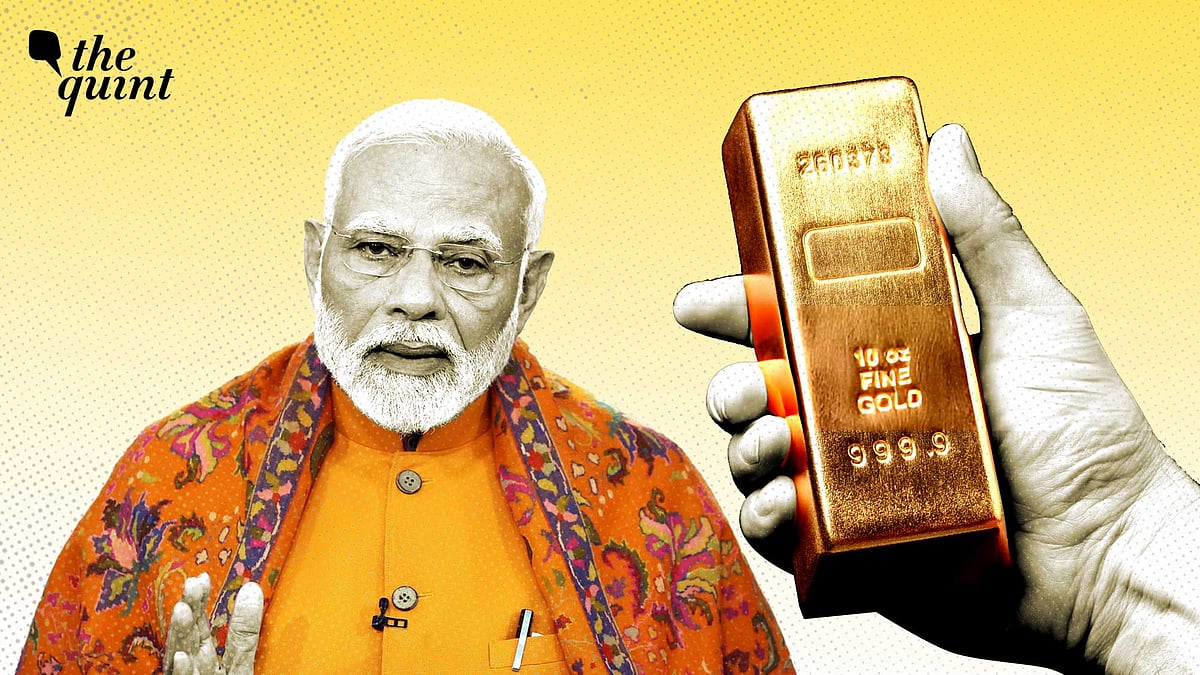
Sovereign Gold Bonds: Why Modi Govt's Risky Bet Was 'Designed' to Fail
A more robust analysis of historical gold prices could have made the Modi government see potential long-term risks.
advertisement
I joined the Department of Economic Affairs—the department in charge of the Sovereign Gold Bond (SGB) scheme—on 12 July 2017. The revival of SGBs, which were facing investor disinterest, awaited a government decision.
They had been launched by the Modi government in November 2015 with much fanfare and expectation. However, against the target of Rs 25,000 crore, the government could collect only Rs 4,769 crore from SGBs (14 tonnes in equivalent gold) in the first 20 months.
SGB liabilities crossed about Rs 2.2 lakh crore in 2025-26 (implying a loss of Rs 1.5 lakh crore), much higher than the oil bonds liability of Rs 1.66 lakh crore inherited by the Modi government in 2014-15.
Did SGBs have design flaws? Why did the Modi government take such a risky bet on gold? Why did it not course-correct or explore better alternatives?
Modi Govt Misread Gold Price Trend
The Modi government believed that people sought inflation protection and returns through physical gold purchases. It was also concerned about India importing 800-1,000 tonnes of gold annually, causing a significant drain on foreign exchange reserves. The idea was to offer an instrument that mirrored gold price growth, thereby weaning people away from physical gold.
SGBs assured to repay the gold purchased by investment made in SGBs at the gold price prevailing at redemption. It offered, in addition, an interest of 2.5 percent. Low initial demand and a modest rise of 1.94 percent per annum in gold prices during 2014-2017 (from Rs 28,007 per 10 grams to Rs 29,668) appeared to justify this design.
A more robust analysis of historical gold prices could have made the government see potential long-term risks.
Gold prices (24 carat of .999 purity, for 10 grams, which SGBs proxied) in 1990s rose 3.24 percent per annum (from Rs 3,200 in 1990 to Rs 4,400 in 2000).
In the next decade, gold prices increased by a very high annual rate of 15.44 percent (to Rs 18,500 in 2010).
In the next four years (2010-2014), which preceded the launch of SGBs, gold prices increased by 10.92 percent annually. Over the 14-year period from 2000-2014, gold price inflation was quite high at 14 percent per annum.
No Course Correction
Initial lack of investor interest led the government to believe SGBs were not attractive enough.
On 27 July 2017, it introduced measures to sweeten the scheme: individuals and HUFs were allowed to invest up to 4 kg per person, and trusts up to 20 kg. Commissions for agents and banks were also increased.
Still, there was no great enthusiasm for SGBs during the first five years from 2015 to 2020. Only about 31 tonnes gold-equivalent SGBs were subscribed.
A steady demand for SGBs emerged after 2020. Gold prices increased by 38 percent from Rs 35,220 per 10 gram in 2019 to Rs 48,651 in 2020. As it made SGB investments look great, more than 26 tonnes of gold was subscribed to in 2020-21 alone.
Prices remained elevated over the next three years, reaching Rs 65,330 in 2023. Subscriptions rose sharply to Rs 16,037 crore in 2020-21, followed by Rs 12,808 crore and Rs 6,148 crore in the subsequent years.
Exit Came Late and Abruptly
Despite tell-tale signs of SGB borrowings becoming ultra-high cost, the government was quite upbeat about them in 2023-24. Two tranches of SGBs (Rs 1,500 crore) issued in 2015-16 were coming up for redemption in 2023-24 as well.
The government budgeted to receive net (after repayment) Rs 9,700 crore in 2023-24 Budget Estimates, which went up big to Rs 25,352 crore in Revised Estimates. The SGBs yielded Rs 23,951 crore that year, the highest amount ever.
The government got alarmed only in 2024-25.
The government had budgeted Rs 15,000 crore in receipts (net of Rs 3,500 crore repayments). However, as liabilities became clearer, all SGB tranches were cancelled in 2024-25. New receipts were reduced to zero in Revised Estimates. The government repaid Rs 8,124 crore against a nominal redemption value of Rs 3,500 crore that year.
Provisions Lagged Far Behind Reality
The original SGB scheme envisaged the government to make provision by transferring the difference between government’s average cost of borrowing and interest payable on SGBs to a Gold Reserve Fund (GRF).
No provision was made in 2015-16. In 2016-17, a provision of Rs 68 crore was made. It was followed up with provisions of Rs 205 crore in 2017-18 and Rs 325 crore in 2019-20.
Yet, the government continued with gross under-provision of liability. In 2019-20, it made a provision of Rs 724 crore. It was Rs 677 crore in 2020-21. As more SGBs were bought, transfer to GRF was raised to Rs 1,825 crore in 2021-22, Rs 2,425 crore in 2022-23, and Rs 3,553 crore in 2023-24.
As contours of excessive liability became clearer, in 2024-25, the government made a large provision of Rs 28,813 crore. In 2025-26RE, while a smaller provision of Rs 2,465 crore has been made for the GRF, the government has provided Rs 50,000 crore for Economic Stabilisation Fund, which appears essentially for discharging gold bond liabilities.
Even so, total provisions remain far short of the actual liability.
A Smarter Design Was Possible
A more strategic approach would have led the government to look for a better construct of SGBs to serve its objective of dissuading Indians to buy physical gold without costing the government a bomb.
The Reserve Bank of India (RBI) has been buying gold from 2017-18 for building its reserves. The government could have handed over SGB proceeds to the RBI for buying physical gold and keep it in its gold reserves. On repayment of SGBs, the RBI could have sold the gold and paid the government the exact equal amount to repay SGB subscribers.
The government can try this option to revive SGBs.
Who Bears the Cost Going Forward
The SGB scheme was completely the Modi government's brainchild. As noted above, it led to a clean loss of about Rs 1.5 lakh crore.
The Modi government will pass on the liability of servicing SGBs repayment of about 60 tonnes of gold (for SGBs purchased during 2021-24) to the new government in 2029.
Should the new government blame the Modi government for leaving this liability, like Finance Minister Nirmala Sitharaman has been doing for oil bonds?
No.
Whichever government is in power in 2029 must honour these commitments without resorting to a blame game.
(Subhash Chandra Garg is the Chief Policy Advisor, SUBHANJALI, and Former Finance and Economic Affairs Secretary, Government of India. He's the author of many books, including 'The $10 Trillion Dream Dented, 'We Also Make Policy', and 'Explanation and Commentary on Budget 2025-26'. This is an opinion piece, and the views expressed above are the author’s own. The Quint neither endorses nor is responsible for the same.)
- Access to all paywalled content on site
- Ad-free experience across The Quint
- Early previews of our Special Projects
Published: undefined