
She Ran 3 Km Barefoot to Feed Her Daughter. Why Is That an Inspirational Story?
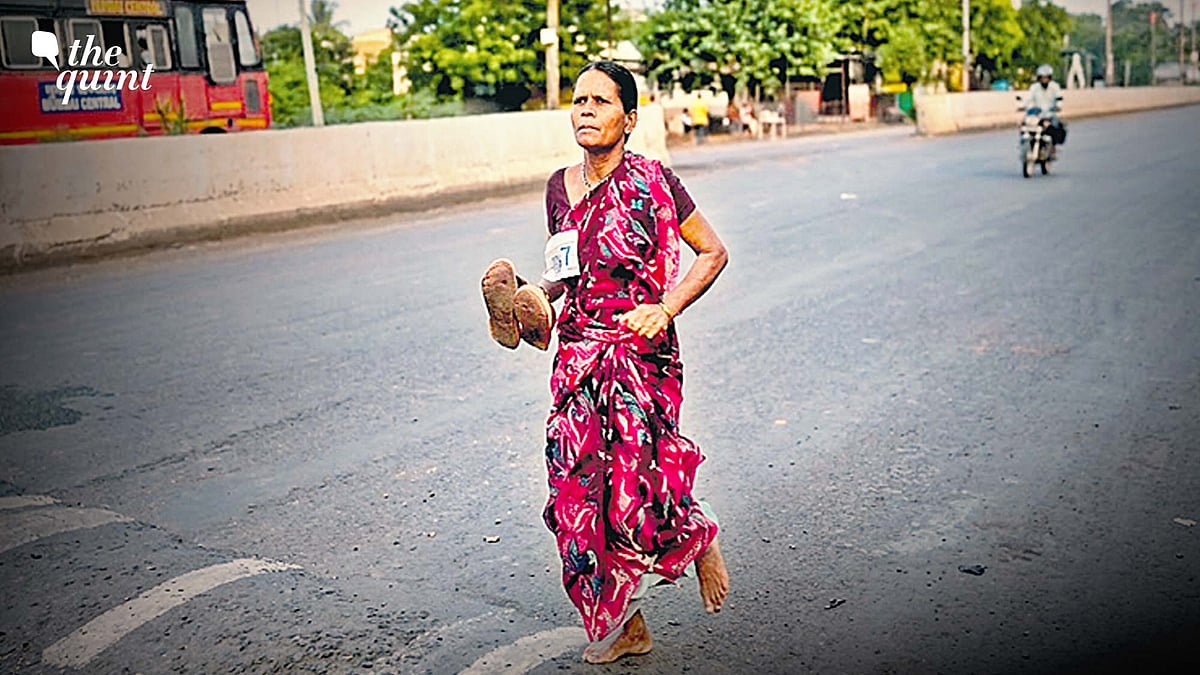
Imagine the headline saying, "Woman runs 3 km barefeet to feed her daughter". The story doesn’t sound as triumphant.
advertisement
Ramabai quit school after Class VII. We don’t know what her life was like, what her parents were like, her childhood. We know she married and had two daughters with her husband—Aarti and Pooja. We know that her husband died in an accident fourteen years back. We don’t know what kind of an accident? Road? Industrial? There is no information.
We know that Pooja had to work in a farm at one point as a manual labourer and right now is at a Dnyandeep Academy, a private organisation which trains people for police recruitment exams. We know that Aarti, who is 20 years of age, currently lives away from her and is studying B.Sc in Computer Science.
Ramabai works as a cook at the same academy. She makes two hundred rotis every day, six thousand a month, for Rs 9,000. We know that she never takes any holiday.
We know that Aarti did not have money for food or rent and one evening called her mother to tell her as much. We know that things were so bad that Ramabai could not sleep all night. Next morning, Ramabai found that her employer was taking students for a 3 km run which had a cash prize of Rs 3,000. She expressed willingness to run the same race and won it.
All the aforementioned information is buried in the many reports on this race in multiple news publications. The headline in each one of them is triumphant. Ramabai won this race. Almost every news report screams the same—"Barefoot mom in saari runs 3 km to win INR 5k for kids education."
Someone suffering poverty, put in extraordinary physical labour, prevailed against all odds, and won. Applause.
Toxic Positivity: Packaging Survivalism as Inspiration
The Times of India appears to have done the longest (in both word count and facts) story. In it, the owner of this academy, and Ramabai’s employer gets the most quotes. He was surprised and ‘moved’ by her victory.
She asked him in the morning if she can run and and he said sure. She is the hero of the story and he, the silent generous benefactor. The prize money was Rs 3,000 but he gave her Rs 2,000 more. We are told that he has waived the fee that Pooja would have had to pay otherwise.She says she will buy pens and books for Pooja with the extra money. She also says that there is no greater pain than watching your children being deprived.
Why did her employer not offer her a pair of shoes to run the race? Why is she being paid below minimum wage? There will not be a race every month. How will her daughter eat next month? How is she expected to raise two daughters on a salary of Rs 9,000? Why is she never given any holidays? Every single headline omits a fact Ramabai herself has told everyone. Her daughter also needed money for food. But imagine the headline saying—"Woman runs 3 km barefeet to feed her daughter".
Suddenly the story doesn’t sound as triumphant. Why is this not the headline? Because it indicts someone. Who? The employer whose employee is having to run 3 km barefeet to just about feed her children? Despite making two hundred rotis every day for 365 days? The government which claims we are in amrit kaal? The society which argues it is moral? The fellow members of Ramabai’s religion? Country?
They are lazy, and therefore undeserving. At best, they don’t deserve rights, they can be given charity. Charity being given to them isn’t evidence of their destitution but greatness of the person giving her money. He is not questioned about minimum wage laws, labour laws, her working conditions.
He and the other peers in his class make the argument that they don’t owe anyone anything because they pay taxes. It’s the government’s job not theirs. If and when the government tries to share with them, they express resentment. Their favorite politicians calls it ‘revdi’. Columnists call welfare wastage leading to deficits. If their Provident Funds are taxed they scream bloody murder. It seems like the government does owe them a lot. The companies they own get loan waivers.
Poverty and the Double Standards of Morality
It is crucial for their moral survival that Ramabai’s story is framed like it is. That the headline hides what it hides. That some questions are asked and others aren’t. This is also why the rich so deeply resent the poor. The poor are a reminder of their gluttony and greed. They should be evicted, their slums destroyed, they should not be seen. Their existence feels like a chargesheet which will one day result in a trial.
The rich and middle class are different. Unliked the poor who sleep most of the day, the other classes work and worked hard. Their life is also difficult? They would like to become the richest person in India, own the most expensive watches, but are they able to? No. Everyone is on their own. They don’t owe the Ramabais of the world anything.
Ramabai is only quoted expressing gratitude and asked what will you do with this money? Just imagine, a reporter who has just learned someone’s children would starve if they don’t risk breaking their bones asking- what will you do with this money? Pens and books for pooja and the rest for aarti she says. The academy doesn’t give pens and books to pooja. In exchange for six thousand rotis every month, it gives a seat and a roof to Ramabai and her daughter, isn’t that enough? It is luxurious, some may say her salary should be less.
This is the only answer she is permitted. Can she say, “Shame on you for asking what I will do with this paltry sum", or, “My survival is month to month, my employer, my society, my government is simultaneously complicit in and indifferent to my exploitation."?
She would immediately lose her employment, her daughter would lose opportunity. She doesn’t have savings. There is a script she is a part of. She must speak her lines and only those. Else, there is no shortage of Ramabais, Aartis, and Poojas, her employer will find the others.
Ramabai incidentally belongs to Beed, where thousands of women were forced to undergo hysterectomies (uterus removals) by their contractor-employers, so that they don't miss a single day of work. Maharashtra's Deputy Chief Minister Eknath Shinde admitted as much. As many rich/middle class people will tell you, if only these women weren't lazy and worked harder, they would escape this fate.
(The author is a lawyer and research consultant based in Mumbai. This is an opinion piece, and the views expressed are the author’s own. The Quint neither endorses nor is responsible for them.)
- Access to all paywalled content on site
- Ad-free experience across The Quint
- Early previews of our Special Projects
Published: undefined