
Panneerselvam’s Defection to DMK Is Less Betrayal, More Political Arithmetic
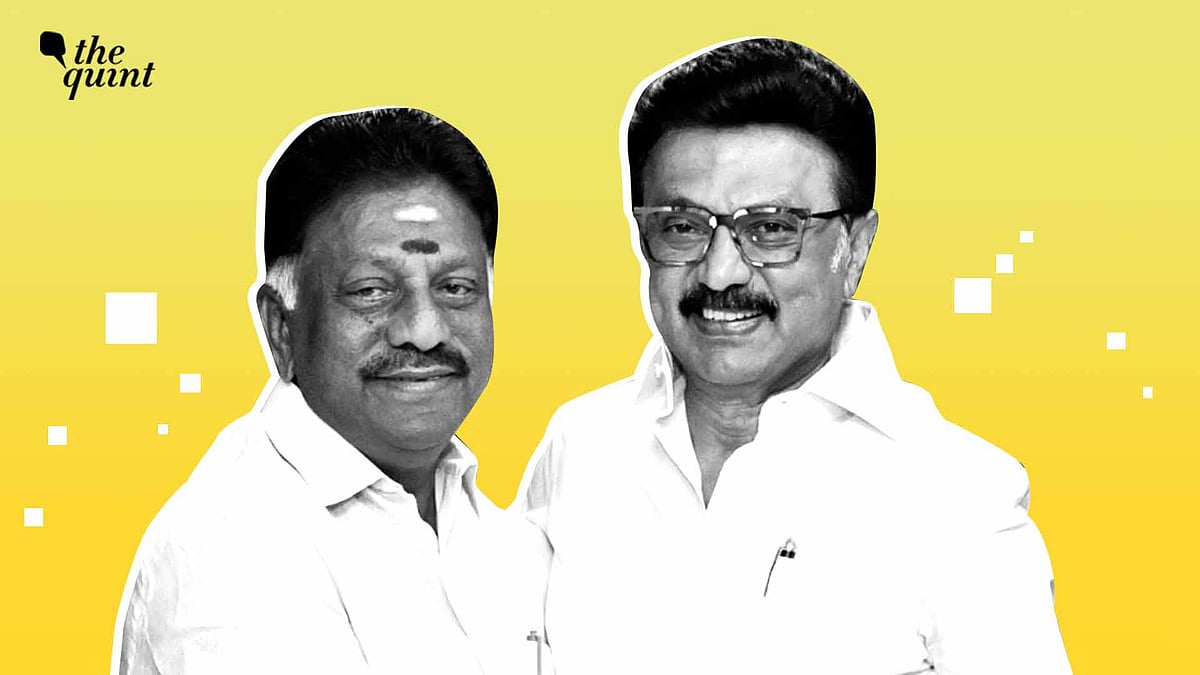
The visual narrative is potent: a leader once seen as Jayalalithaa’s heir, validating her party’s principal rival.
advertisement
The political migration of O Panneerselvam (OPS) from the All-India Anna Dravida Munnetra Kazhagam (AIADMK) to the Dravida Munnetra Kazhagam (DMK) is being hailed by DMK allies as “historic” and dismissed by critics as opportunistic irrelevance.
The truth lies elsewhere. It is not a dramatic ideological realignment, but a revealing symptom of how far the AIADMK has eroded since the death of J Jayalalithaa, and how effectively the DMK, under MK Stalin, is capitalising on that decay. OPS’s public charge that the AIADMK has “no future” under Edappadi K Palaniswami (EPS) encapsulates this perception of institutional decline, regardless of partisan exaggeration.
When he now declares the DMK his “parent organisation”, though technically accurate, and praises Stalin as custodian of Dravidian values, it is not ideology speaking. It is political survival.
From Loyalist to Outsider
Why did this happen? The immediate cause is straightforward: OPS lost the AIADMK power struggle. Since 2017, the party has been consumed by factional conflict between OPS and EPS.
EPS consolidated organisational control and expelled OPS and his supporters. OPS’s claim that EPS “decimated” the AIADMK reflects grievance more than analysis. But grievance matters, because it rendered him politically homeless. He also framed his marginalisation in regional-caste terms, alleging that EPS sidelined leaders from the southern Mukkulathor belt, a charge that resonates in the region, where OPS retains residual influence.
OPS’s rationale is understandable. The AIADMK and DMK share Dravidian roots, both descending from C N Annadurai and the social-justice movement. The porous boundary between them has long enabled defections without doctrinal shock. OPS invoking Annadurai while joining the DMK is therefore politically convenient rather than contradictory.
The decisive trigger, however, was humiliation. OPS framed his move as an end to years of mistreatment. In personality-centric parties, dignity and relevance matter as much as ideology. A sidelined leader with residual symbolic capital becomes a prize for rivals. Stalin recognised a wounded opponent and absorbed him.
Symbolism Over Vote Share
Will this help the DMK? Electorally, OPS brings limited direct vote transfer. His base is narrow and regionally concentrated, primarily in Theni and adjoining southern constituencies. Even there, influence has eroded after years of marginalisation. The DMK leadership knows this. The value lies elsewhere.
Second, opposition arithmetic in the south. In multi-cornered contests, even small vote pockets can decide outcomes. By joining the DMK, OPS ceases to be a separate vote-splitter in southern districts, where the AIADMK’s traditional Mukkulathor base is already divided among the EPS, Sasikala, and Dhinakaran camps. Absorbing his limited support into the DMK fold both prevents further fragmentation of anti-DMK votes and nudges a fragment of that once-consolidated AIADMK social base toward the ruling party.
Third, narrative advantage. Politics thrives on perception. OPS’s defection feeds a storyline of AIADMK decline under EPS, while the DMK expands. Successive crossovers, from district figures to a former Chief Minister, create an image of one-way political traffic toward the ruling party. In a state where voters gravitate toward perceived winners, this bandwagon effect is valuable.
Fragmentation Inside the Opposition
How will this affect the AIADMK?
In arithmetic terms, not dramatically. OPS was already expelled and had lost organisational control and cadre loyalty. His independent vote share had dwindled to negligible levels.
But politics is not arithmetic alone; morale and perception matter. OPS’s defection reinforces the narrative of AIADMK shrinkage and leadership desertion. For a party struggling to redefine itself after Jayalalithaa, such optics erode cadre confidence. High-visibility exits amplify grassroots doubts about the party’s future under EPS, precisely the perception OPS has sought to project.
Of course, the BJP’s footprint in Tamil Nadu remains limited, and the AIADMK still depends on regional identity rather than national alignment. Hence, OPS’s departure may not fundamentally alter NDA prospects, but it sharpens the ideological contrast the DMK seeks to draw.
The Sasikala factor complicates matters further. V K Sasikala retains emotional resonance among sections of the AIADMK cadre, especially in the southern and delta regions. Like OPS, she represents continuity with Jayalalithaa’s inner circle. With her newly started outfit, if she mobilises even modest support, the AIADMK faces a four-way division in its traditional base: EPS loyalists, Sasikala followers, Dhinakaran cadre, and residual OPS sympathisers drifting toward the DMK.
The cumulative fragmentation of this southern base, historically central to AIADMK victories, is the deeper structural shift behind these crossovers.
Toward an Asymmetrical Political Order
Overall, the DMK enters the 2026 assembly election structurally stronger than its principal rival. It may be worthwhile to remember that OPS’s move does not create that strength; it merely reveals it.
Beyond immediate electoral arithmetic, the crossover shows a significant transformation in Tamil Nadu politics: a shift from the charismatic bipolarity of Karunanidhi and Jayalalithaa to an asymmetrical order of Stalin versus a fragmented opposition. As the DMK absorbs fragments of its weakened rival while retaining Dravidian continuity, the competitive dualism that long sustained the State’s politics risks giving way to one-party predominance.
Finally, to the question many in Tamil Nadu are asking: is this a sign of tactical sharpness from Stalin? Just days after bringing the DMDK (Desiya Murpokku Dravida Kazhagam), founded by actor Vijayakanth, into his alliance, he has now added a former rival with limited electoral weight. What might this signal?
The answer lies in a basic rule of power politics: effective strategy often means neutralising potential rallying symbols before they can coalesce. OPS may not bring many votes, but he still carried symbolic value as a senior AIADMK figure who could have united dissatisfied anti-EPS groups within the party’s broader support base. By bringing him into the DMK, Stalin prevents him from becoming a rallying point for those factions and, at the same time, strengthens the impression that the opposition is steadily disintegrating.
So, simply put, OPS joining the DMK reveals the AIADMK’s decline as much as his own struggle for political survival. The DMK gains optics; the AIADMK loses morale. For 2026, it underscores the defining asymmetry of Tamil Nadu’s emerging political order, a dominant ruling party confronting a fragmented opposition.
(P John J Kennedy, educator and political analyst based in Bengaluru. This is an opinion article and the views expressed above are the author’s own. The Quint neither endorses nor is responsible for them.)
- Access to all paywalled content on site
- Ad-free experience across The Quint
- Early previews of our Special Projects
Published: undefined