
'Bengal's Chanakya' Mukul Roy Was the Master of ‘Aaya Ram, Gaya Ram’ Politics
Roy was once Mamata Banerjee’s right-hand-man, then the BJP gave him the charge to uproot TMC.
advertisement
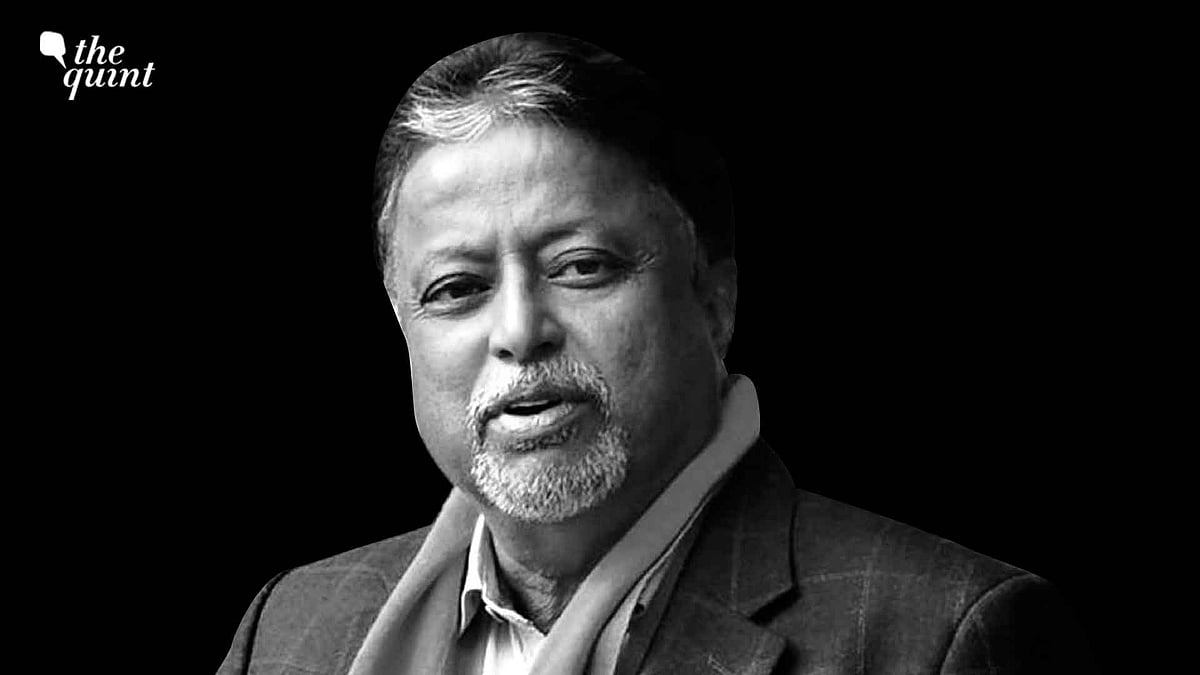
Former railway minister Mukul Roy died in the wee hours of 23 February following prolonged illness that kept him bedridden for months. He was 71. His legacy lives on—political poaching has become part and parcel of Bengal politics, thanks largely to him who first turned this skill into art.
West Bengal Chief Minister Mamata Banerjee and Prime Minister Narendra Modi expressed their grief at his demise. Roy worked with both of them. He was not a mass leader. He never had any large following. But, he excelled in backroom work, strategising and political deal breaking. He deployed them in the service of both Banerjee’s Trinamool Congress (TMC) and Modi’s Bharatiya Janata Party (BJP), at different times, and with different success rates.
'Better Back Home'
When Banerjee took Roy back into her party on 11 June 2021, she did not have much to gain from him. She had returned to power just five weeks ago for a third consecutive term, that too with her biggest mandate. Roy had quite miserably failed in his mission to dethrone her.
Yet, she herself reinducted him into the party. In a sympathetic tone, Banerjee alleged that the BJP used central agencies to force Roy to join the party and that Roy had to bear a lot of mental torture, which made him unwell. Since he is only one of their own, he is better back home for peace, she said.
There were two messages. First, Roy, her closest confidante for the longest period, was better back by her side rather than with her opponents. He was skilled in brokering deals. He knew organisers in Bengal’s every nook and corner. On matters most confidential, Banerjee often trusted him the most.
Reshaping Political Culture
West Bengal was not known for defections of politicians or elected public representatives. For decades, the contest remained polarised between the Left and the Congress and leaders from neither side switched camps. After the birth of the TMC in 1998, leaders often changed between the Congress and the TMC. Roy, however, turned defection engineering into a game after Banerjee came to the helm of Bengal’s affairs in 2011.
During the landmark anti-displacement movements in Singur and Nandigram during 2006-08, Roy played an instrumental role in building rapport with maintaining coordination with smaller Left parties and civil society groups and personalities.
The TMC and the Congress were in an alliance since the 2009 Lok Sabha elections, but the TMC walked out of it in September 2012. Within two months, in November, Roy got two Congress MLAs—Krishnendu Narayan Chowdhury of English Bazar in Malda district and Humayun Kabir of Rejinagar in Murshidabad—to join the TMC.
This was the beginning. In November and December, 2013, respectively, Roy brought Congress MLAs Ajoy De and Saumiutra Khan to the TMC.
Then, in the February 2014 Rajya Sabha election, Roy engineered what was unprecedented in Bengal politics—cross-voting in the Rajya Sabha election. He got five opposition MLAs—Sushil Roy and Imani Biswas of the Congress and Anantadeb Adhikary, Dasarath Tirkey and Sunil Mandal—to vote for the TMC to ensure the victory of an additional TMC candidate. Another Congress MLA, Abu Naser Khan Chowdhury, wasted his vote. All six joined the TMC.
By 21 July 2014, the list had become longer—Gholam Rabbani, Asit Mal, and Umapada Bauri of the Congress joined the TMC along with the CPI(M)’s Chhaya Dolui.
So, between November 2012 and July 2014, the TMC had managed to poach 10 Congress and four Left legislators to join their party, thanks mostly to Roy. He was leading the party’s defectioneering charge.
These defection drives, by weakening the Left and the Congress, created the political vacuum in the opposition space that was much required for the BJP to grow in Bengal. With the weakening of the TMC’s traditional opposition, the Left, the BJP started championing itself as the true force capable to dethrone the TMC by virtue of their rule at the Centre.
The Falling Out
Roy’s relations with Banerjee soured from September 2014—apparently over indications of Mamata Banerjee grooming nephew Abhishek as her political heir, but publicly over the party’s way of dealing with the CBI investigation into the Saradha chit fund scam in which the party’s top brass were accused.
After a rather dull couple of years during which Abhishek Banerjee and Suvendu Adhikary’s importance in the party kept growing, Roy started a new innings in the BJP in November 2017, now focussing on deploying all his defectioneering and organisational skills to weaken the TMC and help the BJP grow.
The BJP top leadership, realising the importance of his experience and organisational skills, literally turned him into the “number 2” in Bengal BJP. Perhaps, only after state president Dilip Ghosh, in terms of influence. On strategy matters, he was trusted, most likely, even more than Ghosh, who had entered politics only in 2014. In December 2017, when asked about Roy’s role in the party, Dilip Ghosh told journalists in Kolkata: ‘He’s guiding us.’
In February 2018, the BJP appointed him as the convenor of the party’s panchayat election management committee. After the BJP emerged as the TMC’s main opposition through exemplary performance in the rural polls, the party also made him the convenor of the 2019 Lok Sabha election management committee.
Ahead of the elections, Roy gave the TMC a tough run for their votes. He poached Saumitra Khan, then a TMC MP, and got him a BJP ticket to contest. Then came the turn of more pro-BJP defections: veteran TMC MLA from Bhatpara, Arjun Singh; rebel TMC leader from Cooch Behar, Nishith Pramanik; Congress MLA Dulal Bar; veteran CPI(M) MLA Khagen Murmu—giving the BJP’s campaign a great momentum.
After the BJP’s stellar performance in Bengal—winning 18 of the state’s 42 seats, increasing the tally from only two in 2014—Roy pushed further to weaken the traumatised TMC with more defections.
By that time, the BJP central leadership’s trust in him had increased, as Roy's experience in preempting TMC strategies, micro-managing elections, and engineering defections played a crucial role behind their success. Days within the election results, he got three MLAs to join the BJP. His son Subhranshu (who was still with the TMC), Congress-turned-TMC MLA Tushar Kanti Bhattacharya and CPM MLA Debendranath Roy, along with five dozen elected public representatives of local bodies, joined the BJP at the party’s central office in New Delhi.
This was followed by a series of defections, with the TMC’s Labhpur MLA Manirul Islam, former MLA Gadadhar Hazra, Noapara MLA Sunil Singh, Bongaon MLA Biswajit Das, TMC’s Kalchini MLA Wilson Champramari and the TMC’s Dakshin Dinajpur district unit president Biplab Mitra. control. None of these joining events took place after consultation with the state unit leaders. They were all Roy’s works, approved by Vijayvargiya.
But the BJP leader never gave any indication to make Roy feel snubbed or undermined. The BJP knew that the TMC had kept the door open for Roy. During his March 2020 rally in Kolkata, Union Home Minister Amit Shah introduced Roy as ‘the one under whose chairmanship of the Lok Sabha election management committee we won 18 seats in Bengal.’
The BJP subsequently made him the convenor of the municipal election management committee, appointed him as a national vice-president of the BJP, and later, the chairman of the 2021 Assembly election management committee.
The central leadership’s trust was evident. What was also evident that engineering defection in the TMC camp was their key poll strategy, for which Roy was their best bet. Roy, indeed, brought several more from the TMC’s fold to the BJP’s ahead of the assembly elections—Sabyasachi Datta and Rajib Banerjee, among others; albeit with lower success rate this time.
A Misfit in BJP
Roy’s life in the BJP was never comfortable. The state level leaders were upset that he was being imposed on them. Of course, he carried greater weight than any BJP leader in the state.
One of the founding members of the TMC—the first all-India general secretary—Roy was frequently referred to as the ‘Chanakya of Bengal politics’ in the Bengali media.
On Mamata Banerjee’s instruction, Roy wrote to the election commission on 17 December 1997, informing it that a new party, named the Trinamool Congress, had been formed on 28 November 1997, with Roy as the general secretary.
Banerjee formally joined the party on 26 December, four days after the Congress expelled her. Since then, Roy remained one of Banerjee’s closest aides till their fall-out towards the end of 2014.
A Rajya Sabha member from 2006 to 2017, he served as the railway minister from March to September 2012. He managed the party’s booth and block level organisation and a substantial part of fundraising. He knew hundreds of organisers in every block and town of the stat—something that no BJP leader in the state was even close to knowing. He knew booth management. But Roy’s growing clout in the party made many BJP old-timers unhappy.
Roy had always been reluctant to contest elections. He preferred strategising over contesting. After losing in the 2001 Assembly elections on a TMC ticket, he first returned to the contests in 2021—only after the BJP’s top leadership pressed him. The BJP fielded him from a safe seat, so that he could focus on the broader strategies and statewide campaigns. This led to his first electoral victory—from the Krishnanagar Assembly seat.
Several of Roy’s strong suggestions were not heeded to. He advised against high pitched communal campaigns, so that Muslim votes do not get polarised in the TMC’s favour—a trend observed in 2019 Lok Sabha election itself. He advised using Bharot Matar Joy Hok in Bangla instead of Bharat Mata Ki Jai in Hindi to ensure Bengalis did not feel threatened by the prospect of Hindi-speakers’ dominance.
He had also started feeling insecure, especially with the BJP’s national leadership starting to give more importance to newcomer Suvendu Adhikari, who joined the BJP at the end of 2020 and emerged as Roy's key competition in the party. This was particularly after Adhikari’s performance of defeating Banerjee from his home turf of Nandigram, where she came to contest leaving her safe seat of Bhawanipur.
The soft spoken Roy rarely lost his cool. He was not a good orator but he measured his words carefully. He did not aim for limelight, but he loved the power to be able to pull the strings. In the Bengal BJP, there was too much chaos, competition and uncertainty for Roy’s comfort.
Therefore, Roy’s homecoming started the moment the TMC signalled its willingness to take him back. It, though, did not mark the beginning of a new innings.
However, Roy’s health deteriorated fast and he gradually became confined to his room at his native place, dependent on carers.
Today, Roy is no more but the trend that he started has got deeply entrenched in the state’s political culture. As the 2026 assembly elections inch forth, one may expect more defections of political fortune seekers. On the TMC’s part, Abhishek Banerjee now looks after what one might call defection-management.
(Snigdhendu Bhattacharya is a journalist who writes on politics, history, culture, environment, and climate change. He has authored books on leftwing insurgency and Hindu nationalism. This is an opinion piece. The views expressed above are the author's own. The Quint neither endorses nor is responsible for the same.)
- Access to all paywalled content on site
- Ad-free experience across The Quint
- Early previews of our Special Projects
Published: undefined