
More ‘Shakti’ Than ‘Nari Shakti’: Reading Modi Govt’s Latest Move
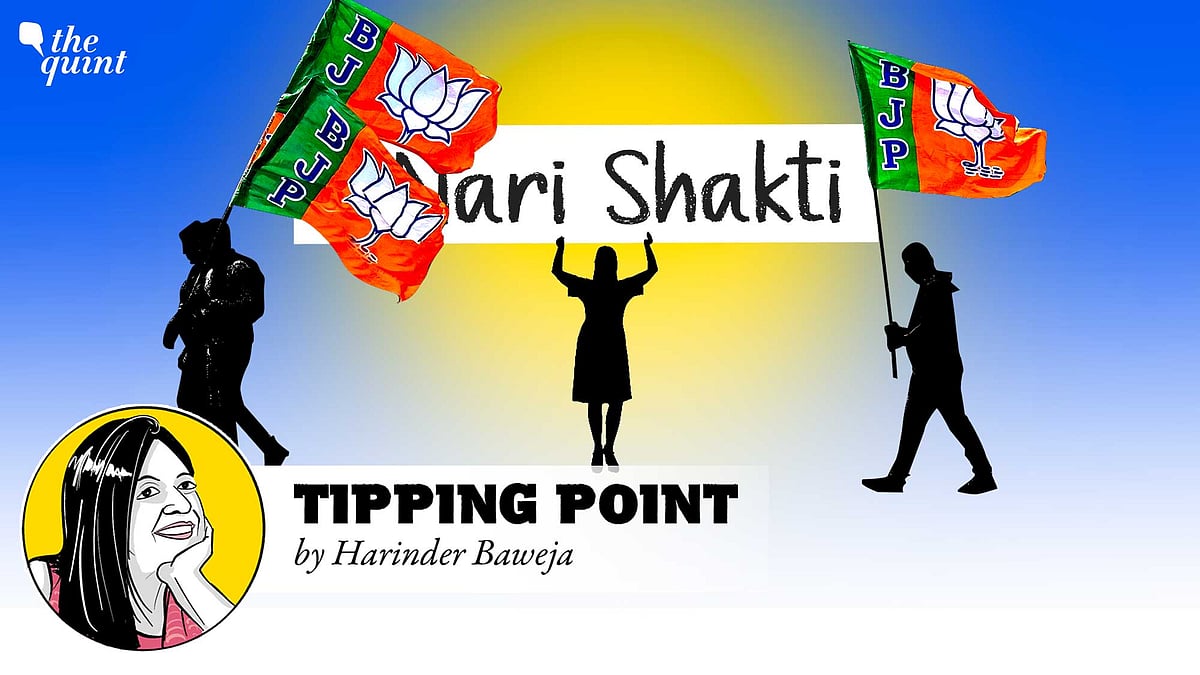
The authoritarian streak is visible even though it is being packaged in the name of Nari Shakti.
advertisement
Prime Minister Narendra Modi is loath to take U-turns and reverse legislation he has himself framed as ‘historic’. Yet, he has done just that with the Women’s Reservation Bill that was finally passed in September 2023 under his stewardship. In a clear rethink, Modi has now called for a special session of Parliament to push through amendments with far reaching political consequences.
The rethink, by a government that has espoused the cause of ‘Nari Shakti’, deserves a deep dive, particularly because Modi extolled the virtues of the ‘historic’ piece of legislation in 2023. The bill, which has had a contentious and chequered history and stayed in the making for nearly three decades, was hailed as a significant step toward “women-led development.”
In a grandstanding speech, Modi said “God had given him the opportunity” to take it forward. Despite the opportunity, the government is now proposing amendments that have Opposition parties up in arms. Their main cause of concern: the government has not acceded to a request for an all-party meeting. Nor, for that matter, is the government willing to wait till the monsoon session in July.
The Curious Timing
Why, then, the haste to call a special session in the midst of state elections in Assam, Puducherry, Tamil Nadu, Kerala, and West Bengal?
Before we answer that question, let us look at just a few data points to assess if ‘Nari Shakti’ truly lies at the heart of what Modi called a ‘God’ sent opportunity. Let’s take the three states where electioneering has reached a feverish pitch.
In Assam, the Bharatiya Janata Party (BJP) has fielded only six women, one down from the previous election. The party, led by incumbent Chief Minister Himanta Biswa Sarma, has found electoral space for only 7 percent of women.
In Tamil Nadu, where the BJP is contesting 27 seats, it has found space for only five women candidates.
In West Bengal, where the BJP is up against one of the longest-serving women chief ministers, the party had announced a seat for only one woman in the first list comprising 119. In a state where incumbent Chief Minister Mamata Banerjee chooses women candidates as part of electoral strategy, there is another statistic that makes up for the lack of numbers currently unavailable as West Bengal only votes at the end of the month: In the 2024 Lok Sabha elections, the Trinamool Congress was the only party that crossed the 33 percent mark even though the Women’s Reservation Bill had not formally been actioned. The TMC’s accounted for 38 percent of women MPs.
For the same 2024 Lok Sabha election, the ruling BJP ‘led’ with giving 69 of 440 seats to women, but accounted for 16 percent, a notch less than the 33 percent reservation it had hailed as historic. That’s less than half the number that Mamta’s TMC scaled by touching 38 percent. The BJP was of course not obliged to roll out 33 percent of its seats for women but clearly there was no intent either to celebrate the ‘historic’ moment.
Elections at the Core?
So, is the West Bengal election at the heart of the special session being called for bang in the middle of a hectic campaign?
Partly, yes, because it puts not just the TMC, but all other parties in a bind. None of them want to be seen as being anti-women, not Mamta for sure, who over the years has built women power—booth level upwards—not just as part of an electoral strategy but as a political core.
The Modi government’s timing is suspect, to say the least. For one, it expects Opposition MPs to abandon the election campaign and spend three days in Parliament and two, the government aims to put its political adversaries on the back foot. Who, in other words, can afford to be called out for being anti-women?
But that’s only half the picture and that’s why I used the word, ‘partly.’
A Shift From 2023
Questioning the “extraordinary hurry”, Congress Parliamentary Party chairperson, Sonia Gandhi, called out Modi for pushing delimitation in the garb of women’s reservation. In a piece for The Hindu, Gandhi called the move “an assault on the Constitution,” and warned that any exercise to increase the strength of the Lok Sabha should be “politically and not just arithmetically equitable.”
The arithmetic reference is to do with the widespread speculation that the government is also considering a separate delimitation bill that seeks to expand the number of Lok Sabha seats from 543 to above 800.
Now, if the government’s intentions are being suspected, it has itself to blame. In 2023, the Congress was in favour of the 33 percent reservation for women to kick in from the 2024 Lok Sabha election itself, but the government refused; instead linking ‘Nari Shakti’ to a fresh census and a delimitation exercise under Article 334-A.
‘Shakti’, Not ‘Nari Shakti’
The rethink now appears aimed at forcing the Opposition to agree to a delimitation based on the 2011 Census. The government’s aim now is to delink the promised Caste census from the delimitation exercise. Once again, Modi is trying to push the narrative and his agenda without the important democratic rails of consensus and consultation.
The authoritarian streak is visible even though it is being packaged in the name of Nari Shakti. The question of whether the Opposition will play ball—the Constitutional amendments require that the Bill/s be passed by a two thirds majority—will be known when the special session is underway between 16 April and 18 April.
What is clear is that there is a real attempt being made to redraw the boundaries of state and Parliamentary constituencies. There is also a fear regarding inequitable distribution between North and South India because population numbers determine delimitation. Quite clearly, the BJP wants to tilt the electoral balance in its political favour.
So let's not pretend that its about Nari Shakti alone, when it's not. What it is about is plain and simple ‘shakti’. The Nari is but an excuse. That question was settled, fairly and squarely, in September 2023. There was no reason for it to be reopened at this particular point in time.
(Harinder Baweja is a senior journalist and author. She has been reporting on current affairs, with a particular emphasis on conflict, for the last four decades. She can be reached at @shammybaweja on Instagram and X. This is an opinion piece and the views expressed are the author’s own. The Quint neither endorses nor is responsible for them.)
- Access to all paywalled content on site
- Ad-free experience across The Quint
- Early previews of our Special Projects
Published: undefined