Why a Rajasthani Panchayat Wants to Ban Women from Using Smartphones
After protests and criticism on social media, the panchayat has withdrawn the order, stating it was a 'suggestion'.
advertisement
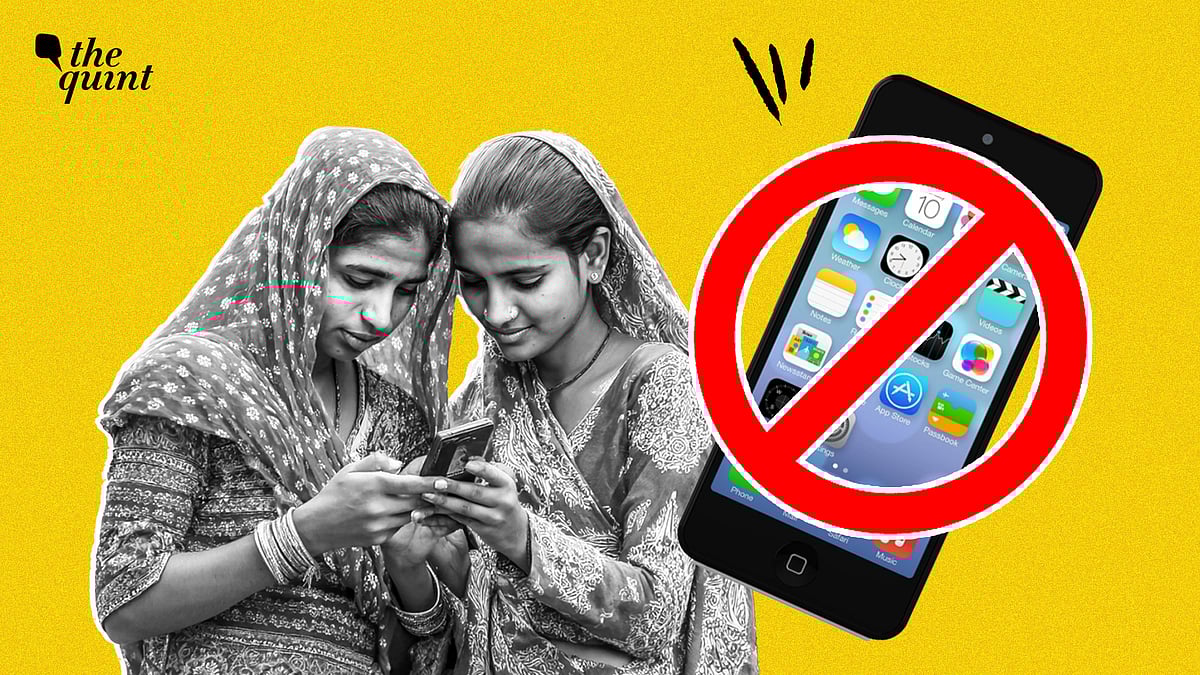
Recently, a video of a local Panchayat became viral on social media, owing to a diktat it imposed in Ghazipur village, situated in Jalore district of Rajasthan, around 415 kms from the state capital. In its ruling, the village body held that no women or girls from these villages will be allowed to use smartphones (camera phones with internet access).
The order, issued on 21 December during a public meeting convened in Ghazipur by the members of a caste panchayat (khap) of 15 villages in Jalore district, said that women are only allowed to use basic keypad phones.
With plans to impose the order by 26 January next year, as per the video which made rounds on social media, the ruling stated, “There will be a ban on smartphone usage by women in the villages. At the same time, if girls require mobile phones for education they will be allowed to use them only at home. But they will not be allowed to carry them to weddings, social events or neighbours’ houses."
Mobiles Damaging to the Eyes
The decision sparked outrage on social media, triggering protests which eventually compelled the Panchayat to clarify their stand and withdraw the decision.
A member told The Quint:
When asked if the decision had been reversed, Sujanaram Chaudhary, one of the members of the caste Panchayat, told The Quint, “The suggestion was given to village elders. In the community meeting, only a proposal and suggestions were placed; it was not implemented. Opinions were being sought, and it was planned to be implemented on 26 January 2026."
While clarifying the 'order' he said, "Due to lack of awareness, children also sometimes fall victim to cyber fraud. We never said that women and daughters should be completely banned from using mobile phones. In today’s times, if girls need mobile phones for studies, they can keep and use them at home for educational purposes so that their studies are not affected in any way".
However, according to local sources, the issue emerged after a couple of young women from the region in their early 20's recently revolted against their families and left their parents' houses. The incident left the family members in a tough spot.
Activists Seek Legal Action
Urging that strict legal and administrative action be taken against the Panchayat representatives responsible for issuing such a decision, the National Federation of Indian Women (NFIW) strongly condemned the ban.
"This decision is not only a direct attack on women’s fundamental rights, but also goes against the core principles of the Constitution, democracy, and gender equality," reads the statement.
Speaking to The Quint, Nisha Sidhu, NFIW General Secretary, said, "Imposing restrictions on women is not the solution, the real solution lies in putting an end to patriarchal thinking. Women are not the property of any panchayat or society".
Urging state government to ensure the protection, safety, and awareness of women’s digital rights in rural areas is taken, Sidhu added:
Jalore Collector Pradeep Gawande told the media, "The administration received the video that was circulated on social media and we are looking into the matter."
Beyond Smartphone, a Deeper Gender Divide
In Rajasthan specifically, the lack of mobile phone access in rural areas has hindered the implementation of even digital education apps. Under the previous Ashok Gehlot government, Rajasthan launched a major scheme aimed at providing free smartphones with internet connectivity to women across the state, thereby bridging the digital divide and empowering women.
The plan (often referred to as the Indira Gandhi Smart Phone Scheme) aimed to distribute phones to 1.3 crore (13.5 million) women, with three years of free data, under a multi-phase rollout. The scheme had an estimated budget allocation of Rs 16,000 crore in the state budget and planned camps statewide for distribution, as reported by The Indian Express.
Women and girls in rural Rajasthan often have limited smartphone and internet access compared to urban areas, which affects education, information access, financial services, and safety resources. Major schemes have aimed to put smartphones and data directly into women’s hands as tools of empowerment and literacy, but political changes and implementation challenges have affected these schemes.
Restricting phone use in Jalore thus contrasts sharply with state and national goals to increase digital access and skills to bridge the gap between traditional norms and modern digital policy objectives.
(Tabeenah Anjum is an independent journalist reporting on politics and current events from Jaipur, Rajasthan.)