
At Ali Khamenei’s Funeral, the Biggest Story Was Who Wasn’t There
Iran's Supreme Leader Mojtaba hasn't been seen since the decapitation strike, writes Vivek Katju.
advertisement
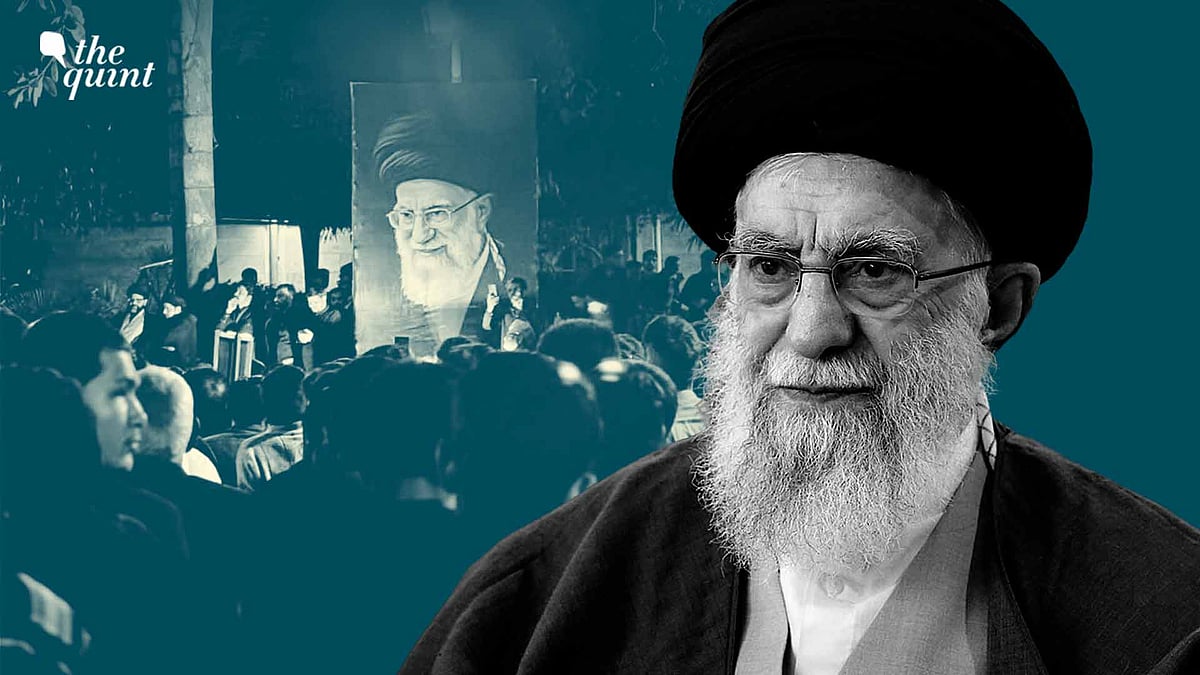
The late Supreme Leader of Iran, Ali Khamenei, and members of his family were laid to rest in the Imam Reza shrine in Mashhad in the early hours of 10 July. They were all killed in the decapitation strike carried out by Israel and the US at the start of the Iran war on 28 February.
The Iranian authorities deliberately planned a funeral which included processions in Tehran and Qom in Iran, followed by Najaf and Karbala in Iraq, from where they were taken to Mashhad for burial.
Media reports indicate that the funerals witnessed a genuine outpouring of grief at the loss Iran had suffered as well as anger against the US and Israel for their actions.
This was not surprising because the Iranians are a proud people and killing of the Supreme Leader and his family members, including an infant granddaughter, outraged them. Their collective memory of the martyrdom of Imam Hussein, the grandson of Prophet Muhammad, at Karbala was revived.
The Iranian leadership deliberately decided to take Khamenei’s body to Karbala, one of Shia Islam’s holiest places. The objective was to reinforce the connection they had made between Imam Hussein's and Khamenei’s martyrdom at the hands of ‘tyrants’. The majority Sunni Muslims don't largely share Shia sentiments about Khamenei’s martyrdom, though there are some among them, too, who grieve the manner in which he was killed.
There is little doubt though that the decapitation strike has reinforced hostility against Israel and the US in the Shia world. Khamenei will permanently enter Shia Islam’s list of prominent martyrs who paid the price for defying arrogance and upholding Islam.
When the Agreement Came Under Fire
Ali Khamenei’s son Mojtaba, who was selected as his successor soon after his father was killed, has not been seen or heard at all since the decapitation strike. It is believed that he suffered injuries though no one really knows how bad they were.
If there was one occasion on which he should have stood before and with his people, it was at his father’s funeral. That would have sent a message of reassurance to Iran and the world that he is in a position to lead his country—and take final war and peace decisions. Mojtaba’s three brothers publicly joined the mourners. That only made his absence more significant.
The Iranians claim that he was not allowed by his security personnel because of fears that the US and Israel may kill him. That apprehension should not have prevented his public appearance, because a leader has to take some personal risks if the occasion demands—and this one undoubtedly did.
US President Donald Trump declared on 4 July that the US will pause negotiations—and won't take any military action till the funeral concluded. This was the decent thing to do, though conventional decency and Trump are far removed from each other. What would have also been in America's mind was that many countries would send delegations to mourn Khamenei.
While none of the European countries sent delegations, many Islamic and Global South nations did. Saudi Arabia and Qatar were the two Arab gulf countries to also do so. Pakistan’s delegation was led by Prime Minister Shehbaz Sharif. This was not surprising in view of the intermediation role Pakistan had played.
The Indian delegation was led by Bihar Governor Syed Ata Hasnain, who is a Shia Muslim. The Minister of State for External Affairs, Pabitra Margherita, accompanied him. Media reports indicate that Iran was satisfied with the level of India’s representation but the Iranians are masters of dissimulation. Hence, it is difficult to assess whether the level of the Indian delegation met their expectations.
Why Neither Side Can Walk Away
A major component of the MoU was the opening of the Strait of Hormuz. It required Iran to make “its best efforts for the safe passage of commercial vessels with no charge for 60 days only from the Persian Gulf to the Sea of Oman and vice versa”. It also stated,
Besides, according to the MoU, Iran and Oman were to hold a dialogue “to define the future administration and maritime services in the Strait of Hormuz in discussion with other Persian Gulf littoral states in line with the applicable international law and the sovereign rights of coastal states of the Strait of Hormuz.”
The US response to Iranian attacks on ships in the Strait of Hormuz was swift and intense. It did not adhere to Trump’s assurance because of the Iranian provocation. It carried out multiple bombing raids over two nights in southern Iran, including targeting a few bridges and railway lines. It also reimposed its earlier embargo on the export of Iranian oil. Trump declared that the MoU was all but dead. On its part, Iran used missiles to attack US bases in Jordan, Kuwait, and Bahrain.
Fears of the breakdown of the talks led to a rise in oil prices and a fall in the stock markets. It also raised apprehensions about major disruptions in movement of maritime traffic through the Strait of Hormuz. All this is now abating because the earlier mediators have got involved in repairing the damage to the MoU. Trump has also indicated that technical negotiations—and these would naturally be on nuclear issues—can continue.
The fact is that neither Iran nor the US can afford to go back to the MoU period. The fears that both had earlier still prevail. Neither side can really risk a long-term closure of the Strait of Hormuz and the reimposition of the naval blockade, leave alone the collapse of the Iranian state or mayhem in the Gulf countries.
However, the path of the MoU implementation will be bumpy. It will be punctuated with short and sometimes, as on this occasion, intense military exchanges along with angry rhetoric. Amid all this hydrocarbons, movement will take place through the Strait of Hormuz.
(The author is a former Secretary [West], Ministry of External Affairs. He can be reached @VivekKatju. This is an opinion piece and the views expressed are the author’s own. The Quint neither endorses nor is responsible for them.)
- Access to all paywalled content on site
- Ad-free experience across The Quint
- Early previews of our Special Projects
Published: undefined