
India-EU FTA: What Does India Get From the ‘Mother of All Deals’?
How US responds to the FTA will be critical, and Trump's petulance can play spoiler in an unexpected manner.
advertisement
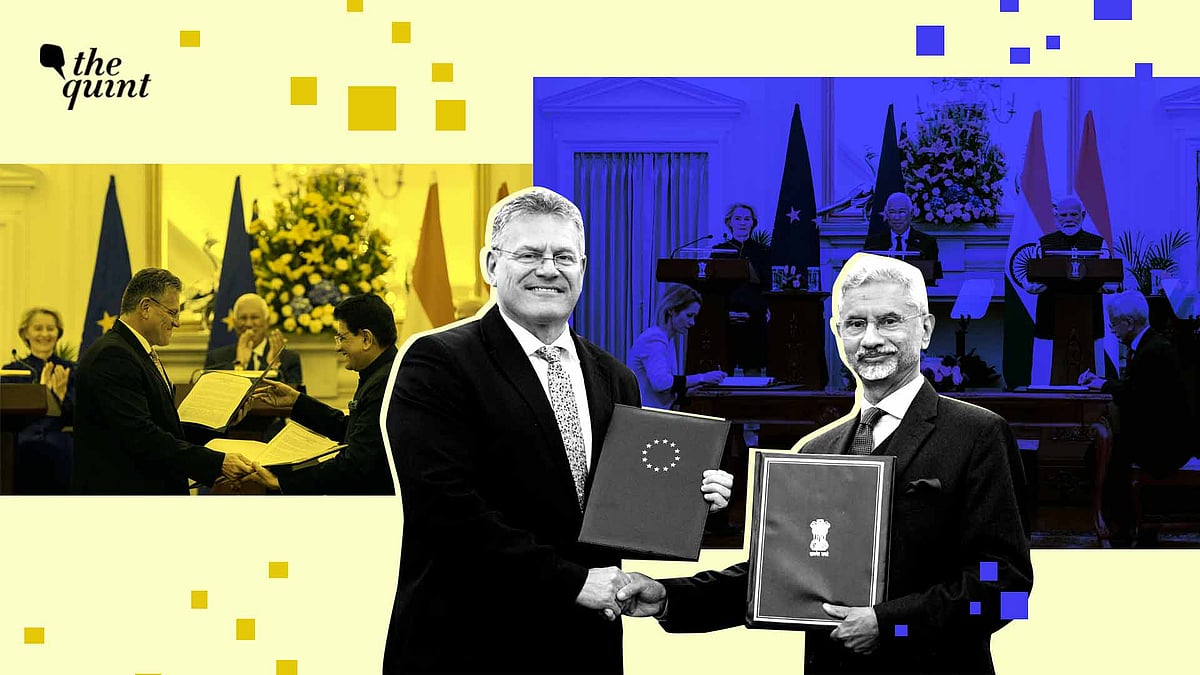
After nearly two decades of on-and-off talks starting in 2007, negotiations for the India-European Union (EU) Free Trade Agreement (FTA)—widely dubbed as the "mother of all deals"—were successfully concluded on 27 January 2026 in New Delhi. The initial documents have been signed and full ratification (including by the European Parliament), followed by the legal finalisation, may take up to a year. It is expected that implementation of the FTA will commence in 2027.
This is a major strategic accomplishment for both India and the EU. Prime Minister Narendra Modi and European Commission President Ursula von der Leyen are to be commended as they seem to have proved their critics wrong.
Prickly Partners: India and EU Face Off with US
Successful closure of a complex trade agreement between two prickly trade partners (both India and the EU have to tread very carefully to avoid domestic backlash in reducing tariffs) comes at a time when the world is in a state of considerable geo-political and geo-economic turbulence. This has been triggered by the feckless policies unleashed by US President Donald Trump since he assumed office for a second term in January 2025.
The US is unhappy with this development. The American Treasury Secretary Scott Bessent, a key Trump aide, publicly slammed the deal in media interviews just before the announcement. He accused the EU of indirectly "financing the war against themselves" by engaging deeper economically with India.
Bessent highlighted, "We have put 25 percent tariffs on India for buying Russian oil. Guess what happened last week? The Europeans signed a trade deal with India." He framed this as Europe undermining its own security stance on the Russia-Ukraine conflict, while claiming the US has "sacrificed more" in efforts to resolve it.
Justifying the Name
Why is this agreement called the "Mother of All Deals"? The key reasons it earns this hyperbolic but fitting label is its unprecedented demographic and economic scale.
India, the world’s most populous country, has 1.4 billion people and the EU that comprises 27 countries with a combined population of 450 million people will now form a joint market of roughly 2 billion people and a total GDP of US $25.5 trillion (EU $21.3 trillion and India $4.2 trillion respectively).
Current bilateral EU-India goods trade is around $130–140 billion, with services adding more value and taking the total in excess of $190 billion including investments.
The current FTA aims to sharply reduce/eliminate tariffs on most EU exports to India (currently as high as 96 percent in some sectors) and phased zero duties for many Indian exports to the EU over the next seven years.
For the EU, increased exports would come in cars, wines/beer, machinery, luxury goods and food products will become less expensive and hence more competitive in India.
Leaders claim this agreement has the potential to double trade value in many areas, boost manufacturing, create jobs, attract investment and integrate India deeper into global supply chains. However, as in all such trade agreements—much will depend on the actual realisation of the benefits that have been listed. It is instructive that agriculture has been largely left out in deference to domestic sensitivities on both sides.
Defence and Strategy
The strategic and geo-political importance of the 27 January agreement for both India and the EU stems from the prevailing global framework dotted by rising protectionism (for example the US tariffs), supply-chain disruptions and over-reliance on certain partners (USA and China).
In essence, the deal serves as a hedge and diversification tool for both the EU and India, who have to engage with the world’s two largest economies and major powers—perhaps a bit warily. EU President Ursula von der Leyen highlighted that it reduces "strategic dependencies when trade is being weaponised," while broader agreements (for example, on security and defence) complement this by fostering trust in critical sectors like technology and green energy.
While strengthening strategic ties between two major democracies, this agreement supports the EU's "de-risking" from China policy and aligns with India's push for multi-alignment through multiple FTAs and strategic partnership agreements to become a developed economy by 2047.
The current FTA is embedded in a 'Joint India-EU Comprehensive Strategic Agenda to 2030', covering prosperity, sustainability, technology/innovation, security/defence, connectivity and global issues.
This reflects shared values and concerns, as the world's two largest democracies, enabling cooperation on challenges like climate change (with EU climate support funding), innovation, and regional stability—at a time when the US has withdrawn from the leadership role it had long assumed.
The key areas of defence cooperation are envisaged through joint initiatives and dialogue on shared priorities in the first instance. These include:
Maritime Security by way of enhanced collaboration in the Indo-Pacific and beyond, including joint exercises, information sharing, and freedom of navigation to counter threats in vital sea lanes.
Cyber and Hybrid Threats through coordinated responses to cyberattacks, disinformation and other non-traditional threats.
Space Security dwelling on expanded dialogue in relation to space situational awareness (SSA), debris monitoring, secure satellite communications and alignment on emerging technologies like 6G.
Counterterrorism cooperation through deeper intelligence sharing, capacity building and joint efforts against transnational terrorism.
Integration of Indian firms into European defence value chains (for example, with companies like Airbus, Dassault, Rheinmetall); potential Indian participation in EU programmes like the SAFE (Security Action for Europe) initiative, which has allocated almost Euro 200 billion, could be valuable in the realisation of ‘atmanirbharta’ (self-reliance).
The EU remains dependent on the US for its own security and military inventory through NATO and cannot afford to tread on Trump's toes at this point. India is in a similar predicament and is dependent on arms imports from Russia for its own security.
All eyes are now on Trump. How the US responds to the India-EU deal will be critical, and Trump's petulance can play spoiler in an unexpected manner.
(C Uday Bhaskar is a leading expert on strategic affairs. He is currently Director, Society for Policy Studies. This is an opinion piece. All views expressed are the author’s own. The Quint neither endorses nor is responsible for them.)
- Access to all paywalled content on site
- Ad-free experience across The Quint
- Early previews of our Special Projects
Published: undefined