
Imtiaz Ali and the Burqa: The Strange Confidence of Explaining Muslim Women
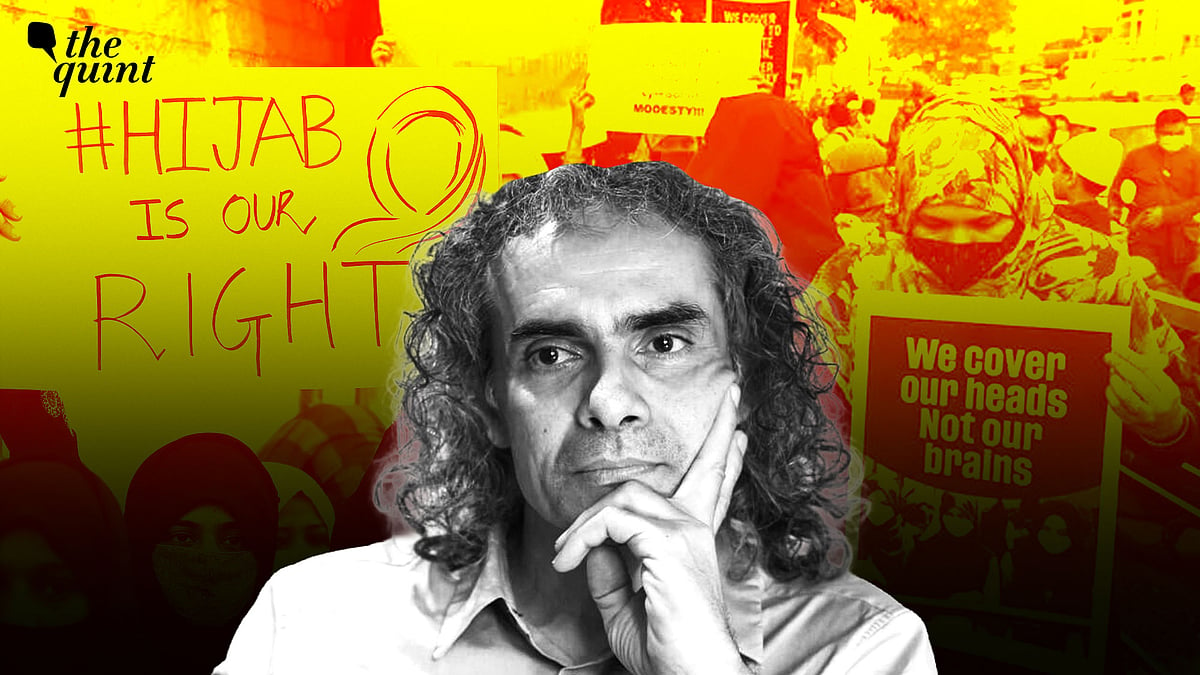
Imtiaz Ali isn't just saying Muslim women are wrong, but that they are incapable of knowing when they are right.
advertisement
Imtiaz Ali has made some of the most tenderly observed films about women's interiority in Hindi cinema. Geet, Veera, Heer and Laila are contradictory, complicated, difficult, restless women who don’t fit into conventional moral archetypes. They startled us and that is why they captivated us. They sometimes make choices that are immoral, but are also deeply liberating. They demand our aesthetic attention precisely because although we relate to Geet, Veera, Heer and Laila yet we do not relate to them at all. Although Geet also loved travelling by train by herself, yet she never had to worry about getting lynched in a train because of Hijab. The deep-rooted mistrust in Muslim women of an ability to cultivate rich interior lives in the films of Imtiaz Ali is the reason that his recent remarks about Muslim women do not surprise me at all.
His quote was: "I don't like when someone says 'I am comfortable in my burqa. I am comfortable in my parda'. It's a degenerated society; if you feel like this, it's not okay. It means that you have become so victimised in your mind, I don't know how."
If we say we are uncomfortable, we must be oppressed. If we say we are comfortable, we must have internalised this oppression. The framework cannot be disproved, because it was never meant to be tested. It was meant to position the speaker as the one who sees clearly while the woman in question stays the one who cannot see at all. This means that there is no possible answer this woman can give that would be accepted on its own terms.
A Muslim woman can never be right about her own life, this is why these conversations do not feel like conversations at all to me.
'Everyone can speak about Muslim women...except Muslim women'
This position has become one of the many ways in which Muslim women are discussed across the political spectrum. From conservatives to liberals to progressives, everyone seems to have an answer but the Muslim woman herself: what she should wear, what freedom ought to feel like and so much so what she must desire. These different deliberators draw different conclusions, but all of them seem to begin from the same assumption. That they know Muslim women's lives better than they do themselves, and they go further on to claim knowledge of what Muslim women know not. This is the problem that Saba Mahmood identified in Cairo.
Working with women in Cairo’s mosque movement who consciously choose the desire of piety through practicing the Muslim faith, Saba Mahmood found that liberal feminism had become so invested in resistance that it failed to recognise agency when women choose religious practices.
A woman who consciously occupied those norms therefore appeared incapable of exercising agency at all. If a woman said she had chosen them, then the choice itself became further proof that she had internalised her own subordination.
The problem I see is that people tend to quickly believe that they have not only understood the Muslim woman’s choice but have also decoded her very desires. Imtiaz Ali's remark falls into the age-old trap of denying women authority altogether. He is not simply determining that they are wrong but attesting that they are incapable of knowing when they are right.
Targeting Muslims Bodies and Identity
The problem with this position is not just articulated in a narrative vacuum. It becomes much very much more tangible when it is placed in the political conditions of contemporary India. Here, the question is no longer whether the hijab is oppressive. We are living through a moment in which the language of liberation overlaps with the language through which the state regulates visible Muslim bodies and identity.
The politics of the hijab in India cannot be separated from the politics of Muslim identity itself. We are not having this conversation in a country that is indifferent to Muslim women choosing to cover. We are having it in a country where the hijab has become one of the central battlegrounds through which the state, majoritarian politics and mainstream media negotiate the place of Muslims in public life.
Whether the girls wanted to wear the hijab quickly became beside the point. The important thing here is that contesting claims to authority had been made and the state had tried to lay down the overly used idea of liberation.
It suddenly seemed to be affordable for the beti to not be in the classroom, and the hijab seemed to stir Indian secularism somewhere that seemed to be very fundamental to it. Symbolic interventions replace the harder and often disposable work of changing the conditions under which Muslim women actually live.
It is more convenient to remove a head-scarf than to confront residential segregation, discriminatory hiring, underinvestment in Muslim-majority neighbourhoods, or the fact that Muslim women remain among the most educationally and economically marginalised communities in the country. Or in other words, removing the head scarf became the better bargain against the task of dismantling the whole notion of Indian Secularism.
The Real 'Degenerate' Society
The assumption that Muslim women cannot be trusted to explain their own lives is hardly new. It survived the many wars on terror, when Muslim women were made to be moral justification for military intervention. It now thrives within sections of liberal and progressive politics and media that sincerely believe they are speaking the language of feminism. It is expressed through uncountable medium, but it rests on the same assumption. Muslim women continue to be presented mostly as objects to be rescued rather than political subjects capable of identifying the terms of their own liberation. This rather aged thought practice betrays itself in the remarks made by Imtiaz Ali.
I have encountered it enough in progressive spaces to recognise it immediately. I know men and women who told me that I can not be revolutionary enough because I wear a Hijab and that my opinion shouldn’t be taken seriously. I also know people who have told me and women I know that we cannot be revolutionary enough because we haven't yet won the fight with our families over curfew timings. That our politics are compromised because we navigate rather than confront. That choosing our battles makes us complicit. And underneath every single one of those conversations was something that had nothing to do with our liberation. What they wanted was our availability. They wanted us free enough to be accessible to them, free from family, free from restrictions, free at 11 pm, but not free in ways that would make us inconvenient or undesirable or beyond their management. Liberation as a condition of access.
The woman who declines, who covers, who stays home past a certain hour by choice, who does not perform her freedom in the approved register, is the one with false consciousness. She needs to be explained to herself. The woman who navigates her circumstances cannot possibly have reflected on them. If she has chosen negotiation over confrontation, then the negotiation must have been chosen for her.
To tell a Muslim woman in India today that her comfort with the hijab is evidence of living in a "degenerated society" is to direct the analysis at the wrong place. If there is something extremely degenerate about today's India: it is the spectacle of a society that has made a cultural life around the idea of the nation and women's clothing into a test of national belonging. Who ought first to answer the charge of degeneration, the person who transgresses the humanity of a woman wearing the hijab, or the institutions that deny girls an education and employment because they refuse to remove it. Rather than pathologise Muslim women for finding meaning in the hijab, perhaps we should ask what kind of political culture has become so invested in making that meaning invisible.
People have argued over the hijab for decades and will continue to do so. It was important to emphasize that Imtiaz Ali failed to imagine the possibility that a Muslim woman has already thought about these questions as seriously as he has. Her answer is treated not as the conclusion of her own reasoning but as evidence that she has failed to reason at all. That is a difficult position to distinguish from the paternalism feminism set out to challenge.
(Nabiya Khan is a researcher and PhD student at Rice University. Her focus is on the infrastructure of oppression. This is an opinion piece and the views expressed above are the authors' own. The Quint neither endorses nor is responsible for them.)
- Access to all paywalled content on site
- Ad-free experience across The Quint
- Early previews of our Special Projects
Published: undefined