
IDBI Bank Sale: A Public Asset Deserves Competitive Bidding, Not Throwaway Price
IDBI Bank must be put back for sale again, writes Subhash Chandra Garg.
advertisement
Let me begin with a disclaimer. I strongly believe that the privatisation of banks and public sector enterprises was among the best policy options for India—and that I was instrumental in sewing up the IDBI Bank deal in June 2018 to make it a 'private bank' by selling 51 percent of its stake to the Life Insurance Corporation of India (LIC).
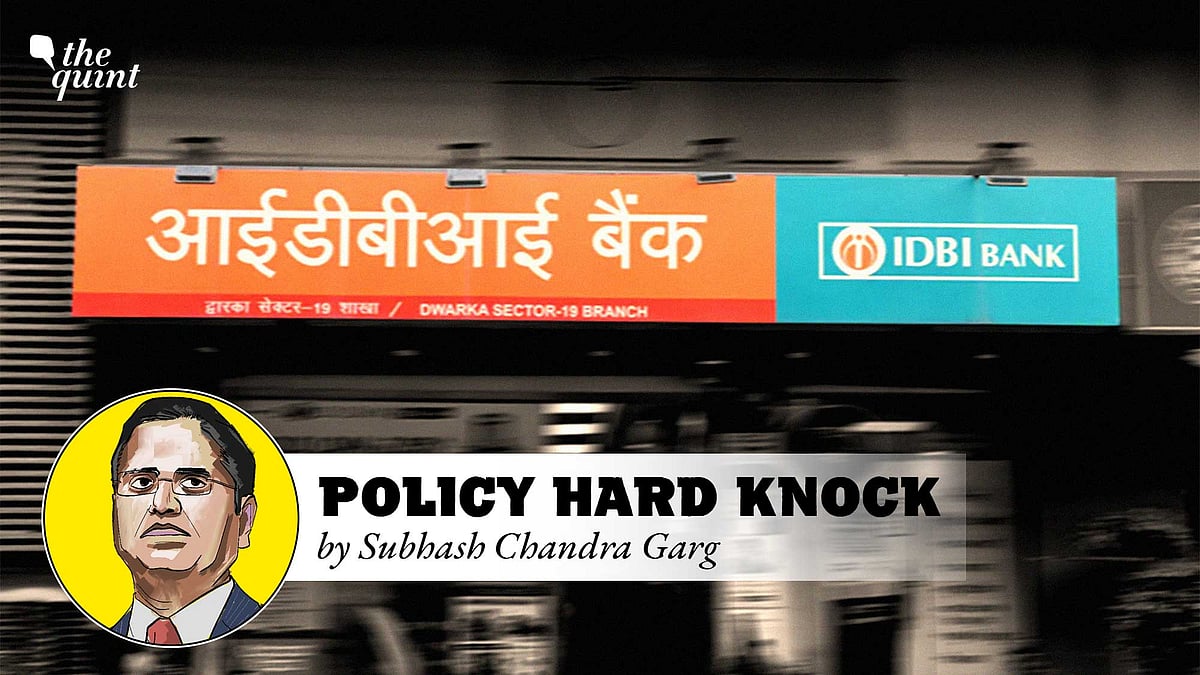
IDBI Bank still remained effectively a public sector bank until 14 October 2026, when the government approved a sale of 60.72 percent equity (30.48 percent government, 30.24 percent LIC) to a strategic buyer, M/s 10955230 Canada Inc, the parent entity of Fairfax Financial Holdings, for Rs 52,878 crore.
The government claims that the price it got (Rs 81 per share) is higher than the bank’s fair valuation (reserve) price of Rs 75.99 per share. The sale has created a major storm which will gather more steam. Is the IDBI Bank being sold cheap? Is the valuation price fair or is this a crony deal?
The Backstory
The Modi government had approved—in line with its ideological belief that it is not the government’s business to be in business—the strategic disinvestment/privatisation policy in 2015. Finance Minister Arun Jaitley had announced in Budget 2016-17 the government’s intent to bring its stake in IDBI Bank, a public sector bank since 2003 following the merger of IDBI Ltd into it, below 50 percent.
The International Finance Corporation, a World Bank affiliate, was approached. It made a good offer for taking over 100 percent of the government stake. The deal fell through largely because government officers were not equipped to do such a single institution deal.
The bank was doing very badly. In 2017-18, it reported a net loss of Rs 8,238 crore and had gross non-performing assets (NPAs) of Rs 55,588 crore (27.95 percent of total outstanding loans), the highest ratio amongst the public sector banks. The government was understandably worried.
On 1 August 2018, the government announced its 'no objection' to reduction in its shareholding in IDBI Bank 'to below 50 percent by dilution' and approval of the acquisition of controlling interest by LIC as a promoter. On 21 January 2019, the government sold a 51 percent stake to LIC at Rs 21,624 crore (average price Rs 61 per share). The Reserve Bank of India reclassified IDBI Bank as a private sector bank in law.
In practical terms, with LIC holding 51 percent and the government 46.46 percent stake, amounting to a total of 97.5 percent stake in the bank on 31 March 2019, it was still effectively a public sector bank. The government continued to treat the bank as such.
Over 2019-20 and 2020-21, the government infused a total of Rs 12,438 crore in IDBI Bank as equity in the form of recapitalisation bonds like other public sector banks. In two years, of the Rs 21,624 crore the government received from its 51 percent stake sale, 57.5 percent was gone back to IDBI Bank as equity.
Long Dicey Road to Privatisation
IDBI Bank began witnessing a massive turnaround from 2020-21 when it earned net profit of Rs 1,359 crore, which steadily grew to Rs 9,315 crore in 2025-26. Gross NPA was down to 2.32 percent in 2025-26 and net NPA to 0.15 percent. The bank, on 31 March 2026, had turned into a super healthy bank with 26.65 percent capital adequacy ratio, Rs 3.47 trillion of deposits, return on equity of 18.93 percent, and free reserves/surplus of Rs 56,885 crore.
The government initiated privatisation in October 2022, when the bank was still in the doldrums, and invited an Expression of Interest (EOI) for the combined sale of 60.72 percent equity.
The media informed that Kotak Mahindra Bank, Emirates NDB, Fairfax Financial Holdings, and Oaktree Capital Management were the four qualified parties which were invited for submitting financial bids in January 2026 (termed initial bids now). Kotak Mahindra Bank and Oaktree Capital Management did not submit their financial bids.
Both the bids submitted were below the reserve price and "were not approved." Normally, that would have been the end of the EOI process. Yet, the government "in exercise of the powers delegated and conferred upon the collective decision-making mechanism, and to enhance the value of the transaction as far as possible," reinvited sealed bids "from qualified bidders" (not clear whether from two or all four) on 18 May 2026. This re-invitation was a complete violation of the government disinvestment process.
Emirates NDB and Fairfax Financial Holdings submitted their revised bids in July 2026 (their initial and revised bids, except the winning bid not disclosed). Emirates NDB Bank had acquired RBL Bank by buying a 60 percent equity stake in June 2026 for Rs 26,000 crore. Its bid for IDBI Bank could not have been a serious bid, making the privatisation process of IDBI Bank effectively a one bidder race.
The government decided to seal IDBI Bank to effectively a single bidder, Fairfax Holdings, in October 2026 by lowering the reserve price in the midst of the process.
A Crony Transaction
It is absolutely necessary to create intense competition for selling any public asset—airports, telecom spectrum, or banks. The IDBI Bank bid process singularly failed on this score.
India's bank ownership policy framework (crushing restrictions on equity ownership, voting rights, fit and proper criterion for key managerial position) does not attract global bankers and serious Indian entrepreneurs to bid for banks. Tepid initial bids for IDBI Bank reflected this. It is also hugely embarrassing that the only strong Indian entity (Kotak Mahindra Bank) decided not to make the financial bid.
The government has now disclosed that it had fixed a reserve price of Rs 94.42 per share while evaluating the January 2026 bids. The Fairfax bid price is not known. The government's press release, issued on 14 October, announcing sale to Fairfax uses convoluted arguments to besmirch its own reserve price.
The government is being disingenuous by making a reference to the price of Rs 42.40 per share on the day before the preliminary information memorandum/ EOI issued on 7 October 2022 as IDBI Bank was reeling under the massive load of NPAs and just coming out of a mountain of losses, making it completely unrepresentative of the real worth of the bank in October 2026 when its financials were comparable to the best in the business.
The government’s argument that the price of Rs 108.12 per share on the last trading day before 8 January 2026 (the initial bid day) was impacted by the bidding effect, and therefore, not representative, is bizarre. That price did reflect the value which the buyers of IDBI Bank shares on that day believed would still yield gains to them, with the bidders expected to bid at a still higher price. Discrediting this price is the surest indication that the government wanted to lower its reserve price of Rs 94.52 per share.
Behind the Bid
Another argument advanced, that the stock price of IDBI Bank had fallen to Rs 70.38 per share on the last trading day, i.e. 15 May, before the invitation of bids on 18 May, to justify lower reserve price, is nothing short of perverse.
Non-approval of bids received in January 2026 had disappointed most of the people, leading to a widespread belief that the government would not privatise IDBI Bank. The invitation for re-submission of bids in May was more of a hush-hush affair. As soon as the people came to know of the re-invitation of bids, the market price of IDBI Bank shot up again, rising to more than 80 in June and crossing over 90 in September.
The entire privatisation process, including very low competition leading to virtually a single bid and producing a designer reserve price to suit what the virtually single bidder was prepared to pay, makes the IDBI Bank privatisation a complete crony deal for Fairfax Holdings.
Cancel or Get the Bid Challenged
This gross violation of the public asset sale bidding system by revising the reserve price below the financial bids post opening alone will justify the cancellation of the sales process for IDBI Bank. Considering the IDBI balance sheet, its profit, almost nil NPAs returns on equity etc, Rs 81 per share price is a steal, a throwaway price.
After cancellation and designing the policy much better to ensure intense competition, IDBI Bank must be put back for sale again.
In case the government and the RBI are not willing to restructure the policy package, the government must convert the Fairfax Holdings bid of Rs 81 per share into a Swiss Challenge bid and invite open bids again from all banks and financial institutions, domestic or international (with a reasonable eligibility net worth, say 50 percent of IDBI Bank’s net worth).
Such a privatisation would be close to the real privatisation of a public asset, at a right and fair valuation for the government and LIC.
(Subhash Chandra Garg is the Chief Policy Advisor, SUBHANJALI, and Former Finance and Economic Affairs Secretary, Government of India. He's the author of books such as 'The $10 Trillion Dream Dented, 'We Also Make Policy', and 'Explanation and Commentary on Budget 2025-26'. This is an opinion piece, and the views expressed above are the author’s own. The Quint neither endorses nor is responsible for the same.)
- Access to all paywalled content on site
- Ad-free experience across The Quint
- Early previews of our Special Projects
Published: undefined