
'Not for Sale': What I Learned Firsthand About Greenland’s Colonial Past
For a people long spoken about, not listened to, the idea of trading one distant master for another hardly appeals.
advertisement
Donald Trump may believe Greenland can be annexed “whether they like it or not” but the more pertinent question is whether Greenland’s Indigenous people are willing to exchange one colonial power for another.
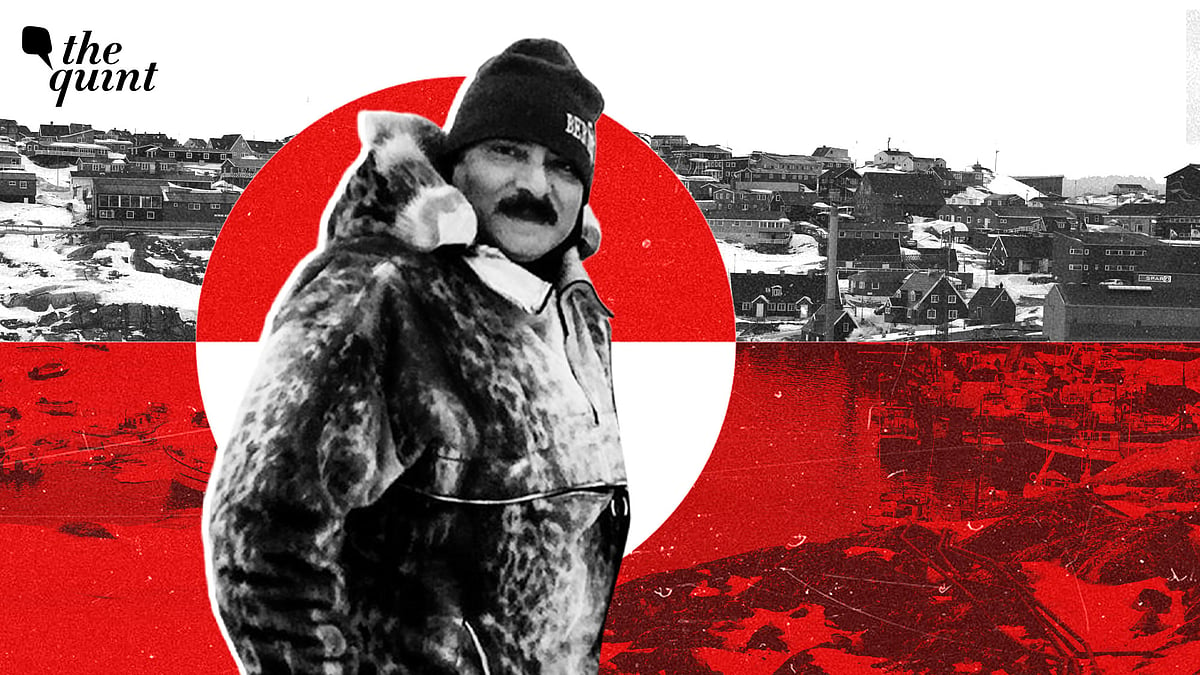
A few years ago, I flew from Iceland into Greenland and landed in Ilulissat, a small town clinging to the west coast just above the Arctic Circle. Ilulissat enjoys a front-row view of the Ilulissat Icefjord, a UNESCO World Heritage Site where skyscraper-sized icebergs drift majestically into Disko Bay.
Greenland did not become Danish through conquest, treaty, or consent. Its colonial absorption was slow, bureaucratic, and deceptively gentle—through missionaries, trade monopolies, and administrative control.
(Photo Courtesy: Akhil Bakshi)
Greenland did not become Danish through conquest, treaty, or consent. Its colonial absorption was slow, bureaucratic, and deceptively gentle—through missionaries, trade monopolies, and administrative control.
Colonialism Without Conquest
Denmark’s claim to Greenland dates back to medieval times, when Norse settlements fell under the Norwegian crown. When Denmark and Norway entered a dynastic union in 1380, Greenland was absorbed—at least on paper—into the Danish-Norwegian realm, even though the Norse had long vanished and Inuit communities were the island’s sole inhabitants. For centuries, the claim remained largely theoretical.
Trade monopolies soon followed, foreign access was restricted, and governance was imposed without treaties or consultation. By the nineteenth century, Greenland was openly administered as a Danish colony, ruled from Copenhagen.
By the nineteenth century, Greenland was openly administered as a Danish colony, ruled from Copenhagen.
(Photo Courtesy: Akhil Bakshi)
'The Story Isn’t So Simple'
One night, driving to the outskirts of Ilulissat to watch the Northern Lights, I asked my guide—an Indigenous Greenlander—whether locals still considered Denmark a colonial power.
He paused, then said quietly, “People sometimes say Denmark was kind to us. Maybe that makes them feel better. But if you ask us, the story isn’t so simple.”
He began with Thule. In the 1950s, Danish authorities relocated Inuit communities so the US could build an airbase. “No real choice, no real discussion,” he said. “We were pushed off land our families had lived on for generations and dumped somewhere harsher, where hunting was harder.”
Then there were the children sent to Denmark in the 1950s to be groomed as “role models”. Many never truly returned. They lost their language, their families, their bearings. Denmark apologised for the experiment only recently—seven decades too late.
Modernisation brought further upheaval. Villages were shut down, families moved into concrete housing blocks, hunters told to find salaried work overnight. When social problems followed, responsibility somehow landed on the victims rather than the planners.
“And don’t get me started on the birth-control scandal,” he added, referring to Inuit girls and women fitted with IUDs without informed consent to “manage” population growth. “That still hurts.”
Modernisation brought further upheaval. Villages were shut down, families moved into concrete housing blocks, hunters told to find salaried work overnight. When social problems followed, responsibility somehow landed on the victims rather than the planners.
(Photo Courtesy: Akhil Bakshi)
Greenland’s Resource Temptation
Greenland is believed to possess significant oil and hydrocarbon potential, though none has yet been commercially extracted. Estimates by the US Geological Survey suggest that northeastern and offshore regions could hold resources equivalent to roughly 31 billion barrels of oil-equivalent. Whether these riches ever materialise remains uncertain, but their strategic allure is undeniable.
At my hotel, I struck up a friendship with a neighbour—a Kalaaleq Inuit and Assistant Professor of political science at Ilisimatusarfik, the University of Greenland. His campus is in Nuuk, the capital, some 560 km away. In a country with no roads between towns, that distance might as well be interplanetary.
Over a memorably challenging dinner—boiled seal meat, raw whale skin, fermented shark, and reindeer seasoned with seaweed—we discussed economic exploitation under Danish rule.
“Extraction,” he said, “Did not always look like open-pit mines. It was quieter, administrative—but no less real.”
Extraction Without Excavators
For much of the twentieth century, Greenland’s economy revolved around fishing—first cod, later shrimp, and halibut.
Then there was cryolite, mined at Ivittuut from the nineteenth century until the 1980s. Essential for aluminium production, Greenland’s cryolite was strategically vital during the Second World War, underpinning Allied aircraft manufacture. Denmark derived enormous geopolitical value from a single Greenlandic mineral.
Animal products—seal skins, whale oil, blubber—were commercialised within Danish trading systems. Control of markets mattered more than control of the hunt. Geological surveys mapping uranium, rare earths, and iron ore represented another form of extraction: knowledge as power, concentrated in Danish institutions.
“Labour and geography are resources too,” he added. Greenlanders provided cheap labour, and Greenland’s Arctic location gave Denmark strategic importance during the Cold War and within NATO.
“So when my students ask whether Denmark took resources from Greenland,” he concluded, “I tell them this: Denmark controlled access, decisions, and benefits. That control, more than the volume extracted, is why the relationship still feels colonial.”
Geological surveys mapping uranium, rare earths, and iron ore represented another form of extraction: knowledge as power, concentrated in Danish institutions.
(Photo Courtesy: Akhil Bakshi)
Independence, On Greenland’s Terms
Greenland’s independence movement has been gathering force since the mid-twentieth century. Early nationalist voices emerged in the 1960s, followed by the pivotal 1979 Home Rule referendum. Autonomy deepened further in 2008, when voters overwhelmingly backed self-government, gaining control over domestic affairs, natural resources, and a legal pathway to full independence.
Today, independence is no longer a fringe aspiration but a mainstream political goal. Major parties—including Siumut, Inuit Ataqatigiit, and Naleraq—support sovereignty in principle, and most Greenlanders favour independence at some point.
Following the March 2025 parliamentary elections, a new coalition government led by Demokraatit’s Jens-Frederik Nielsen took office. The coalition supports independence in principle but favours a cautious, incremental approach. Rather than rushing toward rupture, it keeps independence on the roadmap while acknowledging economic realities and maintaining a functional partnership with Denmark.
Greenlanders recognise the language of “strategic interest” and “benevolent oversight”; they have lived its consequences in their land, their bodies, and their families. If Denmark’s colonialism was quiet and bureaucratic, an American annexation—brash, transactional, openly extractive—would be something else entirely.
Greenland today is edging, carefully and deliberately, toward sovereignty on its own terms—not as a trophy to be claimed or a resource vault to be unlocked. The real question is not whether Greenland can be annexed “whether they like it or not”, but whether the great powers of the 21st century are finally prepared to accept an answer they have rarely heard from the Arctic before: No.
(The author is a Fellow of the Royal Geographical Society and Explorers Club USA, and Editor of ‘Indian Mountaineer’. He is also the founder of Bharatiya Yuva Shakti, an organisation that ensures good leadership at the village level. He tweets @AkhilBakshi1. This is an opinion piece, and the views expressed above are the author’s own. The Quint neither endorses nor is responsible for the same.)
- Access to all paywalled content on site
- Ad-free experience across The Quint
- Early previews of our Special Projects
Published: undefined