
The 'Chindia' Era? Why China May Become a Potential ‘Make In India’ Ally
Apart from sending a new signal to Trump, the policy underlines in a subtle way that “Make in India" offers avenues.
advertisement
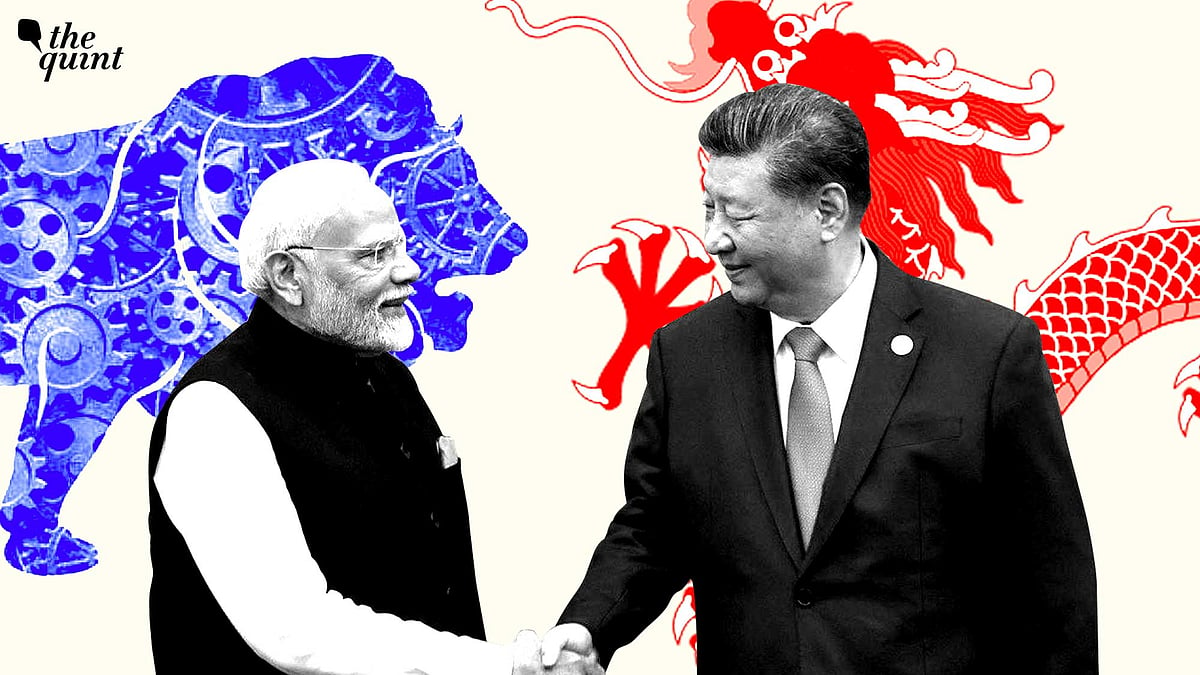
Back in the early 1990s, I was present at an industry event at the Taj Palace hotel in New Delhi, when former finance minister P Chidambaram, who was then India’s commerce minister, spoke about the idea of “Chindia” – an economic amalgamation from Asia that could emerge big in the global economy. I was reminded of that event this week as Prime Minister Narendra Modi’s government eased up rules for Chinese investment through a limited but significant window that was closed in 2020 in the aftermath of the Galwan border clashes that set back already shaky bilateral relations.
The answer to the question, “Are things back to normal?” demands a counter-question: “What exactly is normal in an increasingly abnormal world?”
Behind the FDI Shake Up
The Bharatiya Janata Party (BJP)-led National Democratic Alliance government’s tweaks of foreign direct investment (FDI) rules are best seen in that light—because the world is just not what it used to be when Chidambaram was a key figure leading India into a new wave of optimism, when globalisation and liberalisation were operative ideals.
The rise of an inward-looking “MAGA” (Make America Great Again) lobby and a welter of Trumpist sanctions make India look nowhere near the strategic US ally that the Narendra Modi government projected India to be over the better part of its 12-year rule.
On the other hand, a lot has changed in the world of high technology, producing both threats and opportunities for India—one in which it might well be a good idea to keep options open.
Officially, the government’s relaxation of FDI rules from countries that have land borders with India is couched in nuanced terms as it technically includes Bangladesh, Nepal, Bhutan, Afghanistan, Myanmar, and even Pakistan.
But in effect, the new rules stick to old caveats that exclude Pakistan and essentially roll back some provisions that restricted China in the aftermath of the 2020 clashes in the Ladakh region.
The Union Cabinet’s rules now incorporate the idea of “beneficial ownership” and allows companies that have no controlling stakes from the bordering countries to invest in India without seeking prior government approval. There are caveats that Chinese companies may invest up to 10 percent in Indian businesses without such approval and that minority investments by Chinese entities will be processed within 60 days.
The 2020 press note concerning the issue had extended the restrictive provisions, until then applicable only to Bangladesh and Pakistan, to all bordering countries, effectively bringing China into the loop. Pakistan has always been an adversarial state and Bangladesh in relation to India has been more of a recipient than external investor.
As we can see, China can now only play footsie with Indian entities without immediate state intervention—but it is significant as a long-term strategy and as a geo-economic move on the geopolitical chessboard.
The Chinese Pull
A decade ago, Modi proudly led his “Make In India” initiative to boost manufacturing and jobs in the country. It has met with limited success at best as targets have not been achieved. A key lynchpin of that strategy was a “China Plus One” push under which US companies were gradually expected to boost manufacturing in India to diversify away from China, both to reduce political risks and lower costs.
Not counting a few companies like Apple that now makes loads of iPhones in India, that strategy has hardly worked. The unpleasant emergence of President Donald Trump and his MAGA-oriented Republicans have ironically made India and the US look more like rivals seeking to boost domestic manufacturing and jobs rather than partners in a “go-to-market” venture for the entire planet.
Look at what happened since then to get a checklist of strains between India and the US: Trump imposing hefty 50 percent tariffs on Indian goods to artificially manufacture a no-deficit equation in bilateral trade; Trump coercing India into not buying oil from Russia; Trump talking of India being a dead economy and then making his 18 percent minimum tariff on Indian goods look like a gift rather than a trade barrier. Then we have all the turmoil caused by Iran under which India now stands peculiarly isolated between warring parties.
You get the overall picture.
Facing Up to Trump
The BJP government has been criticised a lot for its lackadaisical response to Trumpist posturing. Modi signalled on a possible change in priorities last September when he not only attended a summit meeting of the China-led Shanghai Cooperation Organisation (SCO) but also took a famous car ride with Russian President Vladimir Putin in Tanjin. This was weeks after Trump slapped prohibitive tariffs on India. The eventual trade deal with the US is on shaky ground, caught in a Supreme Court case in the US. China is now getting a second look.
The policy tweak is best seen with two lenses. The first one involves the old post-colonial equation between India and China in which two developing countries can be partners. The other one involves a New Age framework under which disruptive technologies and the rise of hardline nationalism in the West require a realignment of relations.
A lot will now depend on the details of various sectors. There are some in which India has a potential edge, and many in which China has excess capacity. Capital goods, electronic components and semiconductors or solar-energy-linked polysilicon and ingot-wafers are among identified as areas in which investments are welcome from neighbouring countries, according to government officials.
This could potentially mean Chinese companies as well as global investors who may wish to incorporate themselves in Nepal and Bangladesh, with which India now needs a reset in relations in view of significant regime changes there.
We are not exactly in a “Chindia” moment but one in which “Calibrate before you celebrate” may be a wise thing to say.
(The author is a senior journalist and commentator who has worked for Reuters, Economic Times, Business Standard, and Hindustan Times. He can be reached on Twitter @madversity. This is an opinion piece and the views expressed above are the author’s own. The Quint neither endorses nor is responsible for the same.)
- Access to all paywalled content on site
- Ad-free experience across The Quint
- Early previews of our Special Projects
Published: undefined