
Elon Musk's Ambani Jibe: Starlink's Delays Don't Prove Bias. Jio Is Waiting Too
Starlink is not being denied a licence. The approvals it still awaits are ones its rivals are also waiting for.
advertisement
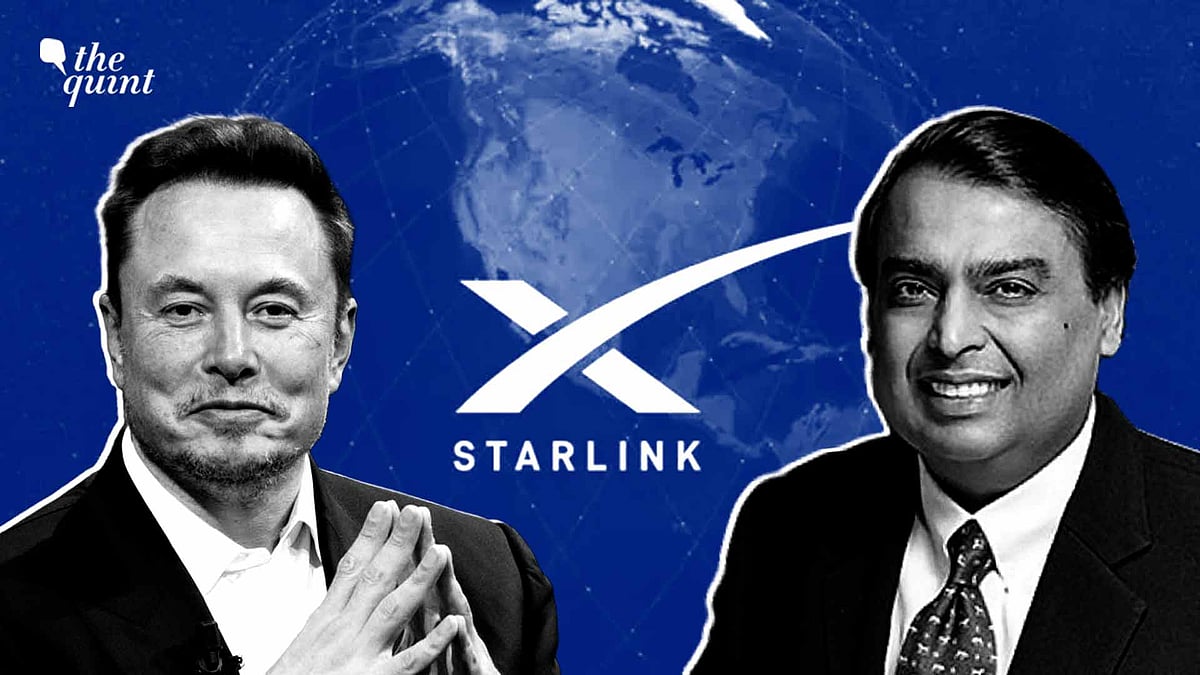
When a licence application stays in process for years, frustration is understandable, and so is the search for an explanation. Elon Musk has offered one. On Wednesday, 7 October, he blamed “certain oligarchs” for blocking Starlink. The next day he asked, “Is Ambani the real boss of India?”
On Friday, 9 October, he went further, addressing “Prime Minister Ambani” in a mock apology and asking whether India’s richest man would let Starlink compete.
The charge is serious: that a domestic rival is shaping the rules that govern its competitor. It deserves to be tested against the record rather than accepted or dismissed on reflex.
The government has responded firmly. The Ministry of Communications called the satcom (satellite communication) framework fair and non-discriminatory, described claims otherwise as baseless, and said all three applicants—Jio SES, Starlink, and OneWeb—and are at broadly the same regulatory stage.
A senior adviser in the Ministry of Information and Broadcasting added that neither Musk nor Starlink is entitled to preferential treatment. In his account, Starlink already holds its permit and space-regulator authorisation, and is waiting only for security clearance.
On that point the record supports the government. Starlink is not being denied a licence; it holds one.
The Administrative Path to Launch
Every satellite operator in India passes through the same five gates.
The first is the licence. The Department of Telecommunications issues a letter of intent before a licence—as it did for OneWeb and Jio. Starlink received its licence in June 2025, the third company after OneWeb and Jio.
The second is space authorisation. The Indian National Space Promotion and Authorisation Centre (IN-SPACe) cleared Starlink in July 2025. In August this year, Starlink reapplied for its second-generation constellation.
The third is security compliance. Operators commit to conditions such as storing Indian data locally, then demonstrate them in tests. Starlink began its security tests in October 2025.
The fourth is spectrum pricing. The Telecom Regulatory Authority of India (TRAI) recommended a charge of 4 percent of revenue. On 3 September, the Digital Communications Commission approved most of TRAI’s recommendations, settling on 5 percent, cut to 4 percent for rural areas, with a five-year tenure. Cabinet approval is still pending.
The fifth is the final go-ahead. No operator can launch without spectrum and a second-stage clearance from security agencies. Starlink additionally needs FDI (foreign direct investment) approval.
Elon Musk’s complaint concerns the last two gates. Neither has opened for Jio either. On the most consequential policy question, the record also cuts against the idea of capture. Jio lobbied for auctioned spectrum; the government chose administrative allocation, the route Starlink preferred.
Starlink's Orbital Debris
Musk’s own position also invites scrutiny. He is worth about $672 billion to Ambani’s $84 billion, and he is using a platform he owns to put public pressure on a sovereign regulator. Critics of concentrated private power may see that as a concern in its own right, whichever a billionaire is involved.
The government’s stated reasons for caution are specific. Officials worry that Starlink’s laser inter-satellite links could route Indian data through foreign jurisdictions, a design Jio-SES and OneWeb do not use.
At home, a Starlink-branded device was seized from militants in Manipur. Starlink can reasonably argue that misuse of hardware is not the same as company wrongdoing. Still, these are questions any security establishment would be expected to ask.
Starlink often points out that it is licensed in 165 countries. That shows wide acceptance, but it does not settle India’s security questions. India borders two nuclear-armed neighbours and manages insurgencies, and decisions taken elsewhere do not bind New Delhi. Each country makes its own security assessment.
Starlink’s history in India also shapes how regulators view it. In 2021, it was ordered to stop booking customers before it had a licence. More recently, the Centre told states to halt MoUs they had signed with Starlink before it secured its licence. At the same time, the commercial picture is more complicated than open rivalry. Jio has agreed to sell Starlink kit in its stores, which sits uneasily with the idea that it is trying to keep Starlink out.
The evidence so far points to a slow and cautious process, not a captured one. Slowness is not proof of corruption, and scrutiny is not proof of sabotage. Starlink’s path to launch runs through meeting India’s requirements and they should thus follow the steps and not jump to conclusions with unfounded aspersions.
(Subimal Bhattacharjee is a Visiting Fellow at Ostrom Workshop, Indiana University Bloomington, USA, and a cybersecurity specialist. This is an opinion piece. The views expressed above are the author’s own. The Quint neither endorses nor is responsible for them.)
- Access to all paywalled content on site
- Ad-free experience across The Quint
- Early previews of our Special Projects
Published: undefined