
What It Means to Belong to the 1% of Divorced Women in India
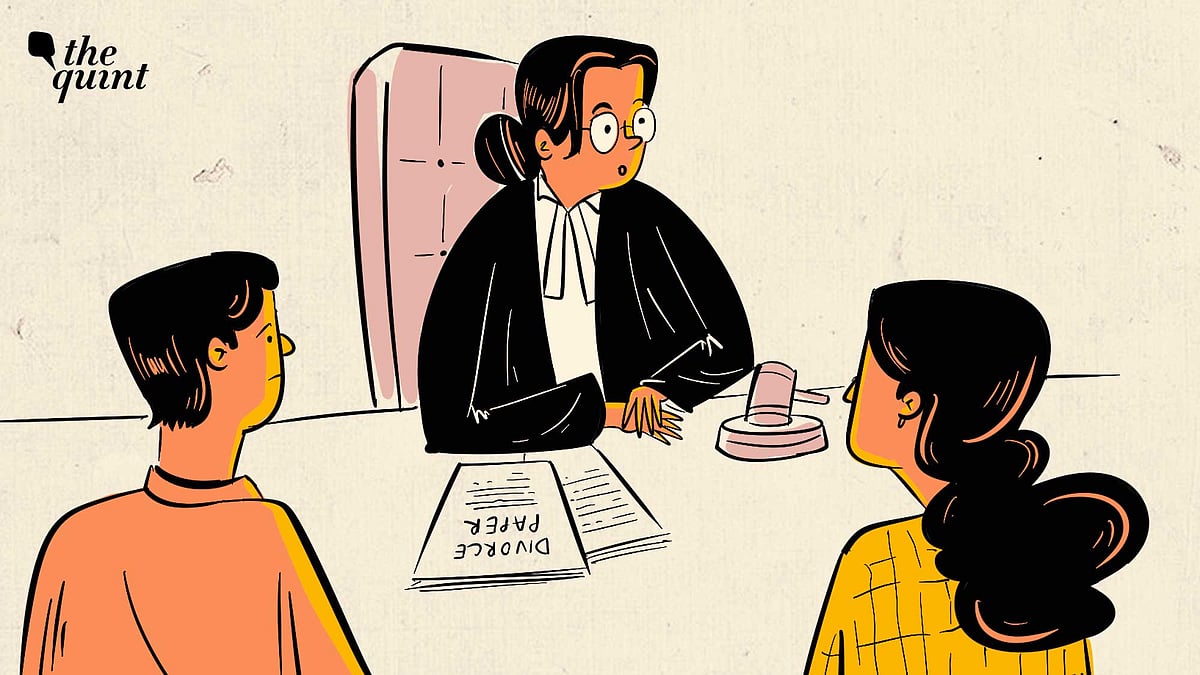
Why does India have an abysmally low divorce rate? Let me tell you about my experience at a Family Court.
advertisement
I hear the radio in South Africa, where I work as an academic, present an interesting fact: the divorce rate in India is 1%, one of the lowest divorce rates in the world. I knew this figure before I heard it on the radio.
How does one explain this abysmally low divorce rate in India?
I could tell you about the low employment rate of women in the country. Economists refer to this as the “missing women” from India’s labour force. India’s female labour force participation has consistently stayed below 30%. The bulk of this female labour force participation in the economy comes from lower-caste and class women. The more educated a woman gets, the chances of her dropping out from the labour market increases as she is required to undertake social reproductive tasks in the family.
In the absence of gainful employment and supportive families, women are financially dependent on husbands and in-laws. When marriages turn oppressive, women are rendered further vulnerable. This explains the high suicide rates amongst housewives in India. As per the National Crime Record Bureau’s (NCRB) data, the suicide rates among married women are higher than farmer suicides.
Instead, let me tell you about my divorce experience at the Family Court in Chennai, Tamil Nadu. This major life event happened to coincide with the global pandemic
Tablets – the Silent Killer
At the entrance to the Family Court, the security official asked me, “are you carrying a tablet?”
“Yes”, I am.
She looked confused and decided to double check my bag.
“Show me your tablet,” she insisted.
I took out a red leather-clad Samsung tablet that my dad had gifted on my birthday. I was planning to disappear in a book.
She looked irritated and I asked her the reason.
I was horrified. I wondered about the despair women felt that made them want to end their lives as protest. I put my tablet back in my bag and headed towards the courtroom.
Dr Ambedkar in the Court Room with Me
I chose the corner-most spot near the entrance in the room. The courtroom looks as bland as seen in Bollywood films. The walls are white, there is the familiar Gandhi’s picture, the judge’s seat is on a raised surface, the ornateness of the judge’s furniture stands out in contrast to the regular broken wooden chairs and a long table where lawyers sit. As we waited for the judge to come, I decided to read Dr Ambedkar’s ‘Hindu Code Bill’, a chapter in Professor Sharmila Rege’s last book Against the Madness of Manu.
“An interesting choice”, I hear a voice from within.
Dr Ambedkar’s ‘Hindu Code Bill’ is radical and the basis of numerous progressive legislations that have been passed in India. Dr Ambedkar knew that by addressing the gender question at the heart of caste, there was a possibility of reforming India’s caste order.
“The judge is about to come, close your book, do not cross your leg, and stand. You do not want to offend the judge,” a guard told me curtly.
I was beginning to feel that my existence in the courtroom was enough to upset the judge. I reluctantly obliged. I saw my ex-husband sit on the other side of the courtroom. We acknowledged each other with a nod.
There is a six-month waiting period from when one applies for divorce and can appear in front of the judge. A couple before us who was trying to get a divorce before the end of the mandatory six-month wait period, was asked to go through court-mandated marital counselling. I braced myself for a similar outcome, but hoped that my powers of persuasion would work (such upper-class delusions).
I did not get a chance to speak. It was swift. The judge said no, the lawyer bowed and thanked the judge, while I stood mute beside my lawyer helplessly.
Then began three online marriage counselling sessions with a Tamil Brahmin law official. He had no psychological expertise, and his only credentials were his grey hair and caste privilege. As it was the peak of Covid, the benefit was I could attend the counselling online and did not have to share my oxygen with the ex-husband. However, the pandemic had debilitated my support system. My entire family was in the hospital with varying levels of lung damage. I had rented a hotel room between the Court and the hospital to attend to my family and the divorce proceedings. I took the counselling sessions online in the hospital’s parking lot, drawing on whatever sustenance I could from family inside. Much of this period in my life is blurry.
I remember the law official trying to address the issue at hand without addressing it. Something about families being the foundation of Indian society, and marriages being about friendship.
But what about women who face abuse?
At the Tata Institute of Social Sciences (TISS), where I lectured in the School of Gender Studies, I remember feeling congratulatory about the Indian women’s movement in pushing for significant legislative changes. Emotional and verbal abuse is recognised along with physical, sexual, and economic abuse under Section 3 in The Protection of Women from Domestic Violence Act, 2005. My slide in class captured what verbal and emotional abuse included:
(a) insults, ridicule, humiliation, name calling and insults or ridicule especially with regard to not having a child or a male child; and
(b) repeated threats to cause physical pain to any person in whom the aggrieved person is interested.
This definition of emotional abuse did not capture my experience. This point was impressed upon me much more now than when I taught the class. Was I not abused because the law had not updated itself to modern day patriarchy?
Outside the classroom, students honing their political thinking asked me to give lectures on gaslighting. At this point, I did not know that this phrase that captured the experiences of women students filing for sexual harassment complaints in the University’s GSCASH, also captured my marital reality. While researching for the talk, I remembered the particularly crippling and insidious nature of abuse that was stored in this curious term – gaslighting.
Incidentally, gaslighting, is the Oxford Dictionary’s 2022 word of the year. This term was first used in the middle of the 20th century referring to deception. The dictionary describes it as, “psychological manipulation of a person usually over an extended period of time that causes the victim to question the validity of their own thoughts, perception of reality, or memories and typically leads to confusion, loss of confidence and self-esteem, uncertainty of one’s emotional or mental stability, and a dependency on the perpetrator”.
Feminists in the 1980s and 90s, confronted the blunt, physical horror of “cylinder deaths”. As women have gained more education, employment, and legal awareness, the methods of patriarchy have evolved.
The methods of modern-day patriarchy, much like my version of tablet, were outside the imagination of our Family Courts.
Divorce – A Huge Privilege
In my second visit to the Family Court, I did not carry my tablet.
I hoped the ordeal would be shorter. The counselling was done and now all the judge had to do was to sign on the greenish-yellow coloured divorce document. Our turn came and much to my surprise, the judge said, “no”. I was at my wits' end. What was more required? My lawyer asked me to be patient. At the end of the day’s proceedings, the judge called us to her cabin.
“Women like you want to leave marriages because you want to run abroad”. I should not have been surprised, but I was.
The judge continued to probe insensitively, assigning the blame for the failed marriage on me. I broke down and between sobs said: “In the military there is one thing that is looked down upon more than anything else. It is cowardice. These men think cowardice is turning their back on the enemy during war. Cowardice is not having the courage to speak the truth”.
I could see my melodramatic-philosophical bent was not entertaining the judge. She managed to, however, reprimand my ex-husband as if he was her naughty son by saying, “How can you hurt someone this educated and good like this?" I laughed between sobs.
The judge had scratched her itch, and I won my freedom.
It has been five years since this incident, and it has taken persistent work to build self-trust. But I say this with the confidence that emerges from a daily lived reality – it is a huge privilege to belong to the 1% of divorced women in India; to live a life on my own terms in a room of my own.
(I would like to thank Ulfrieda Ho for encouraging me to write this piece. Rest in peace, my friend.)
(Dr Ujithra Ponniah is a Senior Researcher at the Southern Centre for Inequality Studies (SCIS), University of Witwatersrand, South Africa. This is an opinion piece, and the views expressed above are the author’s own. The Quint neither endorses nor is responsible for the same.)
- Access to all paywalled content on site
- Ad-free experience across The Quint
- Early previews of our Special Projects
Published: undefined