
Drink 'Panchgavya', Prove Your Faith: Uttarakhand's New Rules of Temple Entry
As the 2026 Char Dham Yatra begins, the Gangotri Temple Committee's mandate for devotees is back in focus.
advertisement
(Become a member and help us preserve our editorial independence. Your support matters.)
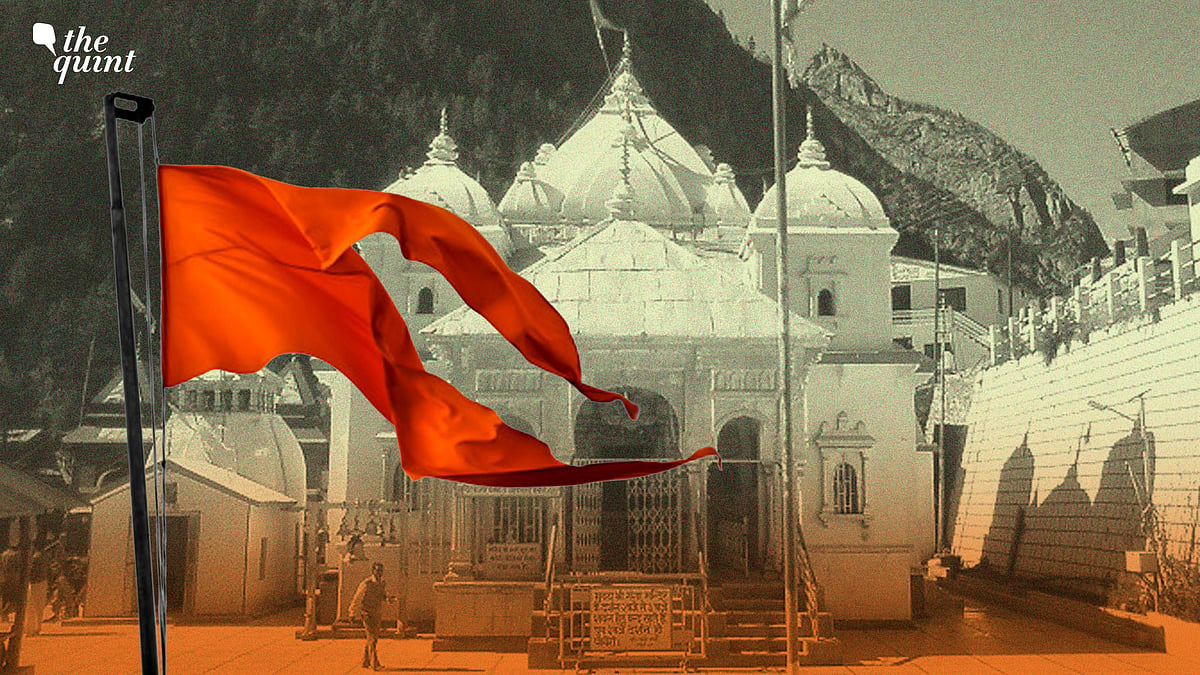
As the 2026 Char Dham Yatra begins, the mandate by the Gangotri Temple Committee in Uttarakhand to carry out a ritual test requiring devotees to drink panchgavya—a mixture of cow urine, dung, milk, curd, and ghee—to prove they are “true Hindus”, is back in focus.
Earlier in March, officials making the proposal had declared, “Jo gau-mutra piyega, uska swagat” (Those who drink cow urine are welcome).
This new diktat from the Gangotri Temple Committee follows the Badrinath Kedarnath Temple Committee (BKTC) formally banning non-Hindus from the 47 temples it controls. Actor Sara Ali Khan had become the first prominent victim of this policy, as those not Hindu by birth must now submit affidavits declaring, “I am a Sanatani, I believe in Hinduism.”
Khan, daughter of Saif Ali Khan and Amrita Singh, was symbolically targeted, echoing controversies around her 2018 film Kedarnath, which depicted a Hindu-Muslim romance against the backdrop of the 2013 floods.
The BKTC's Political Clout
The BKTC, despite receiving government funding, has aligned itself with exclusivist policies.
The committee operates under the Uttar Pradesh Shri Badrinath and Shri Kedarnath Temples Act, 1939, extended to Uttarakhand after its formation in 2000. The state government not only appoints the BKTC chairman, it grants him the rank of minister of state. The government in its annual Budget allocates significant funds to the committee—Rs 121.7 crore in 2026-27. Senior bureaucrats are regularly deputed to the committee, underlining administrative oversight by the state government.
Membership reflects political and social clout—industrialist Mukesh Ambani’s son Anant Ambani was briefly listed as a member in 2019.
Public Spaces, Private Faith Boundaries
Earlier this year, signs declaring “no entry for non-Hindus” and “Hindu-only zone” were installed at Har Ki Pauri in Haridwar. The Shri Ganga Sabha cited a 1916 bylaw designating the site as a Hindu sanctum. The Haridwar municipal commissioner reportedly said he was aware of the signs, but denied the state government had given any approval for them.
Besides these unconstitutional decisions by various temple committees, Uttarakhand has earned this epithet because of a series of government policies, which combine religious exclusion with political strategies.
From UCC to ‘Operation Kalnemi’
In February 2024, Uttarakhand became the first state to adopt a Uniform Civil Code (UCC), setting a precedent for other Bharatiya Janata Party (BJP)-ruled states. Critics see the state's UCC as extremely intrusive, with live-in couples requiring to register their relationship with local authorities by filling up a 16-page form providing personal details, proof of residence, and religious certification. Failure to comply lead to fines, and even result in imprisonment.
Then, in August 2025, the state’s Madrasa Board, which governed minority schools, was dissolved by the state Assembly and replaced with the Uttarakhand Minority Education Authority. The said body has ex-officio members of the state’s School Education Department and State Council for Education and Training, and now regulate the recognition, curriculum, and standards of minority educational institutions.
A month before, in July 2025, Chief Minister Dhami launched the 'Operation Kalnemi' campaign ostensibly to identify “fake sadhus” exploiting Hindu pilgrims. Kalnemi, a mythological demon, was known for deceit and illusion, pretending to be holy while embodying evil.
Dhami claimed the campaign would “protect Devbhoomi (abode of the Gods)”—as Uttarakhand brands itself—from fraudsters.
This campaign was likewise intended to reinforce religious exclusivity.
Elections, Economy, and the Politics of Faith
The under-construction Char Dham Highway has religious optics, too. Despite causing immense environmental destruction and communal polarisation, it is packaged as facilitating Hindu pilgrimage.
These policies consolidate Chief Minister Dhami’s position as protector of Hindutva despite governance shortcomings. They also lay the groundwork for the 2027 Assembly elections, with themes of demographic balance, vigilance against “infiltrators,” grand Kumbh organisation, temple sanctity, UCC enforcement, and marginalisation of minorities. Religious policing blurs into governance, embedding Hindutva into state machinery.
Why Is There So Little Resistance?
That the opposition to Dhami’s brand of Hindutva-inspired governance has been muted and fragmented is itself quite revealing.
The Congress, which is the main Opposition, has weakened over time. It is fragmented, it lacks effective leadership, and the lack of an alternative state-level narrative is preventing it from challenging the BJP.
Through its dominance—from the legislative Assembly to the civic bodies—the BJP has also created a narrative that opposing Hindutva can be costly.
The economy is also partly based on pilgrimage. The Opposition perhaps does not want to appear “anti-Hindu” or “anti-tradition” even if the new Hindutva policies and temple committee moves can impact tourism—another important source of revenue to the state.
In addition, as Muslims are institutionally weaker and dispersed in the plains, so is their political voice and protest. Whichever way one explains the inaction of the Opposition, it is precisely this that has allowed Uttarakhand to test Hindutva-inspired governance without any resistance.
(This article has been updated in light of the Char Dham Yatra commencing in Uttarakhand. The writer is a senior journalist based in Delhi. This is an opinion piece and the views expressed are the author’s own. The Quint neither endorses nor is responsible for them.)
- Access to all paywalled content on site
- Ad-free experience across The Quint
- Early previews of our Special Projects
Published: 26 Mar 2026,05:58 PM IST