
'Chauhaan': The Rajput Ethos Is Bigger Than Today's Identity Politics
The Rajput ideal was never about cultivating hatred or diminishing another, writes (Retd) Lt Gen Bhopinder Singh.
advertisement
Before I begin, a caveat is in order. I write not as a detached historian or a dispassionate academic, but as someone whose life has been deeply intertwined with the Rajput ethos—by janam (birth), dharam (duty), and karam (deed). That perspective inevitably shapes my understanding, my affections, and perhaps even my biases. I, therefore, make no claim to speak for every Rajput or to present the definitive history of a proud and complex community. I merely offer the reflections of one who has lived its traditions from within.
I was born into a distinguished Rajput family with a long legacy of military service, courage, and honour. I was also born at a pivotal moment during India’s proverbial tryst with destiny. By then, Independent India had brought to an end the princely states and the Zamindari order, and with them the centuries-old political and military authority that Rajputs had traditionally exercised. The age of the ruler-warrior had yielded to the age of the citizen-soldier, the professional, the entrepreneur, and the public servant.
We were endlessly reminded till it got distilled into our bloodstream—“Raghukul reet sadaa chali aayi, praan jaaye par vachan na jaayi” (the practice of Raghu’s progeny, has always been such, that even if you have to lose your life for it, you stick to your word.)
The outward circumstances of Rajput life had changed irrevocably, but the inner code by which a Rajput sought to live did not.
Honour, Not Hatred
That inheritance found its natural continuation when I was commissioned into the Rajput Regiment, one of the Indian Army's most battle-honoured and illustrious Infantry Regiments. For more than four decades in “uniform”, I had the privilege of serving the Rajput Regiment with a natural and abiding sense of belonging. Echoes of my childhood thrived in our regimental motto—“Victory or death in battle has been the religion of the Rajput from time immemorial. It is his character that he knows no fear.”
Yet, the Rajput identity I inherited at home and experienced in the Indian Army was never one rooted in regression, exclusion, or hubris. It drew its strength not merely from tales of martial valour, but from an enduring code of honour that placed courage alongside compassion, chivalry alongside humility, and strength alongside decency. Those, above all, were the values I came to truly believe, lay at the heart of the Rajput tradition.
Therefore, the Rajput identity couldn’t ever be about exclusivism. It was understood as an ethical and cultural inheritance rather than a sectarian one. A Rajput could be Hindu, Muslim, or Sikh. Faith might differ, but the code of honour did not. What bound us together was not theology or claims of social superiority, but a shared commitment to fidelity to one's word, dignity in conduct (maryada), and above all, generosity towards others.
Sadly, these days history is getting selectively interpreted to serve communal and political narratives. Complex legacies are reduced to simplistic us-versus-them identities, and communities like the Rajputs risk being weaponised for purposes far removed from their deeper ethos of civilisational grandeur and decency.
The 'Chauhaan' Problem
Increasingly, even our larger symbols of faith appear to be reflecting the anxieties of our times. A symbol of that societal regression are the stickers of the serene and compassionate images of the divine that once adorned our homes and vehicles, that have now been replaced by more aggressive, angrier, and confrontational expressions. It reflects a society where identity is increasingly asserted through defiance rather than through humility, compassion, and inner strength.
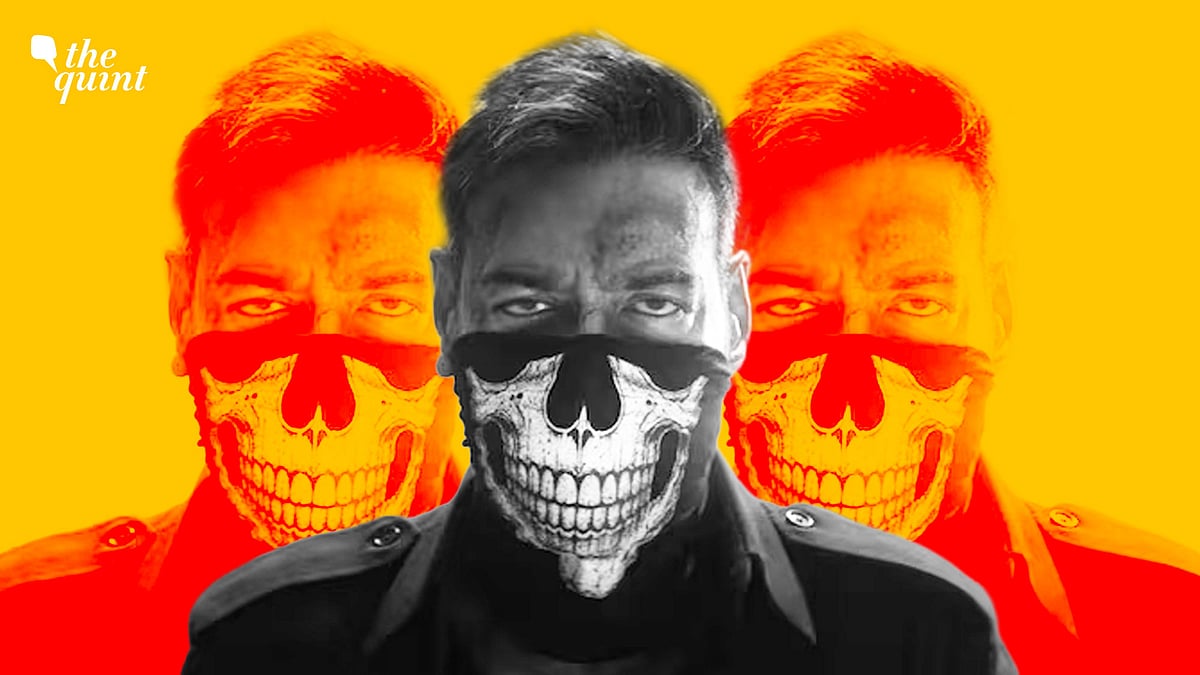
In this context, I recently chanced upon a promotional teaser of the movie Chauhaan. It caught my attention for familial reasons (my sister is married into a similarly militaristic Chauhaan family), with a seemingly telling and loaded punchline, where the quintessential image of the presumable (as the movie is still not released) character Chauhaan, superimposed to pumped-beats of drumrolls with the punchline “Pathan ko keh do, Chauhan aa raha hai”.
This is then followed by visuals of a panicked crowd of Kashmiri rioters running scurry for cover as Chauhaan saunters in with a swagger and bristling eyes in militaristic fatigues and a pistol dangling rakishly from the hips.
Normalising hostility and excesses, selectively mining history (never mind the stupidity of conflating Pathans to Kashmiris), and resorting to identity-based glorification and denigration have, sadly, become defining tendencies of our times. Complex histories are often reduced to convenient narratives of pride and grievance, where the celebration of one identity increasingly comes at the expense of diminishing another.
Seen in this light, the narrative of Chauhaan represents the very antithesis of the Rajput ethos I was raised to understand. To reduce the legacy of a warrior tradition to anger, antagonism, and communal confrontation is to miss its deeper essence. The Rajput ideal was never about cultivating hatred or diminishing another; it was about courage with restraint, honour with dignity, and strength guided by decency. To weaponise a proud heritage into a story of perpetual conflict is, ironically, perhaps the most un-Rajput expression of all.
What Raj Dharma Demands
As a proud constitutionalist, patriot, and liberal, I will always defend the right to creative expression, even when I disagree with the message or interpretation. The answer to a work of art or cinema that one finds objectionable cannot be censorship, intimidation, or violence in the name of any community. At the same time, the freedom to create must coexist with the freedom to critique. I reserve the right to express my disappointment when history is trivialised, when the name of a noble community is invoked for partisan purposes, and when a shared heritage is reduced to a tool for polarisation and the weaponisation of identity.
One final caveat is necessary. I too served and commanded troops in Kashmir during the height of insurgency, and lost many near and dear ones, including family members. Yet, personal loss cannot become a licence for hatred.
The pain of violence cannot justify the distortion of history, demonisation of communities, or polarisation of society through identity. If anything, the battlefield teaches the opposite lesson: that courage must always be accompanied by restraint and humanity. Not sure if Chauhaan would do so—I hope I am wrong.
(Bhopinder Singh is the former Lieutenant Governor of The Andaman and Nicobar Islands and Pondicherry. This is an opinion piece and the views expressed are the author’s own. The Quint neither endorses nor is responsible for them.)
- Access to all paywalled content on site
- Ad-free experience across The Quint
- Early previews of our Special Projects
Published: undefined