
Ajay Devgn’s Chauhaan Turns Kashmir’s Trauma Into Propaganda
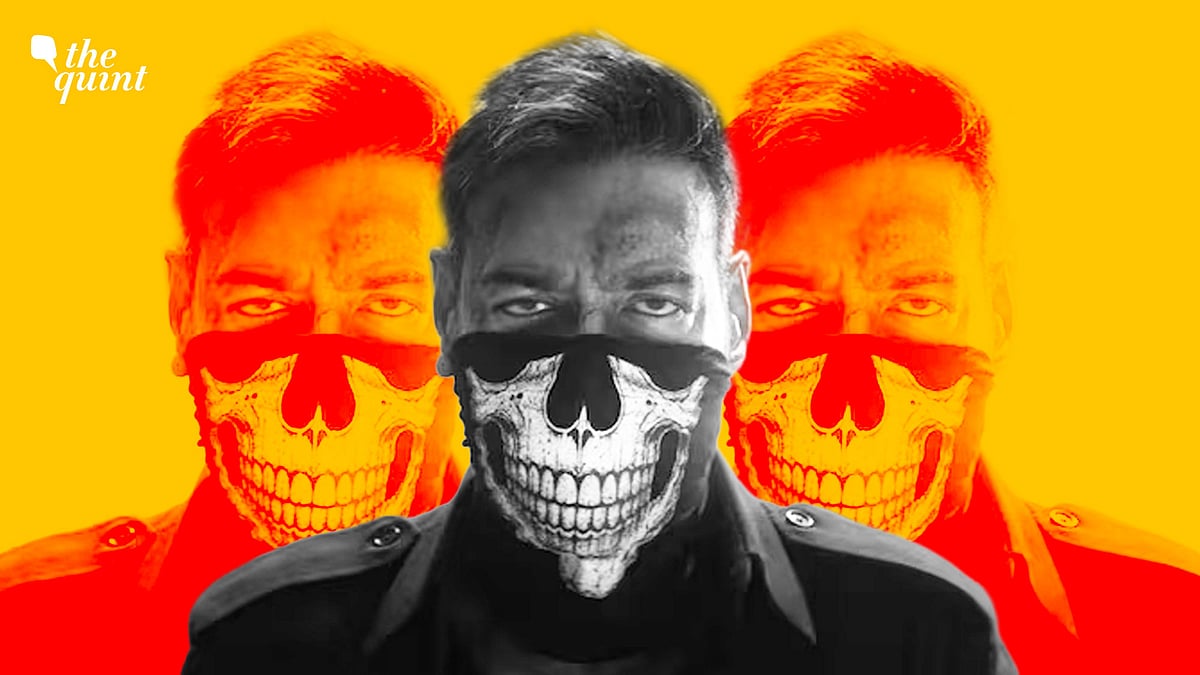
The trailer of Ajay Devgn's Chauhaan terms pellets as "limited damage" on Kashmiri protesters.
advertisement
Bollywood star Ajay Devgn’s recently announced film Chauhaan is not merely courting controversy; it has reopened a wound for victims and families who have lived with the consequences of state violence in Kashmir. In its two-and-a-half-minute teaser, the film does not simply fictionalise conflict. It appears to minimise the scale of human rights violations in a region marked by decades of strife, recasting weapons that blinded, maimed and killed civilians as instruments of tactical restraint.
Dedicated to Devgn’s late father, an action choreographer, the film attempts to draw public sympathy through personal sentiment even as its teaser dehumanises countless families affected by what were officially described as “non-lethal” weapons. The result is not just insensitive cinema, but a familiar Bollywood spectacle in which Kashmiri suffering is flattened, denied and repurposed for applause.
Right off, the teaser shows a protester, donning a gas mask to fight off the effects of tear gas, while Devgn’s character tells us that “gas masks are easily available online”. The irony of purchasing a gas mask “online” in a region which is notorious for some of the most prolonged internet and communication blackouts, is lost in the absurdity of the premise. Law enforcement agencies have relied on constant video surveillance and facial-recognition technology to arrest protesters, something that would have been irksome and ineffective for them were state of the art gas-masks, as shown in the teaser, in such a trend.
Pellet Guns as "Limited Damage"
Apart from the casual dismissal of tear gas which, contrary to popular belief, have proved fatal — Devgn’s character, a Black Cat commando, adds that pellet guns (also deemed “non-lethal” by the government) caused “limited damage”.
Pellet guns, first used in 2010 in the Valley, use cartridges that are filled with hundreds of small metal pellets. As they are fired, the pellets spread out in a cluster that can reach a wide radius, causing injuries indiscriminately to anyone within that unpredictable radius.
In some cases, the forces refused to take responsibility for the injuries and deaths caused by pellets, even as newspapers and hospitals filled with new cases.
Asrar Ahmad Khan, a teenager, died just days before his 18th birthday in September 2019, a month after receiving pellet and shell blast injuries to his head, when the Indian government revoked Jammu and Kashmir’s special status. Officials contended that Khan had been injured by a stone thrown by protesters even as eyewitnesses testified that there had been no protests in their area. Khan’s death certificate, accessed by the Guardian, recorded “severe traumatic brain injury with sepsis with cardiopulmonary arrest” as cause of death.
Metal pellets have killed 18, blinded 139, injured 2,942 and caused eye injuries to 1,459 between July 2016 and February 2019, according to a report by IndiaSpend. Most of the victims were non-combatant civilians and adolescents. 1,994 of these injuries were recorded in 2016 alone.
The use of pellet guns, apart from other human rights violations in the Valley, has done lasting damage. For the countless “damaged” by pellets, the impact was not just physical. It is psychological, it is social, it is sociological. Blindness and disability were forced onto them. They were alienated from the community, social access and mobility. Multiple surgeries and depleted finances left their lives, and the lives of those connected to them, permanently altered.
Limited as it might seem to Bollywood’s hypermasculine and gory aspirations, the damage resounds far more than individual bodies. Trauma, carried by victims and their families. Aspirations, assaulted by “stray” ammunition. Entire lives, families and futures destroyed by the latest firearm in the market.
The Kashmiri in Bollywood — Misunderstood or Deliberately Demonised?
Chauhaan is not novel in its offenses. It follows the customary Bollywood rulebook, and reduces Kashmiris to fanatics, and accords no space to establish or understand the socio-political landscape of the region. The premise, characterisation and dialogues do not show a lack of research or understanding, they in fact establish the colonial gaze, that vindicates violence as necessary, and demands more of it as humans are reduced to numbers, suffering to mere spectacle. It mystifies the political context, and plays with facts to appeal to the emotions.
This kind of narrative building is not just harmless entertainment, it is sinister. It is an attempt to erase public memory and the collective conscience of a nation. Devgn mentions that 75 years later, there is no answer. Perhaps the answer lies within the microcosm of the film, within proud displays of violence and vilification.
The teaser ends with an even more absurd spectacle — a Friday protest is disrupted as Devgn plays the song 'Jumma Chumma' on a speaker — for no apparent reason, apart from reiterating the disregard for not just the people protesting, who have been established as villains by this point (why are they protesting again?), but also disrespect for their religion and practices.
Cinema as Communal Instigation
In a supposedly snide remark to Shah Rukh Khan’s Pathaan, or perhaps the larger Muslim community, Devgn crows, “Pathanon se kehna, Chauhaan aa raha hai.” To use this antithesis and help further a binary in a country that is already stricken by caste and communal politics cannot be excused for careless writing. It betrays the intent of those involved in these productions. Kashmir Files saw people in theatres shouting hate slogans and calling for violence against Muslims. Similar incidents happened with other propaganda films like Chhaava and Kerala Story.
The use of “Chauhaan”, which is a Kshatriya caste, was also criticized by Kshatriya Parishad, a non-profit, which condemned the attempt to appropriate their clan name and reduce their history into “simplistic communal binaries”. Posting on X (formerly Twitter), the group stated, “invoking a Rajput clan name merely to provoke outrage, inflame caste and communal sentiments, or generate political spectacle is both irresponsible and disrespectful.”
“Kshatriya Parishad rejects every attempt to weaponise Rajput history or appropriate Rajput identities for electoral or ideological purposes…We call upon political actors, filmmakers, and media organisations to engage with India's past responsibly, respecting historical complexity rather than exploiting Rajput heritage as bait for divisive political debate,” further read the statement.
In February, Jyoti Deshpande, the President of Jio Studios (producers of Chauhaan) had said in a statement, “I want to be with a studio [sic] that proves Indian cinema can compete with anything made anywhere in the world—not on spectacle alone, but on craft, on artistic integrity, on the power of the story itself.”
But this teaser, and the other films Deshpande is associated with, not only show lack of imagination, craft and research on part of the contributors but also an absence of integrity and sensibility. Reliance on spectacle, gore and charged dialogues in a bid to get the audience’s attention only shows desperation for a capitalistic or perhaps a political cause, not artistic creativity or conviction in any meaningful sense.
What might be a game of fiction and irresponsible world building for people far removed from the realities of those they represent, is a constant and painful reminder of the trauma to the countless people marred by violence. It is a disservice to the memories of the victims, and those who hold on to those memories. It is a denial of their truth, of their voices and their stories. It is violence. It is a form of damage in itself.
(This is an opinion piece and the views expressed are the author’s own. The Quint neither endorses nor is responsible for them.)
- Access to all paywalled content on site
- Ad-free experience across The Quint
- Early previews of our Special Projects
Published: undefined