Dalit Politics Stands at a Cusp, Mayawati Needs Kanshiram Today More Than Ever
If Kanshiram was the abstract, then Mayawati was the action.
advertisement
My relationship with the Bahujan Samaj Party (BSP) is a matter of legend.
Three decades back, I was standing at the gate of then BSP supremo Kanshiram’s bungalow at Humayun Road, New Delhi.
Kanshiram was then the icon of Dalit politics, having risen from scratch and was making waves in Indian politics, and I was an emerging TV reporter, member of the dream team of the iconic Aaj Tak, a 20-minute news bulletin on Doordarshan, but phenomenally popular.
As Kanshiram came out of the gate and tried to get into his very recognisable Contessa, I lunged forward with my mike and asked, “What happened in the meeting?” The deputy speaker of the Lok Sabha, Suraj Bhan, a Bharatiya Janata Party (BJP) leader from Haryana, had visited him. Elections had recently concluded in Uttar Pradesh; the results had been declared, but no government had been formed because no party had a majority in the assembly.
The Assembly was placed in suspended animation. Many months had passed, and the BJP, through Suraj Bhan, was trying to stitch an alliance and explore the possibility of forming a government. I had the information and scoop. In those days, there were fewer TV reporters, and as I moved towards Humayun Road, two or three other reporters, including a few from newspapers, also parked themselves at the gate.
As I asked the question, he got infuriated and hit me hard. Before I realised, I was on the ground, and BSP office bearers were kicking me left, right and centre. My shirt was torn.
Thanks to a woman reporter who shouted at them, ‘Will you kill him?’, I was saved from their wrath. Thanks to her, I was not hurt grievously. TV then was not a 24-hour affair, but the incident made national headlines, and my picture was on the front page of every newspaper the next day. HD Deve Gowda was the Prime Minister, and legendary Communist Party of India (CPI) leader Indrajit Gupta was the home minister. Journalist associations met with them, and after some time, matters were resolved. Later, Kashiram met me at Ludhiana. He hugged me warmly and said it was nothing personal. It was his way of saying sorry.
After that, I kept meeting him and Mayawati. We never carried any bitterness. Mayawati became UP chief minister four times, and when Kanshiram was very ill, Vijay Trivedi and I went to meet him. That was the last time I saw him.
Mayawati's Politics, Kanshiram's Thought
Kanshiram was a visionary politician. He was a lone warrior. I have always said that if Baba Saheb Ambedkar was the original thinker of Dalit Assertion and Indian politics would not be complete without him, then Kanshiram was the second most powerful Dalit leader after Ambedkar, with the vision and originality to create a dalit party, fight elections, and form a government. He should be credited for installing the first-ever Dalit chief minister in India.
It was due to seeds sown by Kanshiram that Mayawati could form a majority government in UP in 2007 and complete her term. Four times she was sworn in as the Chief Minister. She was a formidable administrator, despite coming from a very humble background, she was well-versed in the statecraft. People still remember how she controlled law and order without resorting to ‘bulldozer’ politics and ‘encounter’ was justice.
She was a feisty woman who had an iron grip on her party. She was a worthy successor to Kanshiram.
Mayawati was a great organiser. She built organisations bit by bit in UP. Kanshiram was born in Punjab, where Dalits comprise 36 percent of the population, but he did not succeed there. He had a grand plan to energise Dalits across the country. He used to hold Dalit melas around lesser-known local Dalit icons in states like MP, Rajasthan, Maharashtra, Karnataka, Delhi, Chhattisgarh, and other places. Initially, he succeeded in purely electoral terms, and BSP became a national party, but in these states, he could not secure a leader like Mayawati; therefore, after an initial blip, BSP failed to emerge as a major force despite large Dalit populations. No wonder that after Kanshiram’s demise, Mayawati inherited the party and became the BSP supremo.
But Mayawati was more of a politician. Kanshiram was a thinker. Both needed each other to successfully implement the Dalit experiment in India’s electoral politics. If Kanshiram had the idea, Mayawati had the guile to implement it.
This was the time when Mayawati needed a Kanshiram to germinate a new thought process, when Modi and Bhagwat led Hindutva forces that were out to Hinduise Dalits. It was a paradoxical situation. The community, which worships Baba Saheb Ambedkar, who had warned them that the "idea of Hindu Rashtra should be stopped at any cost", was ready to embrace Hindutva.
Lost to Vote Math
The BJP succeeded in luring a large section of Dalits across the country to join its fold, which was the reason for BJP’s spectacular victories in the 2014, 2017, 2019, and 2022 elections in UP, each time BJP won almost 40 percent or more votes with the active support of Dalits. But in 2024, the BJP cut a sorry figure because of Rahul Gandhi’s 'Save the Constitution' campaign, which kept a section of Dalit voters, especially non-Jatav Dalits, away from the BJP.
According to the CSD survey, 56 percent of non-Jatav Dalits voted for the Samajwadi Congress alliance in the 2024 Lok Sabha election. Even Mayawati’s core supporters, the Jatavs, who comprise almost 50 percent of Dalit voters in UP, have shown signs of disillusionment with her. About 25 percent of Jatav voters voted for the Samajwadi Congress alliance. There was a definite trend that Dalit voters, who had earlier experimented with the BJP’s Hindutva, were moving away from the BJP, but, surprisingly, were also not coming to Mayawati. In fact, they were deserting her in bulk. And if this trend continues, which most probably will, then Mayawati is heading for an existential crisis.
Many Contenders for Future of Dalit Leadership
Mayawati is mercurial. She has the potential to bounce back. She is very hardworking. But to fight back, she needs a clear path ahead, a solid team of warriors. This is the time when Dalit consciousness is on the rise, looking for a new leader and not happy with the prospect of being integrated into the forces of Hindutva, as they fear the dissolution of their distinct identity.
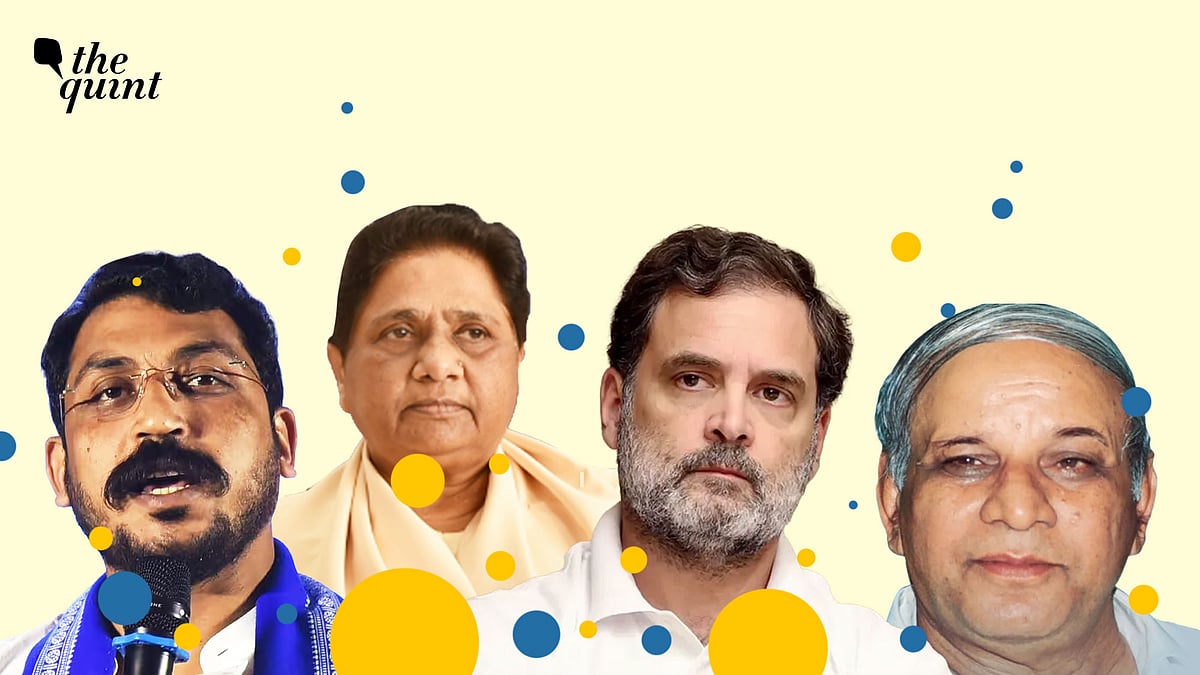
In UP, Chandrashekhar Ravan is also an alternative, but fortunately for Mayawati, he is more focused on winning his own Lok Sabha seat. He is aggressive and daring but lacks vision. Akhilesh Yadav is also eyeing Dalit votes through 'PDA'. Akhilesh, together with Rahul, is an attractive combination for Mayawati‘s supporters.
Warning bells have already rung. Mayawati has to act. But she is busy fighting with his own nephew, Akash Anand. If a leader of her stature can’t decide who should be her successor, then it is a sure shot recipe for disaster.
Her flip-flops are an indication that she misses Kanshiram, the idea. Without his thought process, Mayawati is clueless about what to do, and the party is on its deathbed. It is the greatness of Kanshiram that produced a Mayawati who could rule UP four times. It is a failure of Mayawati’s leadership that she could not find her successor. It is this reason that I admire Kanshiram despite that unfortunate incident.
(Ashutosh is co-founder of SatyaHindi and a former member of AAP. This is an opinion piece. All views expressed are the author’s own. The Quint neither endorses nor is responsible for them.)