
UCC by 2029: Amit Shah's Hindutva Reboot Bid Can Put BJP Allies in a Bind
Informed sources say that the BJP hasn’t yet initiated any discussion on the UCC with any of the NDA allies so far.
advertisement
Union Minister for Home Affairs Amit Shah’s statement in Mumbai that all National Democratic Alliance (NDA)-ruled states will enact a Uniform Civil Code (UCC) by 2029 seems aimed at rebooting the Hindutva plank of the Bharatiya Janata Party (BJP) for the key Assembly elections lining up in the next few months and the next general election.
While the NDA constituents seem inclined to read more rhetoric into Shah’s statement, some of them are apprehensive of a potential rupture in ties if they are pushed to the wall. That the UCC is a BJP plank is apparent, with the issue having figured for decades among the core agenda of the party and the Rashtriya Swayamsevak Sangh (RSS).
This backdrop weighs heavily on the National Democratic Alliance (NDA) constituents, as they seem keen that the BJP should first face the issue of practicality in implementing the UCC in states ruled by the saffron outfit. Informed sources have clarified that the BJP hasn’t yet initiated any discussion on the UCC with any of the NDA allies so far. Thus, Shah’s Mumbai statement on UCC is anchored more on the BJP’s shore than the NDA.
UCC and NDA Allies: Scope of Rupture
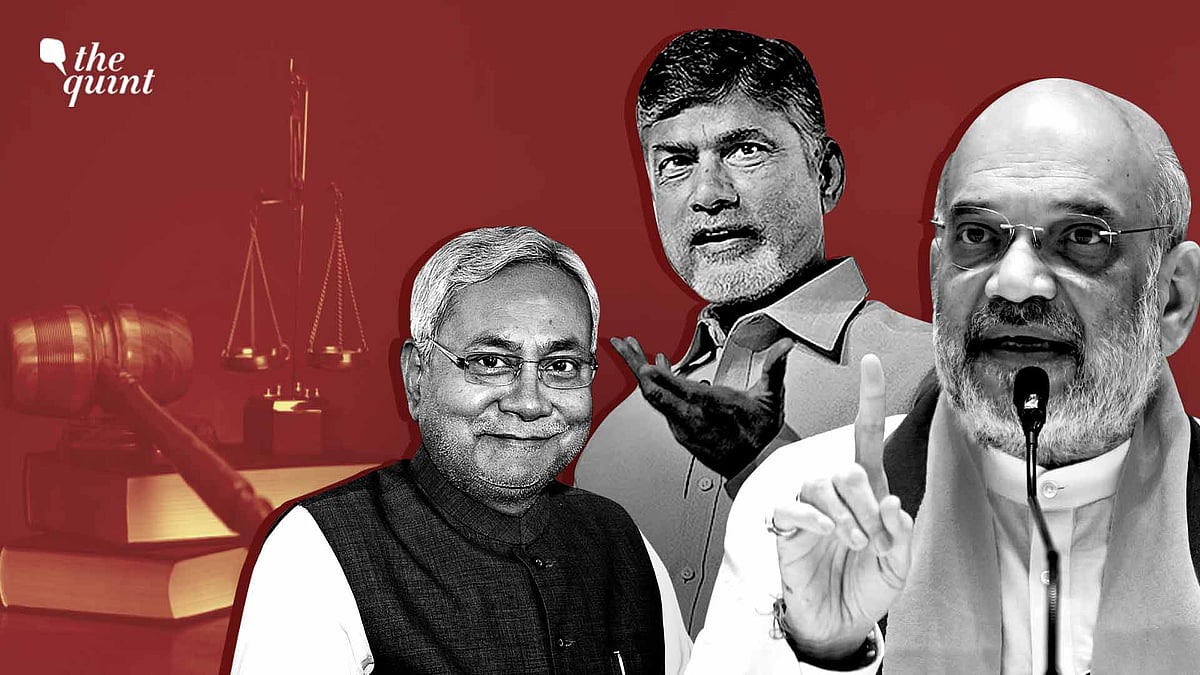
Andhra Pradesh Chief Minister N Chandrababu Naidu and former Bihar Chief Minister Nitish Kumar had acquired spheres of influence in the NDA after the BJP slumped to 240 Lok Sabha seats in 2024, while losing its own majority in the lower house of Parliament.
While the BJP banked on Naidu’s Telugu Desam Party (TDP) and Kumar’s Janata Dal (United) for stability in the Prime Minister Narendra Modi-led government at the Centre, the arithmetic has changed recently after the implosion in the Trinamool Congress and also Shiv Sena (Uddhav Thackeray). Both the TDP and the JD(U) are aware of the BJP’s relentless pursuit to work numbers for numerical confidence in Parliament.
Yet, the JD(U) had stunned political observers by quitting the NDA in 2022. That had come three years after the JD(U) opposed legislation in parliament to criminalise the practice of pronouncing "triple talaq" in 2019. The JD(U) had opposed the bill despite being an NDA constituent. The JD (U) had staged a walkout during voting on the bill in parliament.
Both the JD(U) and the TDP count on sizeable Muslim electorates in Bihar and Andhra Pradesh. Naidu and Kumar have regularly been attending Eid celebrations. They have shown in the past that they value their secular credentials. Muslims in Andhra Pradesh roughly constitute 10 percent of the population, while they number almost 18 percent in Bihar.
Allies Caught Between Ideology and Electoral Arithmetic
Both the TDP and the JD(U) have shown flexibility with their ideological moorings in cementing their bond with the BJP lately.
For Naidu, his alignment with the Centre is key to nursing Andhra Pradesh, particularly in pushing developmental projects, including the building of the capital city of the state. This explains his regular outreach to the Prime Minister.
With Nishant Kumar, son of Nitish Kumar, not fully rising to the occasion to fill his father’s leadership legacy, the JD(U) leaders apprehend that the BJP could even split the party to muster its own majority in the Bihar Assembly. This fear limits the scope of the JD(U) for a 2022 encore of walking out of the NDA.
UCC: A Hindutva Reboot
The BJP leaders are increasingly becoming aware that the party’s sole pivot for the upcoming Assembly elections next year and the general elections in 2029 lies in reloading Hindutva.
The completion of the Ram Temple construction in Ayodhya has deprived the BJP of a political Hindutva agenda. The subsequent row over alleged donation irregularities at the Ram Temple has also dented the Hindutva hegemony plank of the BJP.
Besides, the state of the economy with price rise and joblessness is also seen fast eroding the appeal of Modi. The BJP strategists also have begun worrying that the appeal of welfarism, schemes, and their benefits, is also losing sheen. The BJP, in any case, had already cashed in on the welfarism plank in the 2019 Lok Sabha elections. In 2024, the plank had looked blunted.
With the "triple talaq" criminalisation law, the BJP, per a section of party leaders, had hoped to break the Muslim vote bank, hoping that minority women may look for electoral options. Lately, the BJP is betting on divisions in the ranks of Muslims by spotlighting Pasmandas in its outreach. But the ground assessments of some of the BJP leaders suggest that the party’s calculations about Muslims are largely theoretical.
The UCC by 2029 also seems a laborious effort to re-energise the BJP’s core support base, which lately has begun vocally questioning the Modi government.
(The author is a senior Delhi-based journalist who has covered the BJP, the RSS, and the PMO for over two decades. This is an opinion piece and the views expressed are the author's onw. The Quint does not endorse or is responsible for them.)
- Access to all paywalled content on site
- Ad-free experience across The Quint
- Early previews of our Special Projects
Published: undefined