
The Opposition’s Constitution Problem
The Constitution’s centralising tendencies have undermined the Opposition’s ability to represent minorities.
advertisement
India’s Opposition parties face a striking dilemma: they must defend a Constitution that is often used to weaken them.
Since the Republic’s early years, ruling parties have exploited the Constitution’s centralisation of power to sideline opponents. Tactics have included arrests, election manipulation, bans on opposition groups, dismissal of Opposition-led state governments, and forcing legislation through Parliament despite objections.
Dalits make up roughly 17 percent of India’s population—over 200 million people—making them a decisive electoral bloc that continues to revere BR Ambedkar.
This reluctance comes at a cost. The Constitution’s centralising tendencies have repeatedly undermined the Opposition’s ability to represent minorities.
The Political Cost of Questioning Ambedkar
Kashmir offers a stark example. In 1953, Prime Minister Jawaharlal Nehru used his influence over Karan Singh, the state’s constitutional head, to dismiss Sheikh Abdullah’s government after Abdullah began opposing him. Abdullah was jailed under preventive detention laws that allowed imprisonment without trial, and he remained in custody for about 13 years.
Nehru took similar actions in 1962 against critics of his China policy. Jyoti Basu and hundreds of others were arrested under a preventive detention law passed by Parliament despite strong objections from the Opposition.
The pattern intensified during the Emergency in the mid-1970s.
Prime Minister Indira Gandhi invoked Article 352, citing “internal disturbance,” to declare a national emergency and rule by decree. Fundamental rights were suspended, and more than 100,000 political opponents—including Atal Bihari Vajpayee and Jayaprakash Narayan—were jailed.
From Preventive Detention to the Emergency
Until the 1990s, the Constitution was also used to dissolve Opposition-led state governments. The Sarkaria Commission reviewed 57 instances of President’s Rule between 1951 and 1987, and found that nearly half were driven by Central government interests. This practice declined only after the Supreme Court’s 1994 Bommai ruling, which made such actions subject to judicial review.
Today’s ruling Bharatiya Janata Party (BJP) continues this tradition of using constitutional mechanisms to weaken its rivals. Through amendments, federal restructuring, and administrative tools, it has created a system that constrains the Opposition’s ability to operate effectively.
One example is the 130th Amendment Bill passed in August 2025. It allows the Union government—acting through centrally appointed governors—to remove any chief minister or state minister who remains in jail for more than 30 consecutive days. Given the frequent use of central agencies to arrest Opposition figures, this provision effectively enables the removal of political rivals without legislative approval.
Similarly, the Election Commission’s Special Intensive Revision (SIR) has raised opposition concerns. They argue that it is removing legitimate voters, particularly from minority and marginalised communities, further weakening their strongholds.
Then there is the politicisation of the Governor’s office against Opposition-led state governments. In states like Himachal Pradesh, West Bengal, Tamil Nadu, and Kerala, Governors have used their constitutional powers to stall state legislation, essentially acting as an extension of the Prime Minister’s Office.
Taken together, such structural constitutional provisions make it extraordinarily difficult for a robust Opposition to emerge. The BJP itself took decades to rise to power, aided by its ability to mobilise a broad Hindu base and draw on the organisational strength of the RSS. Today’s Opposition lacks comparable advantages.
'Save the Constitution' Gambit
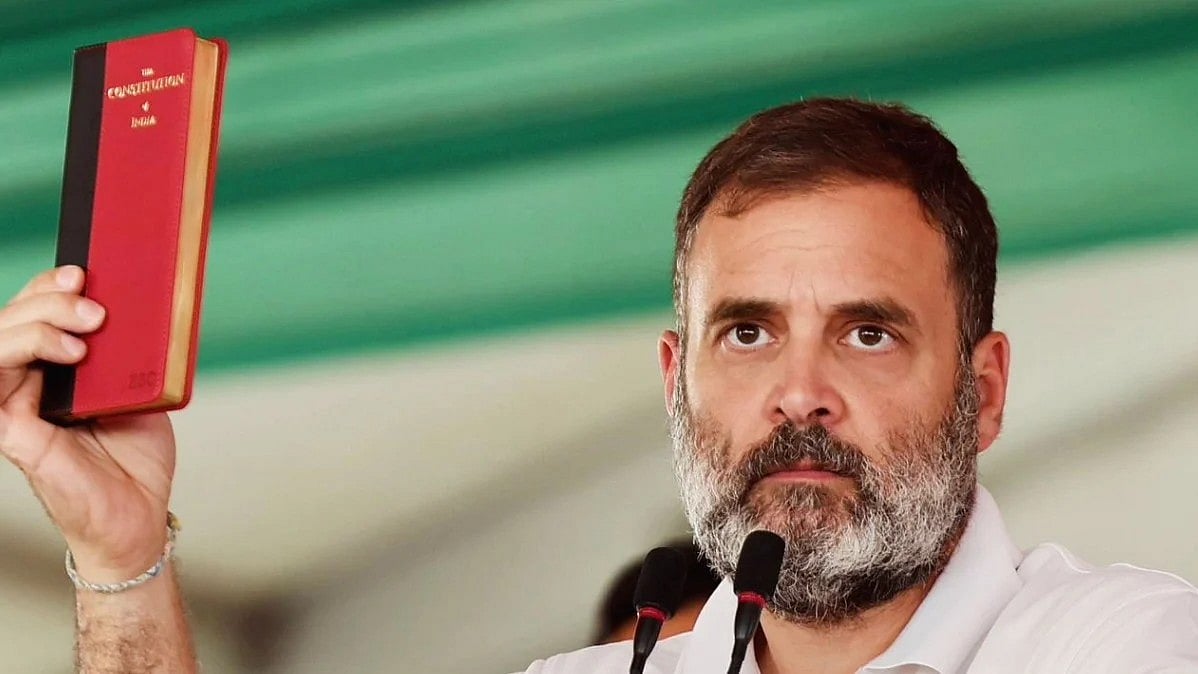
The roots of the Opposition parties’ reluctance to criticise the Constitution were planted during the 2024 Lok Sabha elections. Rahul Gandhi and other Opposition figures transformed the pocket-sized copy of the Constitution into a potent campaign prop. By framing the election as a battle to "Save the Constitution," they successfully tapped into fears among Dalits, tribals, and minorities that the BJP intended to scrap reservations or rewrite the nation’s secular charter.
But this branding created a trap. Having elevated the Constitution to the status of a "sacred" text, the Opposition has made it politically impossible to criticise its inherent weaknesses or expose the ways it can be legally manipulated.
Unless Opposition parties move beyond simply defending the Constitution and begin advocating reforms to curb its centralising tendencies, they risk being permanently sidelined in the very democracy they seek to preserve.
(Bhanu Dhamija is Founder and CEO of the Divya Himachal Group and author of ‘Why India Needs the Presidential System’. He can be reached @BhanuDhamija. This is a personal blog, and the views expressed above are the author’s own. The Quint neither endorses nor is responsible for the same.)
- Access to all paywalled content on site
- Ad-free experience across The Quint
- Early previews of our Special Projects
Published: undefined