
Putin Banquet Row: What's Really the Protocol? Govt Contradicts Own RTI Reply
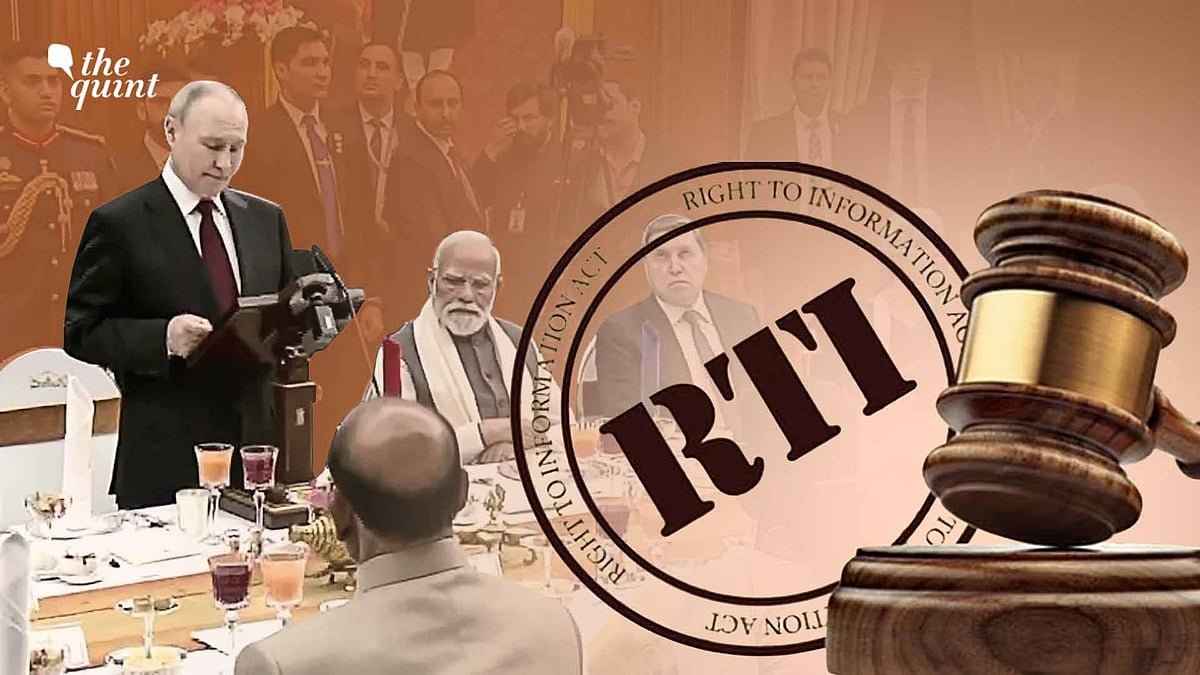
Congress has accused the Modi government of ignoring protocol in the recent banquet for Russian President Putin.
advertisement
(We are able to do such investigative stories because of our editorial independence. Support our work by becoming a member.)
A state banquet was hosted at Rashtrapati Bhavan on Friday in honour of visiting Russian President Vladimir Putin, but the event triggered a political row even before it began. The high-profile dinner, traditionally attended by key political leaders, saw an unusual omission in its guest list.
The Congress alleged a breach of long-standing protocol after confirming that neither its party president and Rajya Sabha Leader of the Opposition Mallikarjun Kharge nor Lok Sabha Leader of the Opposition Rahul Gandhi had been invited. Only Congress MP Shashi Tharoor figured on the list, prompting the party to question the criteria used this time. Tharoor said, “Don’t know on what basis invitations are issued, but I will certainly attend. It is not appropriate that Leaders of Opposition are not invited.”
The BJP, however, countered these charges. MP Kangana Ranaut alleged that Rahul Gandhi was “misleading the public” and argued that his remarks showed a “lack of understanding of diplomatic protocol.” She maintained that foreign leaders “meet whoever they wish,” underscoring the sharp difference between the Congress’ claim of broken convention and the BJP’s assertion that no such obligation exists.
So what is the truth about the protocol regarding state banquets? Who decides who gets to attend them and who doesn't?
President's Secretariat Responds to RTI Query
I had filed an RTI application a couple of years back with the President’s Secretariat seeking clarity on who prepares the guest list for state banquets hosted by the President. The query specifically asked whether the list is drawn up by the President’s Secretariat, President herself or any other authority. I also sought information on whether any guidelines or protocols exist for preparing such invitations.
The replies were revealing. The President's secretariat replied on 3/10/2020 that “The President of India hosts a State Banquet for visiting the Head of State as and when required. Being the host, it is the prerogative of the President as to who should be invited for the banquet”.
A Change in Stand
Later, I filed an appeal before the Central Information Commission (CIC) after the President’s Secretariat failed to provide information on the remaining points of the RTI. When the CIC ruled in my favour, the Secretariat revised its response dated 25 May 2022 and changed its stand, stating that “Dinner invitee list was prepared by the President Secretariat in consultation with the MEA.” It further added that “Invitations are issued as per the approval of the competent authority.”
The two replies expose a clear contradiction. In the first response, the President’s Secretariat claimed that invitation decisions were solely the President’s prerogative. But after the CIC’s intervention, the Secretariat shifted its position, saying the list was actually prepared by the President’s Secretariat in consultation with the MEA and issued with the approval of an unspecified competent authority.
What Do the Guidelines Say?
In the same RTI, I also sought information on whether any guidelines or rules had been issued by the President of India or the President’s Secretariat for selecting invitees to state banquets. This information has still not been provided. The question is significant, as it directly concerns the basis on which Shashi Tharoor was invited while the Leaders of Opposition in both Houses were not.
Past practices further underline why transparency is necessary. In 2020, when the President hosted a state banquet for U.S. President Donald Trump, a private citizen, Sudhir Chaudhary, was invited.
Further, Despite images of these state dinners being widely published in the media and attendees posting selfies from the events, the President’s Secretariat refused to provide the participant lists for the banquets hosted for President Donald Trump in 2020, President Bolsonaro in 2020, Prime Minister Shinzo Abe in 2019, President Emmanuel Macron in 2018, Chancellor Dr Angela Merkel in 2019, and President Obama in 2015. The denial was made by invoking Section 8(1)(a) of the RTI Act.
Section 8(1)(a) of the RTI states that information may be withheld “when information, disclosure of which would prejudicially affect the sovereignty and integrity of India, the security, strategic, scientific or economic interests of the State, relation with foreign State or lead to incitement of an offence”.
This raises a basic question: If disclosure of the invitee list truly affects the sovereignty or security of India, how is the media permitted to publish photographs of the same dinner events without restriction?
How Much is Spent on These Banquets?
In the RTI, I also asked how much public money was spent on these lavish events. The President’s Secretariat responded that “There is no separate account maintained for individual functios. The expenditure is incurred from the Annual Budget allotted to the Household Section.”
Dinners at the President’s House and the food given under the Pradhan Mantri Garib Kalyan Anna Yojana (PM-GKAY) are both paid for with public money. But the level of transparency is completely different. PM-GKAY is fully transparent, while the President’s House shares almost nothing.
On the Annavitaran portal, anyone can see exactly which ration card received how much wheat, rice or maize. But there is no publicly available list of who gets invited to the President’s dinners. PM-GKAY has a detailed set of criteria for who is eligible, but there are no such rules for state banquets. Even the cost of PM-GKAY is published in official press releases, while the expenses of these high-profile dinners remain unknown.
The conflicting replies from the President’s Secretariat, the absence of clear guidelines, and the refusal to disclose even basic details such as guest lists or expenditure all point to a striking lack of transparency around state dinners hosted at the President’s House. At a time when welfare schemes meant for the poorest citizens operate with full public disclosure, the highest constitutional office continues to shield routine information behind vague claims and shifting explanations. The secrecy raises an obvious question: why should publicly funded banquets at Rashtrapati Bhavan remain beyond public scrutiny?
- Access to all paywalled content on site
- Ad-free experience across The Quint
- Early previews of our Special Projects
Published: undefined