
Rs 3,300 Crore Wasted in 10 Years: The Price of India’s Dysfunctional Parliament
How India's Parliament wastes crores — a deep dive into disruptions, delays, and taxpayer Burdens.
advertisement
On the morning of 8 August 2023, the Lok Sabha was scheduled to debate one of the gravest internal crises India has faced in years: ethnic violence in Manipur. Instead, the House was adjourned within minutes.
Opposition MPs stood in the Well, demanding that the Prime Minister speak. Members from the ruling benches shouted back. The Speaker adjourned proceedings. Question Hour was lost. So was the day.
This, however, was not an aberration. It was business as usual for the Parliament of India.
This reporter scraped official data from the Ministry of Parliamentary Affairs (MPA) and found that since 2014, thousands of hours of scheduled parliamentary time have been lost to disruptions.
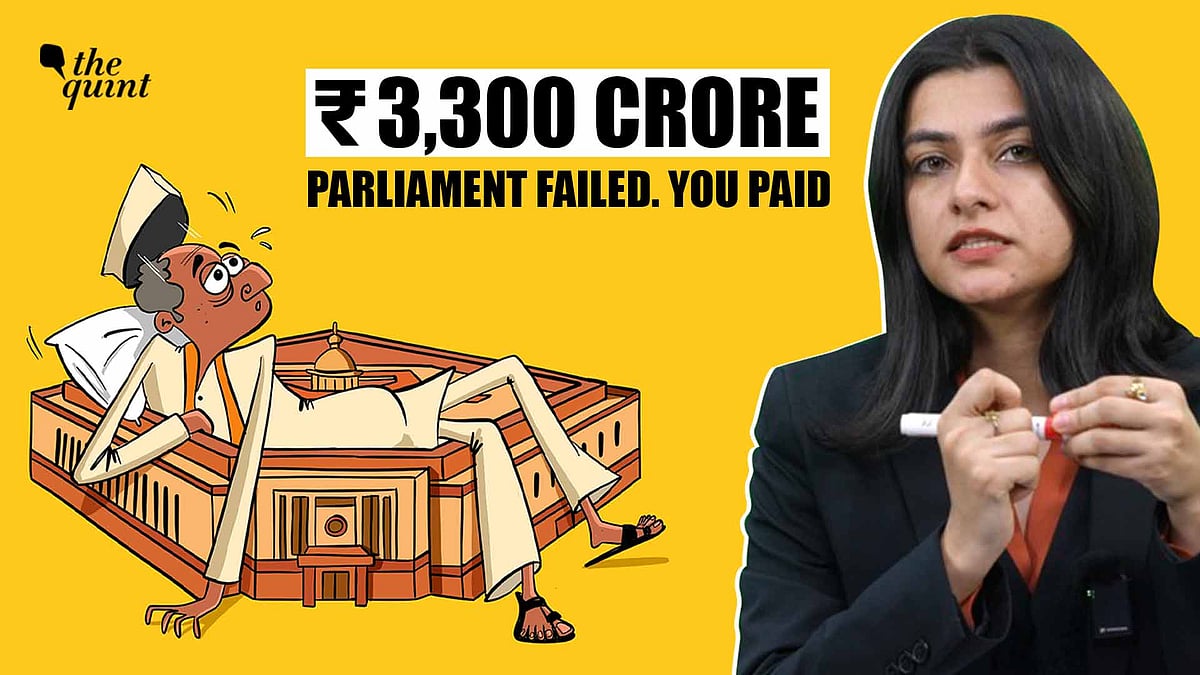
Using a conservative benchmark of Rs 2.5 lakh per minute — a figure repeatedly cited in parliamentary reporting — the estimated cost of interruptions between 2014 and 2024 alone runs into over Rs 3,300 crore.
That is money spent not on debate, not on law-making, but on adjournments.
Fewer Days, Less Democracy
India’s founding leaders envisioned a robust Parliament, which in the 1950s and 1960s, sat for over 120 days a year. MPs debated policy line by line. Question Hour was sacrosanct.
But by the time of the 17th Lok Sabha (2019–2024), the Parliament averaged about 55 sitting days a year. The 18th Lok Sabha, still in its early years, has not reversed that trend.
The Winter Session of 2025 spanned only 15 working days from December 1 to 19. Since the Narendra Modi-led government came to power in 2014, just three of the total 35 Sessions have been shorter than this.
Article 85 of the Constitution requires only that the Parliament meets once every six months. It does not mandate a minimum number of sitting days.
The number of sitting days for the Lok Sabha have been on a decline since decades.
But why did the founding leaders of the Indian Constitution not cap number of sitting days for the Parliament?
Constituent Assembly records show that this was intentional.
Dr B.R. Ambedkar and other framers argued that rigid caps could limit Parliament’s ability to function effectively when urgent or extensive legislative work was needed. The clause was drafted to allow meeting as often as required.
However, over the years, several Committees recommended that Parliament should meet for at least 120 days in a year.
Congress leader Pawan Kumar Bansal, during his tenure as member of Rajya Sabha, made this proposal in his private member Bills. Sitting Rajya Sabha MP Naresh Gujral, in his 2017 private member Bill, suggested that Parliament should meet for four sessions in a year, including a special session of 15 days for debating matters of urgent public importance.
The Price of Paralysis
This investigation is based on official data from the Ministry of Parliamentary Affairs (MPA), which records how much discussion time Parliament schedules and how much of it is lost due to interruptions.
Here's how we calculated the cost:
The MPA records time lost due to disruptions in hours and minutes for both Lok Sabha and Rajya Sabha.
This time is converted into minutes.
Each lost minute is valued at Rs 2.5 lakh, a benchmark repeatedly cited in parliamentary reporting as the approximate cost of Parliament being in session (covering infrastructure, staffing, security, logistics, and MPs’ allowances).
Lost minutes (multiplied by) Rs 2.5 lakh = estimated taxpayer money wasted.
Official data from the Ministry of Parliamentary Affairs (MPA), which records how much discussion time Parliament schedules and how much of it is lost due to interruptions.
Using only officially recorded interruption time, the results are telling.
2018: Approximately Rs 494 crore lost
2023: Approximately Rs 386 crore lost
2025: Approximately Rs 298 crore lost
Across 2014–2024, the cumulative estimated loss crosses Rs 3,300 crore.
Over the last decade the Parliament of India has become a place of disruptions, walkouts, and chaotic protests that prevent any meaningful work from taking place. And every time it fails, taxpayers foot the bill.
(Note: This is a conservative figure. It does not include indirect costs.)
Even When The Parliament Meets, It Often Doesn’t Work
Even when Parliament does meet, it often fails to function. From 2014 to 2025, official records show that Parliament has consistently lost large chunks of its scheduled time to disruptions.
Consider these examples:
2018:
Lok Sabha lost approximately 39 percent of its discussion time
Rajya Sabha lost approximately 53 percent
2023:
Both Houses lost over half their scheduled time
2025 (Monsoon Session):
Lok Sabha functioned for 37 of 120 scheduled hours
Rajya Sabha for about 41 hours
A Pattern of Disruption
The Manipur Crisis
Take 2023. The Manipur violence that year claimed hundreds of lives and displaced thousands. Opposition MPs demanded a statement from the Prime Minister, seeking to hold the government accountable for its handling of the crisis. But the BJP MPs countered by demanding a debate on other states. The two sides clashed, and Parliament was adjourned repeatedly.
By the time Parliament finally debated the issue half of Parliament’s time for the year had been lost to disruptions. This meant that the taxpayer had paid for time that should have been spent holding the government accountable but instead was wasted in political standoffs.
Farm Laws Passed Without Debate
In September 2020, the controversial farm laws, which were eventually rolled back, were passed by the Rajya Sabha without a recorded vote, despite opposition protests.
As MPs from the Opposition demanded a division vote, the Deputy Chairman of Rajya Sabha declared the bills passed by voice vote, sparking outrage across party lines. MPs climbed onto tables and tore rule books in protest.
Despite the chaos, the farm laws were passed with minimal scrutiny or debate.
Article 370: Speed Over Scrutiny
In August 2019, the abrogation of Article 370, which stripped Jammu and Kashmir of its special status, was introduced and passed in Parliament within hours. There was a compressed debate with minimal time for discussion.
As Opposition MPs demanded more debate and consultation, the government pushed through the legislation using its majority, bypassing the usual scrutiny process. The passage of such a far-reaching constitutional change was completed at speed but the necessary debate was left behind.
The Myth of 'Productivity'
Governments claim that Parliament has been more productive than ever, citing records of high “productivity” in recent sessions. In reality, productivity metrics can often be misleading.
Consider 2018. Despite Parliament sitting for only 61 percent of the scheduled time, the government pointed to the “high productivity” of the House.
But what did that “productivity” look like?
In the 2023 Winter Session, the Parliament functioned "orderly" after 141 Opposition MPs were suspended. Bills passed faster. And debate hours increased on paper.
Again, in 2025, despite officially recording 100 percent+ productivity, Parliament’s Monsoon session had lost two-thirds of its scheduled hours. Yet, Bills were passed at lightning speed, with little debate. 90 percent of the Union Budget was passed without discussion.
State Assemblies Are in Peril, Too
Much like the Parliament, the state assemblies also are meeting far too infrequently.
In 2024, state assemblies met for an average of approximately 20 days across the country. This is well below expectations for meaningful legislative scrutiny.
Earlier data shows most assemblies historically sat for less than 30 days a year and far below national legislatures elsewhere.
As per data from 2024, the State Assemblies of Jammu and Kashmir, Nagaland, and Uttar Pradesh met for 5, 6, and 16 working days respectively. This is in sharp contrast with the Assemblies of Odisha, Kerala, and West Bengal which met for 42, 38, and 36 working days.
Time Wasted, Money Lost
India’s Parliament has become an institution trapped in paralysis. Taxpayers are paying for the hours lost to disruptions, laws passed without discussion, and skipped debates. This is happening with no meaningful checks.
The money lost during this process is not just a reflection of parliamentary dysfunction. It is a stark reminder of the democratic deficit growing in the heart of Indian governance.
(Data sourced: Historical Data of Parliament [Dataset]. Dataful.)
- Access to all paywalled content on site
- Ad-free experience across The Quint
- Early previews of our Special Projects
Published: undefined