
Owaisi and Azad Are Natural Allies. Can They Make a Dent in UP?
Why did AIMIM and the ASP tie-up? Where can they gain ground? What does it mean for SP-Congress, BJP and BSP?
advertisement
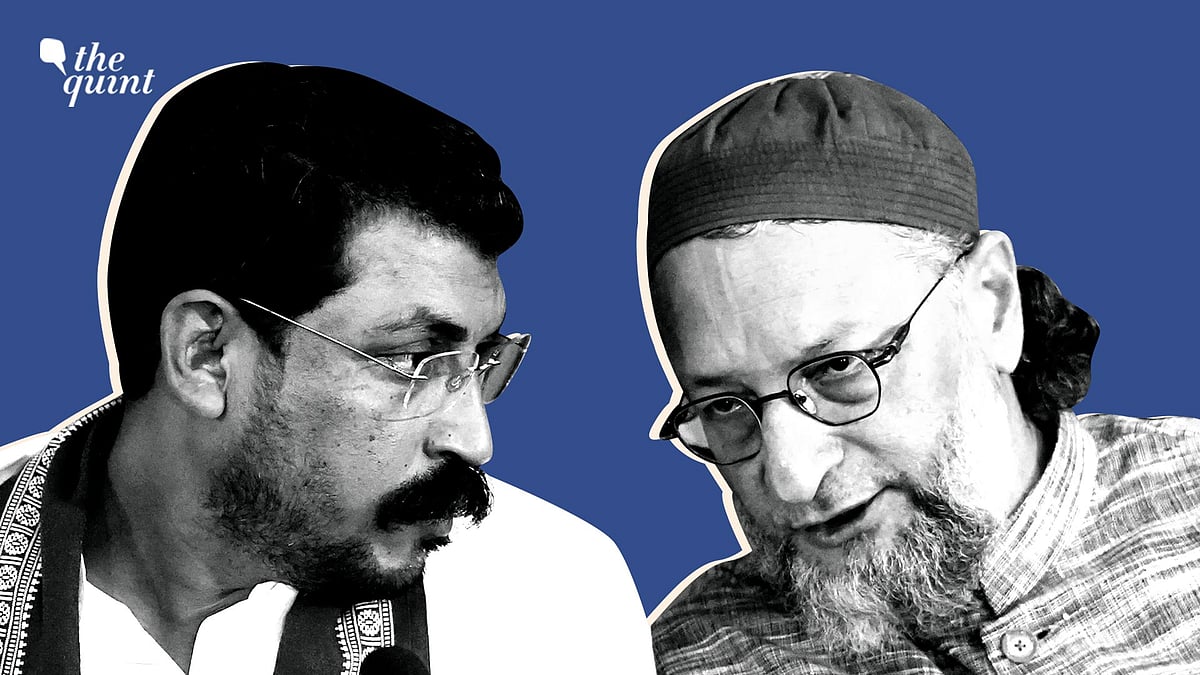
Asaduddin Owaisi's AIMIM and Chandrashekhar Azad's Aazad Samaj Party are natural allies. Therefore, their tie-up for the Uttar Pradesh Assembly elections shouldn't come as a surprise.
In this piece, we will answer three questions.
What makes AIMIM and ASP natural allies?
Will they be able to make an impact in the Uttar Pradesh elections?
What does this mean for SP-Congress, BJP and BSP?
Why AIMIM and ASP are Natural Allies
Both AIMIM and ASP seek a social alliance between Dalits, specifically Ambedkarite Dalits, and Muslims.
Both parties ideally want space within the larger anti-BJP alliance, led by the SP in UP and Congress nationally. But neither has been accommodated by the bigger parties.
The Congress and SP leaders often accuse these two parties of being the 'B-Team' of the BJP, mainly because they compete for anti-BJP votes.
The AIMIM and the ASP have allied in the past as well. In the 2025 Bihar Assembly elections, AIMIM and ASP had formed an alliance that included Swami Prasad Maurya's AJP and Pashupati Kumar Paras' RLJP. Only the AIMIM managed to win seats, all in the Seemanchal region.
In the Lok Sabha, Owaisi and Azad take similar positions, in favour of secularism and constitutionalism.
The AIMIM has allied with Ambedkarite outfits in the past, the most prominent one being Prakash Ambedkar's Vanchit Bahujan Aghadi in the 2014 Maharashtra elections.
Will They Have an Impact?
Assembly elections in UP have been becoming increasingly bipolar even though it isn't a traditionally two-party or two-alliance state. In 2017, the BJP and its alliance secured 41 percent votes, the SP-Congress alliance secured 28 percent and the BSP got 22 percent.
However, five years later, the BJP and allies got 43 percent and the SP with its allies got 37 percent. The latter didn't even include the BSP or the Congress.
The bipolarity has been even more pronounced in Lok Sabha elections.
If the SP and Congress form an alliance with effective seat-sharing, this bipolarity is likely to continue.
The main focus for the AIIMIM-ASP alliance will be areas where Jatav Dalits and Muslims are in sizable numbers and Yadavs are lesser in number, such as Bijnor district, parts of Saharanpur, Meerut and Agra.
A lot will also depend on whether the alliance finds good candidates. AIMIM's growth in UP has been different from Maharashtra and Bihar. In Maharashtra, it grew organically and created a new Muslim leadership in several areas. In Bihar, it did gain due to leaders from an RJD or JD-U background but it also embedded itself in the Seemanchal region.
This hasn't happened in UP.
In 2022 the only AIMIM candidate to make an impact was Guddu Jamali who already was an important leader in Azamgarh district.
Success would mean different things for both the parties. For the AIMIM, winning even one seat will be seen as success. The ASP has a much bigger ambition. It seeks to replace the BSP as the primary party of Dalits in UP.
What Does This Mean for SP-Congress, BSP and BJP?
The AIMIM-ASP alliance is likely to target Akhilesh Yadav on issues like his decision to go to the Ram Mandir in Ayodhya or if the SP doesn't give enough tickets to Muslims.
For the SP, it now becomes all the more important to seal the alliance with the Congress. An SP-Congress alliance sends the sign that the biggest secular party nationally and the biggest secular party in UP are coming together. This will help them consolidate anti-BJP votes, especially Muslims.
Another party that will face a challenge is the BSP. If ASP gets a higher vote share than the BSP, it will strengthen Azad's claim against Mayawati. However despite being weakened, the BSP remains a formidable force on the ground and many voters do recall Mayawati's rule from 2007 to 2012 in a positive light.
The BJP is likely to target a substantial part of their verbal attacks on the ASP-AIMIM alliance to present them as the main Opposition. The BJP has followed this pattern in many states, most notably Himanta Biswa Sarma's attacks on Badruddin Ajmal's AIUDF in Assam.
- Access to all paywalled content on site
- Ad-free experience across The Quint
- Early previews of our Special Projects
Published: undefined