
Rebuild or Pay: A Year Since Nagpur Riots, How Bulldozer Action Collapsed in HC
Over a year, the Bombay HC has rejected all explanations by the NMC for demolishing Fahim Khan's mother's house.
advertisement
On a narrow, dusty lane in Nagpur's Yashodhara Nagar, the debris of a two-storey house demolished by the Nagpur Municipal Corporation (NMC) has remained untouched for the past year—a stark reminder of what once stood there.
The house belonged to the parents of Fahim Shamim Khan, the prime accused in the communal violence that rocked Nagpur on 17 March last year, during Shivaji Jayanti celebrations.
Fahim, then a leader of the Minorities Democratic Party (MDP), was arrested on charges of inciting riots and jailed under the Unlawful Activities (Prevention) Act (UAPA). A week after his arrest, his elderly parents — who lived with other family members in the house — received a notice from the municipal corporation on a Sunday morning.
Rubble of Fahim Khan's mother's house has been left untouched by the family in Nagpur's Yashodhara Nagar.
(Photo: The Quint)
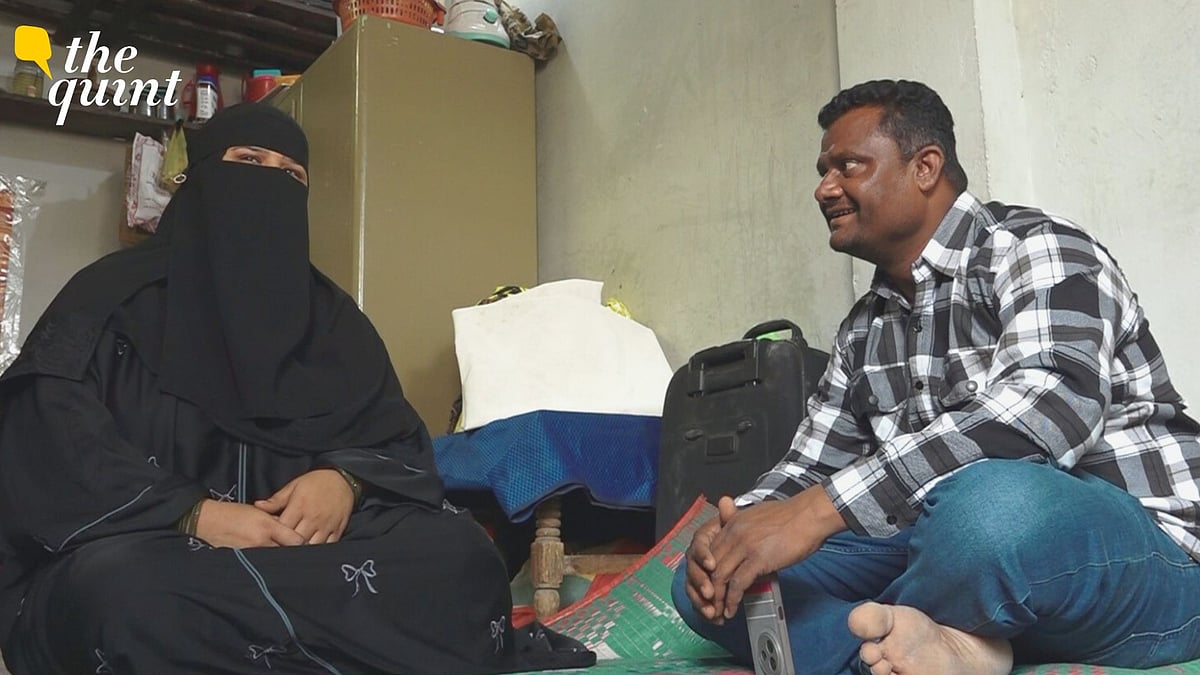
When the authorities brought in the bulldozer, Fahim's wife, Alisha Khan, was at another house in the same locality. She watched, helplessly, as their home was torn down.
"We requested them not to run the bulldozer. The locals and neighbours requested them too. We tried very hard to stop them. But they weren’t ready to listen. We felt very helpless. The house built by my in-laws was demolished. My mother-in-law had fainted. What we went through that day, I cannot put into words," she told The Quint, recalling the events of that day.
A year on, the family's circumstances might seem to have improved—at least on the surface. Fahim was granted bail in July last year, and Alisha was recently elected as a corporator in the very municipal body that demolished her in-laws’ home.
But for Alisha, these developments are only fleeting moments of relief in a much deeper, continuing trauma—one shaped not just by the charges against her husband, but more significantly, by the loss of their home.
The Riots and the Demolition
The chain of events began around 11:30 am on 17 March, when members of the Bajrang Dal and the Vishwa Hindu Parishad (VHP), as part of a state-wide campaign, staged demonstrations demanding the removal of Mughal emperor Aurangzeb's tomb in Chhatrapati Sambhaji Nagar. The protests followed the release of the Bollywood film Chhaava.
Soon after these demonstrations by Hindu right-wing groups, the police filed an FIR at 3:09 pm, invoking sections related to unlawful assembly. A senior police officer told The Quint that additional sections were incorporated later that evening, after the “possible nature” of the chadar was brought to their attention by Fahim and his supporters at the Ganeshpeth police station.
A private vehicle was set ablaze by a mob after violence broke out in Nagpur's Mahal area.
(Photo: PTI)
By around 7:00 pm, as residents prepared for Shivaji Jayanti celebrations in the Mahal area, a group of Muslim youth gathered near the Shivaji statue, raising slogans. What began as an altercation with the police soon spiralled into violence, which spread rapidly across a 2-km radius—engulfing Chitnis Park, Ganjipeth, Gitanjali Chowk, Bhaldarpura, and Hansapuri, all densely populated localities with closely interwoven Hindu and Muslim communities.
In the aftermath, the Nagpur Police registered over 13 FIRs and constituted multiple investigative teams—not only to probe the incidents of violence on the ground but also to track related activity on social media.
The first FIR filed by the police detailed Fahim’s alleged role, naming him alongside 51 others.
While Fahim was arrested on 19 March, the demolition of his family’s house followed just days later, on 24 March.
How The Demolition Case Crumbled in the Court
Advocate Ashwin Ingole, who is representing Fahim’s family in their case against the demolition, told The Quint that there have been four hearings in the matter so far—the first held on 24 March 2025, the very day the bulldozer was brought in to raze Fahim’s house.
After receiving the municipal corporation’s notice, Fahim’s mother had approached the High Court seeking a stay on the demolition.
Along with Fahim’s house, the Municipal Corporation had also partially demolished the house of Abdul Hafeez Sheikh Lal.
Hearing 1: 24 March 2025 — Demolition Carried Out Before HC Could Hear Case
The Court issued notices to the Municipal Commissioner, District Collector, and the State Chief Secretary, questioning why no action had been taken despite the Supreme Court’s earlier order against the demolition of homes. The authorities were directed to present their response before the court.
Hearing 2: 15 April 2025 — Authorities Said They Were ‘Unaware’ of SC Orders
In its November 2024 guidelines, the Supreme Court had made it clear that demolitions cannot be used as a form of instant punishment merely because a person is accused of a crime, and must strictly follow due process. Authorities are required to issue a clear notice at least 15 days in advance, provide affected individuals a fair opportunity to be heard, and pass a reasoned written order explaining why demolition is necessary. Even thereafter, individuals must be given time to appeal or comply voluntarily.
The Court also emphasised that only the illegal portion of a structure should be demolished, unless a complete demolition is justified. The entire process must be properly documented, including videography.
During this hearing, the Municipal Commissioner submitted an affidavit stating that officials of the NMC who carried out the demolition were ‘unaware’ of the Supreme Court’s guidelines.
In his affidavit, the then Municipal Commissioner, Abhijeet Chaudhary, unconditionally apologised to the Court.
(Photo: PTI)
Chaudhary also told the court that the Police Commissioner had sought information about the properties of the accused in the Nagpur violence, and based on that request, the Municipal Corporation carried out the demolition.
The Court then directed the Maharashtra government to submit a response within two weeks.
Hearing 3: May 2025
In May 2025, Maharashtra’s then Chief Secretary, Sujata Saunik, filed an affidavit in the court. She admitted that the government had failed to issue a Government Resolution (GR) following the Supreme Court’s order, as a result of which municipal officials remained unaware of the guidelines. She added that the GR had since been issued. The Court, however, rejected Saunik’s affidavit.
Hearing 4: February 2026
In February 2026, during a subsequent hearing, the High Court directed the Municipal Corporation to either rebuild the house or provide compensation. The Court asked the Corporation to submit a response stating whether it would reconstruct the house or compensate the family.
A further hearing was scheduled for 4 March, but it did not take place. Another hearing was expected on 13 March, but the matter was not listed on the board. For now, it remains to be seen how the Municipal Corporation will respond to the court’s directions.
A Divided Family
While Fahim was in prison and the entire family was rendered homeless, his wife Alisha took it upon herself to hold things together.
"Our house was demolished on the 23rd day of Ramadan. Today (Friday, 13 March) is also the 23rd day. It has been a year. Everything comes to my mind exactly as it happened. In this past year, our entire family has scattered. My elderly in-laws now live with their daughter. My brother-in-law and his family are living in a mosque. And we are living in a tin shed in this intense heat. My little children have lost their joy," she said.
The shadow of criminal charges against her husband in the riots case, however, looms large on the family.
Fahim spent four months in jail under charges related to the violence. The court granted him bail on the rationale that a chargesheet has been filed against him. Observing that there is no longer any need to keep him in custody for investigation, the sessions court granted him conditional bail.
Speaking to The Quint, he maintained his innocence.
"The charges against me are fabricated and they have been sensationalised by the media. I was granted bail based on evidence," said Fahim.
Fahim Khan sttands before the rubble of the demolished house.
(Photo: The Quint)
Fahim further alleged that the order to demolish their entire house came from the "higher ups".
"The house was in my mother's name. Everything was in order, all paperwork was there. There were some unpaid taxes, but that was it. What laws were cited to demolish my mother's house, on whose orders was it done, only they know," he said.
"The notice for demolition was issued just one day earlier, on a Sunday. The next day, the police were present before 10 am. All neighbours were threatened not to leave their homes. They imposed a lockdown. By 10.30 am, the entire house was demolished. In the notice that was issued, it was mentioned that up to 90 metres was encroaching and was illegal. But we don't know who ordered them to demolish the whole building. We lost all our belongings because we were under the impression that only the encroached area mentioned in the notice would be demolished. So, we did not vacate the whole building. But eventually, they did not spare anything," Fahim said.
Politics To Their Aid
Over the past year, the family has faced repeated setbacks. In the aftermath of the violence charges, Alisha said, no one was willing to rent them a house, but the elections helped restore some of the family’s standing in the community.
In the recent elections to the Nagpur Municipal Corporation, Alisha was elected as a corporator from her locality on a ticket from Asaduddin Owaisi's All India Majlis-e-Ittehadul Muslimeen (AIMIM). Alisha attributes her victory to the sense of injustice surrounding the bulldozer action. It was, in fact, this demolition that pushed her into politics.
Now a corporator in the same Municipal Corporation that demolished her home, Alisha says she intends to take that fight into the institution itself. She plans to raise the issue of what she calls “bulldozer justice” in the general assembly of the Corporation.
"Just as our house was illegally demolished by the Municipal Corporation, it should be rebuilt. Either they should compensate us, or they should build the house. What happened to us was wrong. We deserve justice. We have lost a lot. No one should have to face homelessness like we did. I will tell this in the Municipal Corporation assembly," she said.
As for Fahim, even though he claims innocence, the seriousness of the charges against him and the allegations made by the Nagpur police in the chargesheet cannot be overlooked.
"I have not endured as much while being imprisoned, as much as my family has had to due to our house being demolished," he said.
- Access to all paywalled content on site
- Ad-free experience across The Quint
- Early previews of our Special Projects
Published: undefined