
'Chora Toh Chahiye': Inside Haryana's Son Obsession Beating BJP's 'Beti Bachao'
Abortions, growing illegal ultrasound machine rackets and locals who live with a 'sons-must' syndrome in Haryana.
advertisement
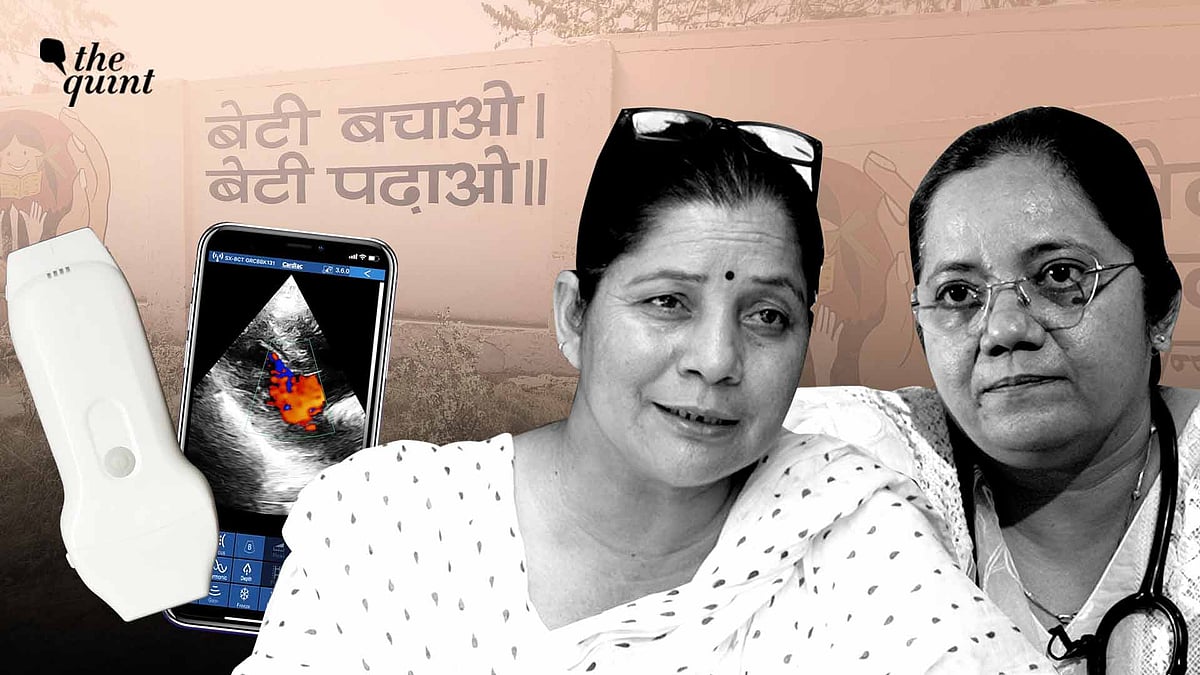
If you travel through Haryana's districts, it is almost impossible to ignore the ubiquitous wall paintings of 'Beti Bachao, Beti Padhao,' 'save the girl child,' and 'stop female foeticide' in front of hospitals and public parks. But the real story lies elsewhere.
In Haryana, a deeply-entrenched, systemic problem ensures that the wall paintings remain a visible contradiction. If you're not living under a rock, you would be aware that Haryana has had one of the worst sex ratio numbers historically, having seen some improvement in the recent years — only to take a dip again.
In the first four months of 2026 alone, the Sex Ratio at Birth (SRB) has fallen down to 895 as compared to 925 of 2025. In May, data reviewed at a meeting chaired by additional chief secretary (health and family welfare) Sumita Misra revealed that among the worst performers were Charkhi Dadri (769), Ambala (843) and Mahendragarh (847), while the better performing districts were Karnal (968) and Faridabad (932) and Kurukshetra (932).
The Quint travelled to Sonipat and Farukh Nagar to uncover as to why Haryana finds itself to be a focal point, what difference has years of 'Beti Bachao Beti Padhao' and other government schemes made on the ground? And what does the crackdown against sex determination practices look like?
Sunita Rani, ASHA leader tends to a new born baby girl in Sonipat, Haryana.
(Photo: Shiv Kumar Maurya/The Quint)
The 'Son Is a Must' Syndrome
The further we went into Haryana, the more apparent the need to have a son became. 'It's still a belief in families here that only a son completes a family, 'ek chora toh hona hi chahiye,' they say," gynaecologist Dr Archana Rohilla told The Quint.
Coincidentally, the day our team reached the clinic, a baby girl had just been delivered. There were smiles, some faint and some hesitant, as they held the baby. A while later, Dr Rohilla took us inside her consultation room.
Dr Archana Rohilla meets and advises pregnant women against sex selection practices in Farukh Nagar.
(Photo: Shiv Kumar Maurya/The Quint)
Since Dr Rohilla attends to patients from around 25 neighbouring villages, she has closely seen how adamant families are to have a boy, despite government's awareness campaigns.
"A woman gave birth to her 11th baby, that was a boy. So they finally stopped. This is why I say there has been no real impact of BBBP or other schemes, maybe 8-10% but not more than that," she added.
Meanwhile, Rani who has been an ASHA leader for 15 years. She said that whenever sex ratio numbers in Haryana drop, it's ASHA workers who are the first to bear the brunt.
Rani also narrated how having a son has become a material marker for families, a pattern that has intensified with time.
"On the sixth day, halwa (sweet) is prepared. But if it’s a girl, khichdi (porridge) is distributed. The barber will summon everyone from the neighbourhood, and they come bearing wheat as a gift. In my neighborhood, a boy was born, and the family celebrated with songs for 20 days! They also distributed dupattas, just like the one I’m wearing, bowls, and local mugs," said Rani.
The kind of wall paintings against female foeticide mostly seen in Haryana districts.
(Photo: Shiv Kumar Maurya/The Quint)
The 'Need' for Sex Selection
This desperation to have a boy child translates into seeking illegal sex determination practices, which as Rani puts it, is still a "blind spot" for many doctors.
Through her PNDT (Pre-Natal Diagnostic Techniques) team, she was informed that now there are small portable ultrasound machines which allegedly show the results of the sex of a baby on one's mobile phone screens.
This is also why Rani feels that the government's awareness schemes have not worked for locals and has lost its momentum. Several schemes like 'Aapki Beti, Humari Beti' and 'Mahri Lado' (radio programme) exist in Haryana.
Similar to Rani, Sudhesh Kumari, another ASHA worker works with her states that Haryana's 'sons-only' or 'sons-must' syndrome is so entrenched in local customs and traditions that it transcends any government scheme or policy.
As Kumari went about on her regular house-visits, we tagged along with her to visit a house where a son had been born. She told us how women try to conceal abortions when it was most probably a girl child.
Sudhesh Kumari, ASHA worker checking the health of a boy child.
(Photo: Shiv Kumar Maurya/The Quint)
In an attempt to tackle female foeticide that the Haryana government started what is called the 'reverse tracking of abortion.'
In reverse tracking of abortion, an expecting mother has to get herself registered within the first 3 months. This data is sent to CMO, Chandigarh as well. The pregnant woman is also assigned an ABHA ID to track her pregnancy.
"Officials then randomly pick a number, and call to confirm with the parents about the delivery of the baby. Usually in the 7th or 8th month. This is reverse tracking. If they have registered their pregnancy and it's recorded for 3 months but the pregnancy does not continue, they will have to provide the medical reasons for it," remarked Dr Rohilla.
Boards for 'Beti Bachao, Beti Padhao' in Farukh Nagar.
(Photo: Shiv Kumar Maurya/The Quint)
Raiding Inter-State Rackets
Despite strict laws like Medical Termination of Pregnancy (MTP) Act being in place, illegal sex determination has continued and officials with the health department of Haryana explained to The Quint why they persist.
Most of the illegal abortions are carried out in NCR regions, mostly in Uttar Pradesh and its border cities.
One of the doctors who executes such raids is Dr Devender Singh Solanki, a PC-PNDT nodal officer. He recently carried out two raids: a Gurugram-Bijnor sex determination racket and the other one was a Gurugram-Meerut one.
In both the raids, he planted a pregnant woman as a fake customer to reach out to the accused for the sex determination tests and an abortion if it's a girl child.
FIR in Gurugram-Bijnor illegal sex determination racket.
(Photo: Shiv Kumar Maurya/The Quint)
While busting the Gurugram-Meerut racket, they found that an accused, Nadeem (who has been arrested) was also charging Rs 15,000- Rs 20,000 to determine the sex of the baby and get an abortion done if it was a girl. The Quint has accessed the FIRs in these cases.
Dr Solanki, through these cases, emphasised that this is the result of a huge demand of such illegal practices in Haryana the supply being met in UP.
Another official of the Health Department, who requested to be anonymous, told The Quint about the decline in Haryana's sex ratio numbers.
He said, "We count the SRB according to the calendar year in totality, this is mainly because birth rates go up during the last 4 months of the year and fall during summers. The data also fluctuates. The current data for the beginning of the year is mostly for us to monitor and gauge the trends.”
The worst performing district remains to be Charkhi Dadri. But when The Quint inquired into the reasons for its abysmal state, a government doctor stated, "In Charkhi Dadri, there is a dearth of gynaecologists. When we get any pregnant patients, we refer them to another Institute in Rohtak so these births are registered there."
Be it Charkhi Dadri or any other district, the hunger for sons still transcends the limited gains made by government's schemes in the past decade or so.
- Access to all paywalled content on site
- Ad-free experience across The Quint
- Early previews of our Special Projects
Published: undefined