
Why Did BJP & Akalis Dump Solo Plans to Get Back Together After 6 Years?
From Tukde Tukde gang to mentally unstable, BJP and SAD leaders have called each other names in the last 6 years.
advertisement
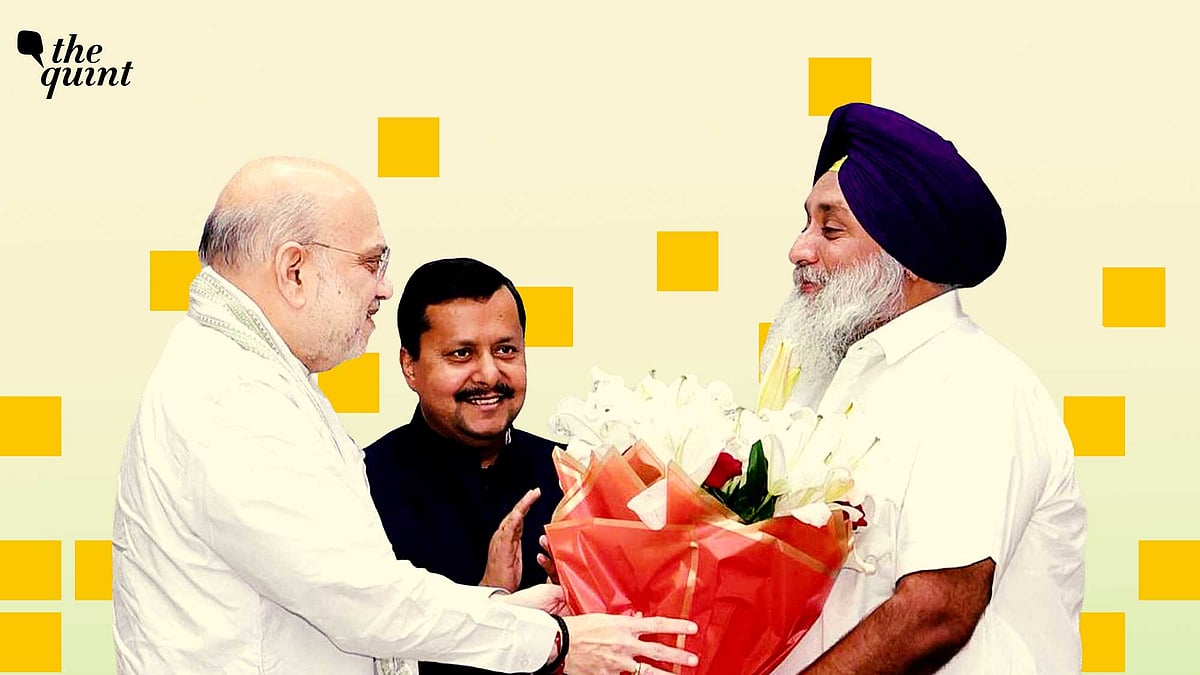
The Shiromani Akali Dal and Bharatiya Janata Party are back together again, after a break of six years. Union Home Minister Amit Shah, BJP president Nitin Nabin and SAD president Sukhbir Badal made this announcement on the occasion of Gurupurab on 24 November.
The two parties first became allies in 1997 but fell out over the Modi government's farm laws in 2020.
In the past six years, the BJP and SAD have traded charges on several fronts. In 2020, Sukhbir Badal had called BJP the real "Tukde Tukde Gang" and accused it of trying to divide Hindus and Sikhs in Punjab. Harsimrat Kaur had accused the then BJP government in Haryana of "murdering democracy by firing water cannons and protesting farmers".
After an attack on Sukhbir Badal in December 2024, BJP minister Ravneet Bittu called the attacker "qaum da heera" (gem of the community), to which SAD's Bikram Majithia responded by saying that Bittu has "lost his balance".
What compelled the BJP and SAD to renew the alliance?
What is the seat-sharing likely to look like?
What impact is the alliance likely to have in the upcoming Punjab Assembly elections?
We will answer these questions in this piece.
Why Sukhbir Badal Had to Back Down
In some ways, revival of the SAD-BJP alliance is an admission of defeat for both the parties.
After it parted ways with the BJP, Sukhbir Badal's main pitch was that the SAD is the only party in Punjab that isn't run from Delhi, as opposed to the AAP, Congress and BJP. Now that argument doesn't hold.
The SAD's calculation was that its 'sacrifice' of the alliance and ministerial berths in 2020 will help it win back Panthic Sikh votes it had lost. That didn't happen. The anger towards the SAD due to the 2015 sacrilege case still remains. The SAD is further hampered by the presence of multiple claimants within the Panthic space: Amritpal Singh's SAD (Waris Punjab De), Simranjit Singh Mann's SAD (Amritsar) and SAD (Punar Surjeet) led by former Akal Takht Jathedar Giani Harpreet Singh.
The victory of Independent candidates Amritpal Singh and Sarabjeet Singh in the 2024 Lok Sabha elections demonstrated their electoral viability, further harming the SAD (Badal).
Sukhbir Badal's 'punishment' at the Akal Takht was also bad optics for him and adversely affected his efforts to revive the SAD in the Panthic space.
Having failed to re-establish the SAD on its own might, Sukhbir Badal now seems to be trying to use the Modi government's support to establish his claim over the Akali legacy.
What Happened to BJP's Plans in Punjab?
For long, BJP leaders had been claiming that the party will establish itself as an independent entity in Punjab. It put in immense resources and manpower to expand beyond its traditional base of urban Hindu voters.
Going back to being the SAD's junior partner, even with an increase in its quota of seats from 23 to around 40, is an admission of defeat for the BJP in three ways.
First, it shows that the party has pretty much failed to win over the rural Sikh vote. This is despite bringing on board several leaders from the Congress. The rumour is that even Punjab BJP president Kewal Dhillon wants to contest from a Hindu majority seat in Ludhiana instead of his traditional seat Barnala. It tried to deploy Haryana CM Nayab Singh Saini to replicate the formula of pitting non-Jats against Jats. But that didn't work out either.
Second, the BJP had been presenting itself as the party of change, as opposed to the Congress, AAP and SAD that have led governments in Punjab. That plank is also gone.
Third, many of the leaders the BJP brought on board, have been opposed to the Akalis in the past. Captain Amarinder Singh, though a former Akali, has been the pole of anti-Akali politics since the late 1990s. The same goes for Sunil Jakhar who was leader of the Opposition between 2012 to 2017. Manpreet Singh Badal, Sukhbir Badal's cousin, fell out with the SAD on the eve of the 2012 Assembly elections. He later joined the Congress. Former police officer Kunwar Vijay Pratap Singh led the probe into the 2015 sacrilege case and his report was deeply critical of the Badals. He joined AAP and became an MLA in 2022. It is ironic that he will now be on the same side as the Badals who his report indicted as well as Captain who he had criticised for going soft on the Badals.
These instances aren't going to be forgotten by the people of Punjab.
The Amit Shah Factor
The driving force behind the alliance is Amit Shah. He has taken charge of the BJP campaign for the Punjab elections. It is said to have been Shah's call to prioritise the formation of an NDA government in the state over the BJP's long-term expansion.
Will it Have an Impact?
Many analysts are putting forward arithmetic based on the 2022 and 2024 elections by adding the vote share of the SAD and BJP. This is very simplistic. The two parties have very different bases: rural Sikh and urban Hindu respectively. More importantly, politics within these sections has changed greatly.
There is still an anti-BJP sentiment among Sikh voters, even though the negativity may have gone down a bit compared to 2022. Then SAD isn't particularly popular among urban Hindu voters.
Let's take a hypothetical situation.
In a seat where there is no SAD candidate, an Akali voter may go with Akali Dal (Waris) or Akali Dal (Punar Surjeet) or even AAP instead of the BJP. On the other hand, an urban Hindu voter may prefer Congress to SAD where BJP isn't contesting.
The main benefit of the alliance is that it gives the impression of being a viable alternative at the state level. If the two parties were contesting separately, only the AAP and Congress would have been viable by virtue of securing votes from both urban and rural areas and from both communities
Seat sharing may not be a big challenge for the SAD and BJP as their bases are clearly defined. However, the SAD may have to spare a few more seats in rural areas to accommodate BJP's new acquisitions from the Congress and other parties.
The trickier part is reviving the SAD in the Panthic space. The Modi government may have to offer something on an issue of public as a 'win' for Sukhbir Badal.
- Access to all paywalled content on site
- Ad-free experience across The Quint
- Early previews of our Special Projects
Published: undefined