'A New Trend in Violence': The Precarious Lives of Vishwasi Christians in Bastar
Looting and demolition of homes have become familiar scenes across at least three districts of South Chhattisgarh.
advertisement
(Exposing communal hate is a key part of The Quint's reportage. This requires courage and editorial independence. Become a member and help us do more such stories.)
Ulleshwari Kashyap, a resident of Ermur village in Bastar, Chhattisgarh, was six weeks pregnant and at home when the attack took place. At around 11 am on 29 December, a mob consisting of dozens of men from nearby villages descended upon the homes of Vishwasi (converted) Christians like her. A total of eight homes were reportedly targeted and looted.
"My husband and brother-in-law were out working in the farms. They broke into the Christian houses, including ours, and started assaulting the people," Ulleshwari tells The Quint.
After sustaining injuries, Ulleshwari was taken to a nearby hospital near Kanker headquarters. By the time the family returned home, they found their door locked on the outside—and the property damaged. "We have been living in this village since 2007. We have not seen anything like this. Our own fellow villagers are against us," Somaru Kashyap, Ulleshwari's brother-in-law, recalls.
The families refused, and on 29 December itself, filed a written complaint with the Police Superintendent of Bastar district at Mardum thana, a copy of which has been accessed by The Quint. The complainants alleged that the attackers spat on the food prepared in the homes, and looted foodgrains, cattle, and poultry, along with other belongings.
While the families eventually broke the locks and returned home as the new year began, many of their belongings remained gone. "No arrests have been made in the case. We don't think any action will be taken," Somaru's brother Raju Kashyap tells The Quint.
When contacted, Mardum Police said peace has been restored in the area.
A day before, on 28 December, a similar attack took place in Kanker's Pusagaon, about 15 km from Ermur, where a mob attacked and ransacked the homes of about 13 Vishwasi Christians.
A Vishwasi woman surveys her damaged home in Pusagaon where 13 homes of Christians were attacked by a crowd on 28 December, 2025.
(Photo: Special Arrangement)
Speaking to The Quint, Pastor Kamlesh Dhruw, one of the victims, says, "The attack seemed planned. All the Vishwasi residents of the village had been called to the village community hall that day for a meeting. The purpose was to tell us to do 'ghar wapsi' or leave the village. The attack took place when all of us were at the meeting."
Just like in Ermur, mobs armed with sticks and rods first attacked the homes, damaged the property, and looted the belongings, including stores of grain and livestock.
Though Dhruw has filed a complaint with the Kanker district collector, he and the others have refused to file a police complaint. “They (the attackers) too are our brothers, and we don’t want to bear them ill. God will do justice,” Dhruw adds.
Activists working on the ground against communal or caste-based discrimination in Bastar claim that looting and demolition of homes has become "a new trend emerging in Bastar, influenced by states like Uttar Pradesh and others".
Fresh Wave of Tensions
While incidents of communal violence have been commonplace in the tribal belts of Bastar the last few years, the fresh wave of tensions in South Chhattisgarh seem to have begun on 15 December—the day 70-year-old Chamra Ram Salam passed away.
Chamra Ram's son Rajman is a Vishwasi Christian and the elected Sarpanch of Bade Tevda village in Kanker since last year. He is the only follower of Christian faith in his family.
After his father's death, Rajman first tried to cremate him the Hindu way. The villagers objected to that. So he tried to bury him the Christian way. That too was not allowed. On 16 December, Rajman claims the family buried him in their own land close to their house, as per the local indigenous norms. "The rites were carried out by my elder brother, who is not a Christian. But the villagers objected to that too," Rajman, who is currently in Jagdalpur, tells The Quint.
Rajman is a member of the local Bhim Army chapter, and thus many from the group were also present. As a tussle broke out, many of the Christians living in the region fled, including Rajman’s family.
Mob excavating Chamra Ram's grave in Bade Tevda village on 18 December 2025.
(Photo: Special Arrangement/The Quint)
Meanwhile, villagers led by members of Sarv Samaj Chhattisgarh also approached the Aamabeda police station and demanded the exhumation of Chamra Ram’s body. They claimed that such a burial in a predominantly tribal village was against the PESA Act 1996 (Provisions of the Panchayats Extension to Scheduled Areas), which empowers Panchayats to protect their traditional culture and customs. Some alleged that the land belonged to a tribal deity.
The next day, on 18 December, a mob attacked Rajman’s house with an order from the police to exhume the body. Kanker Police told reporters that the body had been exhumed for postmortem to ascertain the cause of death after locals raised suspicions over Chamra Ram’s passing.
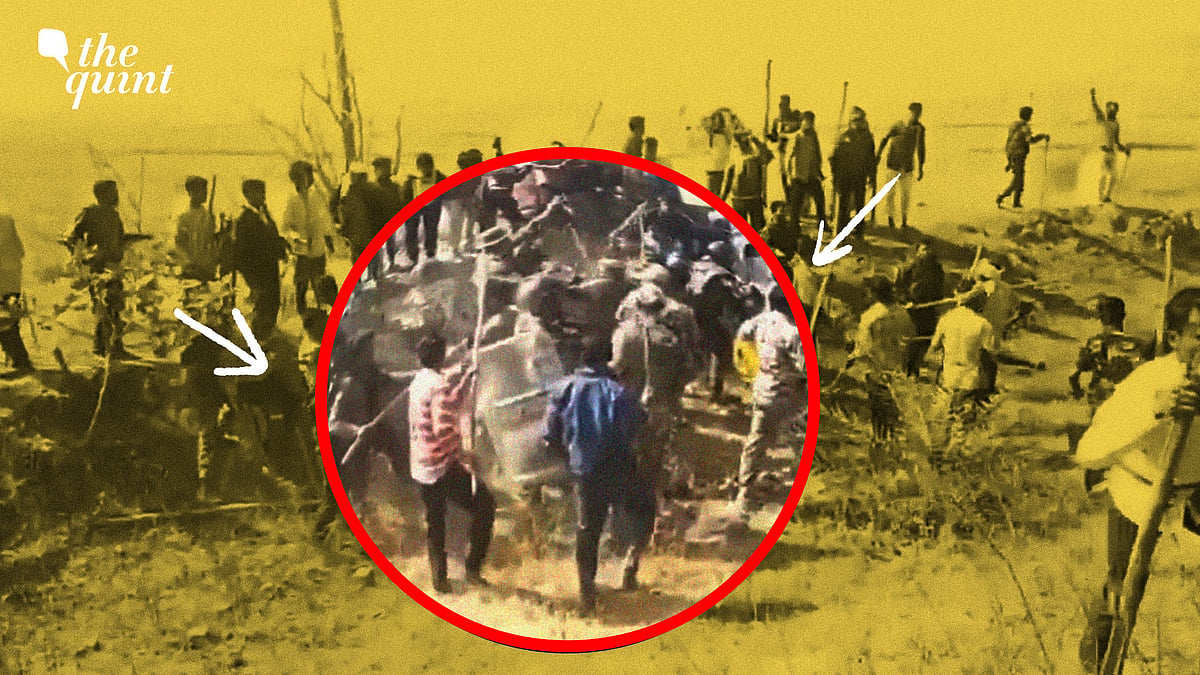
Videos of the incident have since surfaced, accessed by The Quint, in which members of a mob can be seen stone-pelting and ransacking the properties of Rajman and other Christians in Bade Tevda. Armed with bamboo sticks, they are also seen tussling with police personnel who appear incapacitant at controlling the mob. Videos also captured the locals exhuming Chamra Ram's body.
As the tensions spread, local Hindu outfits under the banner of Sarv Samaj Chhattisgarh called for a state-wide bandh on 24 December. The bandh again saw violence through the region as crowds clashed with Christians. The shutdown received support from the Chhattisgarh Chamber of Commerce, traders, and other caste-based organisations.
Mobs clashing with security personnel in Bade Tevda, Chhattisgarh.
(Photo: Special Arrangement/The Quint)
Christian community leaders and activists, meanwhile, have alleged a targeted misuse of PESA laws and collusion of local Hindutva and tribal outfits affiliated to the Rashtriya Swayamsevak Sangh (RSS), Bajrang Dal, and the Bharatiya Janata Party (BJP) that have been incessantly engaging with dominant community villagers and spreading communal hate.
Bade Tevda, for instance, falls under the Kanker Lok Sabha constituency, represented by BJP MP Bhojraj Nag, known for his stance against "illegal conversions" and Vishwashi Christians in the past as the leader of Janjati Surakhsa Manch.
"The RSS-affiliated groups had threatened to return on 18 December in larger numbers, and they did. These attacks are well planned," Rajman alleges.
Also, Sarv Samaj Chhattisgarh is led by former BJP legislator Raja Ram Todem, who has openly threatened to demolish churches in the past. “We are not against Christians but against illegal conversions. These pastors brainwash tribal people and drive them away from Hinduism. This must be stopped,” Todem told The Quint. He further warned that the group's activities will continue as long as "foreign religions interfere with local tradition", even if the police or "prashasan" (administration) do not support them.
Sundarraj Pattlingam, Inspector General of Police, Bastar Range, stated that the issues under consideration are “sensitive in nature and require a nuanced and responsible approach.”
Responding to queries regarding the recent incidents of violence following the 17 December incident in Amabeda, he said that Chhattisgarh Police and the state government are closely monitoring the situation.
“Appropriate and lawful action is being taken against individuals or groups attempting to disturb peace and social harmony in the region. I reiterate that these are sensitive matters, and the local administration as well as police remain committed to ensuring that the lawful rights of all concerned stakeholders are duly protected,” he said.
No Institutional Accountability Despite Increasing Violence
According to data compiled by UCF, a platform that brings together Christian voices and stakeholders from across the country, the last decade (2015-2025) has seen a "500 percent increase" in cases of documented violence against Christians, especially Dalit or tribal Christians.
"UCF started a helpline in 2015 following a visible spike in cases of violence or arbitrary legal action against Christians, especially those who have converted from the Scheduled Caste and Scheduled Tribes," AC Michael, convenor of UCF, says.
Pastor Balram Kashyap of Sidhmur village in Jagdalpur subdivision of Bastar adds that apart from direct attacks, those opposed to Christianity have been using "legal channels and biased interpretations of laws and judgments to intimidate Christians".
On 22 October last year, a hand-painted notice had been put up at the entrance to his village, prohibiting the entry of Christian "pastors and padris (priests)" as well as "dharmantrit" (converted) Christians from other villages, citing PESA.
"How can PESA be used to stomp on the fundamental right to freedom of religion and religious expression ensured to all citizens by the Constitution? It is also against every citizen's right to free movement and privacy," Balram tells The Quint.
Such boards came up in at least 14 villages in Kanker district and two in Narayanpur in the next few weeks—and is quickly becoming the norm across the districts with Christian density.
Alleging the notice, at least in their village, was put up "illegally", Balram alleged that no "Gram Sabha" took place, and that the decision was taken after a random meeting of villagers conducted by "outsiders".
A photograph depicting the board put up at Sidhmur without a formal Gram Sabha.
(Image: Special Arrangement/The Quint)
"I, being a Panch myself from Ward no 3, was not part of this 'farzi' Gram Sabha as no one informed me,” he says. He and other villagers have filed a formal complaint with Bastar SDO regarding the unlawful notice. But they have neither heard back from the authorities yet nor do they expect any legal help.
UCF has helped complainants and victims file scores of applications to local magistrates, police officials, and other authorities. Not much tends to come of these efforts, despite years of waiting.
Govind, who has been following Christianity since 2016, states that the hostilities began in 2023 when Christians from the village were first beaten up in May.
Govind and others filed an FIR in Badanji Police Station on 31 May 2023. No action was taken. Soon after in June, the villagers refused to let Govind bury his deceased mother in the village burial spot. He made a formal complaint about it to the Bastar Collector on 8 June 2023. He got no response. He also wrote to the Sub-Divisional Officer, Lohandiguda, on 3 July, seeking appropriate action, and again got no response.
On 16 July 2023, a complaint was given to several officers regarding the disruption of a Christian prayer meeting in the village, of which Govind was a part. He also complained when his fellow Christians’ farms were destroyed, and their harvests “stolen and sold” by villagers with help from police.
The Quint accessed copies of all the applications filed to local authorities, and has sought a response from Bastar District Magistrate Haris S’ office regarding the same, but received none yet.
"We thought that having written so many times to the authorities, we would be given some reprieve. But no help came, and things kept getting worse untill we had to flee the village in January 2024. That is the situation of most Vishwasi Christians these days in rural Chhattisgarh. We are either homeless, or in constant fear of becoming so," Govind says.
Photo of a church in Narayanpur, Bastar, that had been vandalised by a non-Christian mob in December 2022.
(Photo: Rakhi Bose/The Quint)
Between January and September 2025 alone, 579 incidents were reported by UCF across India. Of these, at least 51 incidents were about restriction to worship, nine cases of assault, 71 incidents of intimidation or harassment and seven incidents of property damage. However, the reporting rate remains abysmal with FIRs filed in just 39 of these incidents, revealing a 93 percent justice gap.
Legally Foregrounding Violence
India's legal framework prohibits discrimination based on religion. However, lawyer Tahmina Arora argues that in the last decade, the rise in violence has been mirrored in increasingly intolerant laws, and court judgments and observations targeting those following Christian faith, especially laws against alleged forced conversion.
The recent cases of violence and funeral obstructions, for instance, reflected a selective misuse and citation of the Supreme Court’s controversial split verdict in the Ramesh Baghel vs State of Chhattisgarh burial case after Baghel, a Dalit Christian, was not allowed to bury his deceased father, Pastor Subhash Baghel, in his village in Chhindwara district of Bastar.
While India has no national law restricting religious conversion, and attempts in the past to introduce such bills in Parliament have failed, more and more states have been adopting anti-conversion or religious protection laws. With Rajasthan passing the stringent Rajasthan Prohibition of Unlawful Conversion of Religion Act, 2025 with provisions for life imprisonment and fines up to Rs 1 crore, India now has 12 states with the so-called Freedom of Religion Acts that prohibit religious conversions through coercion, fraud, or marriage.
"Unlike earlier laws, the Rajasthan anti-conversion act shifted the onus of proof on those accused of alleged conversion than the party accusing, and also includes provisions for demolishing structures used for said conversions. This sets a dangerous precedent," Arora notes.
In 2020, the Citizens for Justice and Peace filed a PIL before the Supreme Court challenging the constitutional validity of the Uttar Pradesh Prohibition of Unlawful Conversion of Religion Ordinance, 2020 (amended Act) and the Uttarakhand Freedom of Religion Act, 2018. The case is still being heard.
Members of UCF including AC Michael (second from left) addressing a press conference to talk about growing anti-Christian hostilities in Delhi on 4 November 2025.
(Photo: Rakhi Bose/The Quint)
But in Chhattisgarh, the state government has also been speaking of strengthening the anti-conversion laws like Rajasthan. In October, Chhattisgarh Deputy Chief Minister Vijay Sharma said the state government will introduce a stricter law in the next session of the state Assembly to prevent illegal religious conversions.
The proposed legislation will also reportedly include provisions to curb ‘changai sabha’ or faith-healing gatherings, which many in the state government consider "misleading".
In a statement, Prasad Rao, member of Jan Sangharsh Morcha Chhattisgarh, said, “The Adivasi community must understand that their enemies are not innocent Adivasi Christians who have converted but the corporate profiteers snatching away their jal, jungle and jameen (water, forests and land).”
Moolvasi groups claim that with the the Naxals in purported retreat, sowing communal strife is the only way for those in power to control the resources by keeping the tribal population divided on communal lines, bereft of the real issues. “Christians are thus the new 'others' in the forests of Bastar," an activist said upon request of anonymity.
Meanwhile, residents like Ulleshwari, who is now in her second trimester and recovering from injuries, have been spending their days and nights armed with lathis. She laments,