Returning Devbhoomi’s Debt: How Waste Can Be Turned Into Wealth in the Himalayas
Environmental discipline must now become part of the spiritual infrastructure, writes Jhanvi Dubey.
advertisement
The Quint is telling the full story of how climate change is reshaping lives in India. Help us do more. Become a member.
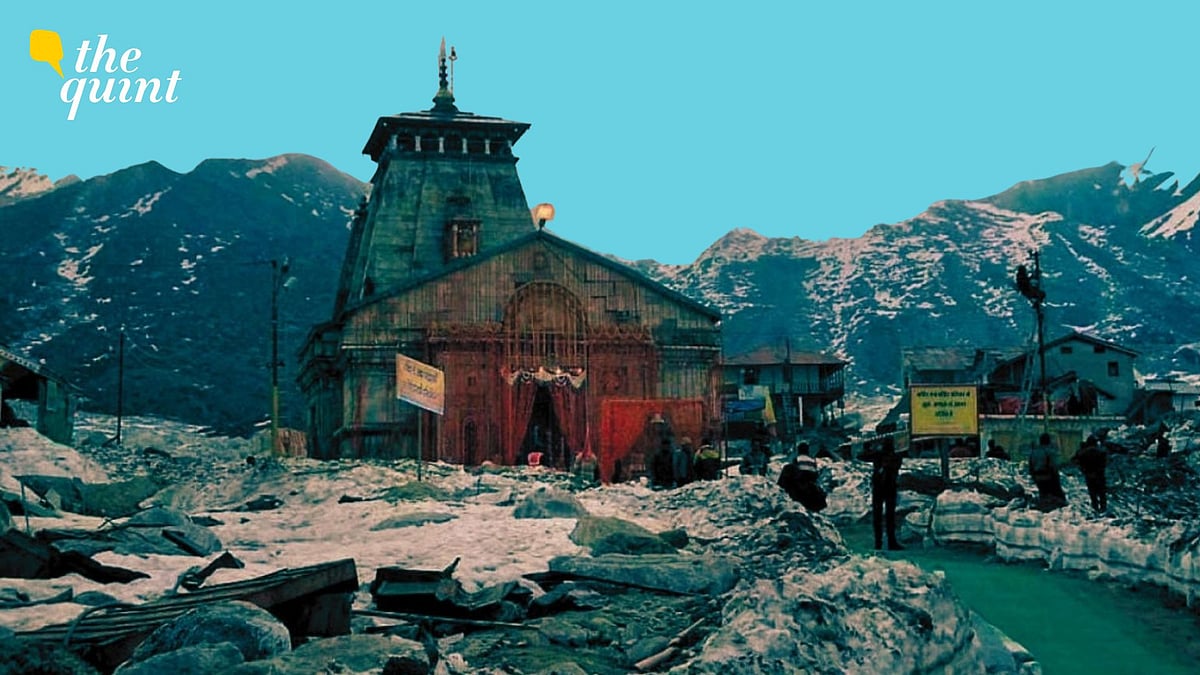
The mountain has always known how to return things to earth—pine needles decay into soil, and the snowmelt feeds into the river. It is only the modern visitor who leaves behind permanence—plastic bottles on the trekking routes of Kedarnath, and disposable cutlery near glacier streams.
Waste in Uttarakhand is not a sanitation problem, but an economic contradiction. Tourism that sustains the state also threatens the ecological beauty the economy rests on.
The Himalayas’ Growing Waste Emergency, and India's New Rules
Uttarakhand as a whole generates approximately 1,500 tonnes of waste daily, and non-biodegradable waste accounts for 96.3 percent of the total load in ecologically sensitive zones.
Studies document the behavioural consequence with extraordinary bleakness—Himalayan brown bears now derive over 75 percent of their food from garbage dumps.
India’s newly notified Solid Waste Management Rules, 2026, which came into effect on 1 April, have significantly altered the governance architecture of municipal waste.
Four-stream segregation at source is now mandatory.
Extended responsibility obligations for bulk waste generators have acquired statutory clarity.
Digital tracking systems are now being institutionalised.
Material recovery facilities are no longer peripheral ideas but central infrastructure.
The new framework consciously moves India from landfill management to circular economy governance. The challenge is converting participation into a structured civic culture.
Making Waste Management Visible and Profitable
Nepal offered one such lesson through the Sagarmatha Next initiative near the Everest base camp region, located at Syangboche, 775 metres above sea level, established under the Sagarmatha Pollution Control Committee. Instead of treating mountain waste solely as refuse, it conceptualised waste as material for design, innovation, tourism engagement, and local enterprise by creating functional design objects, art installations, and sculptures.
Similarly, the HUB of Circular Thoughts in Bratislava, Slovakia transformed public education around waste into an architectural and artistic experience, with almost 80,000 visitors contributing to save more than 100 tonnes of potential waste. In doing so, they welcomed citizens into spaces where circularity becomes tangible, visual, and social.
These would not function merely as segregation points, but would become civic spaces integrating repair workshops, recycled art residencies, biodegradable packaging laboratories, “waste lab” with mountain material innovation studios, and public cafes operating through incentives linked to a waste exchange system.
An incentive-linked "Kachra Cafe Circuit" across Char Dham routes may sound unconventional, yet it could address multiple problems simultaneously.
Create decentralised collection systems in terrain where logistics remain expensive
Provides livelihood for local youth and women’s cooperatives
Convert cleanliness into a visible public culture associated with pilgrimage ethics
Create behavioural continuity in the community
Importantly, these systems need not burden municipal finances indefinitely. India’s amended Plastic Waste Management Rules, 2026, have expanded the compliance ecosystem surrounding Extended Producer Responsibility obligations and recycled content targets.
Brand owners, hospitality chains, beverage manufacturers, and pilgrimage economy stakeholders now possess stronger regulatory incentives to participate in decentralised recovery ecosystems.
Uttarakhand has the opportunity to become India’s first mountain state to operationalise a "Himalaya Circularity Corridor" that enables tourism-linked circular credits, allowing compliant businesses to fund local recovery systems in exchange for measurable environmental performance certification.
This matters because environmental behaviour is rarely sustained by instruction alone. It is sustained by civic aspirations.
At the same time, Uttarakhand cannot replicate metropolitan waste systems designed for flat urban density. Waste policy in mountain states must respect geography before it seeks administrative scale.
If Uttarakhand creates credible policy frameworks supported by transparent metrics, it can attract intellectual and financial capital far beyond conventional municipal funding structures.
The economics are compelling. Scientific studies increasingly demonstrate that circular economies create higher employment intensity per tonne of waste processed than landfill-dependent systems. Research published in the Journal of Cleaner Production and the United Nations Environment Programme (UNEP) consistently notes that decentralised recovery systems generate stronger local value chains while reducing environmental externalities.
Future of Mountain Tourism: Reimagining Pilgrimages
Uttarakhand has already witnessed the early contours of the recommended transformation in Kedarnath itself. The Deposit Refund System, introduced along the Char Dham Yatra, quietly altered one of the oldest assumptions in waste governance.
Pilgrims purchasing plastic bottles paid a small refundable deposit, recoverable upon returning the discarded material at designated collection centres. The brilliance of the model was in behavioural design. Waste acquired value. Plastic stopped being invisible litter and became recoverable currency.
In a terrain where conventional enforcement remains difficult, the state discovered something more durable than surveillance—it discovered civic alignment. Uttarakhand should now institutionalise this principle beyond plastic bottles alone through "Himalayan Circularity Corridors", digitally redeemable "Green Yatra Credits", and "Zero Waste Pilgrimage Corridors" during peak yatra season.
(The author is a Research Associate at the National Economic Forum. This is an opinion piece and the views expressed are the author's own. The Quint does not endorse or is responsible for them.)